Arrangement Timeline & Sections
Intention
Last session glued the voices into one organism by giving them a shared modulator — the horizontal axis, cohesion at any single instant. This session goes after the vertical one: development over time. My patches are strong loops that arrive somewhere in sixteen bars and then just hold; the skill I keep missing is making a patch progress — sections that enter and leave across minutes, an arc instead of a plateau.
The move is to sequence presence, not notes. A gate sequencer normally decides when within a bar a voice fires; slowed right down and pointed at whole voices, the same tool decides whether a voice is in the song at all right now. So instead of programming pitches I program an arrangement — which of the five voices are present in each section — and the track plays itself, hands-free, entrances and exits and all.
The part that keeps this from sounding like random drift is a single slow timeline: a song-position clock that every section change hangs off, so a breakdown lands on a bar line rather than mid-phrase. That coordinating clock is exactly the structure my generative patches have always lacked.
Starting patch
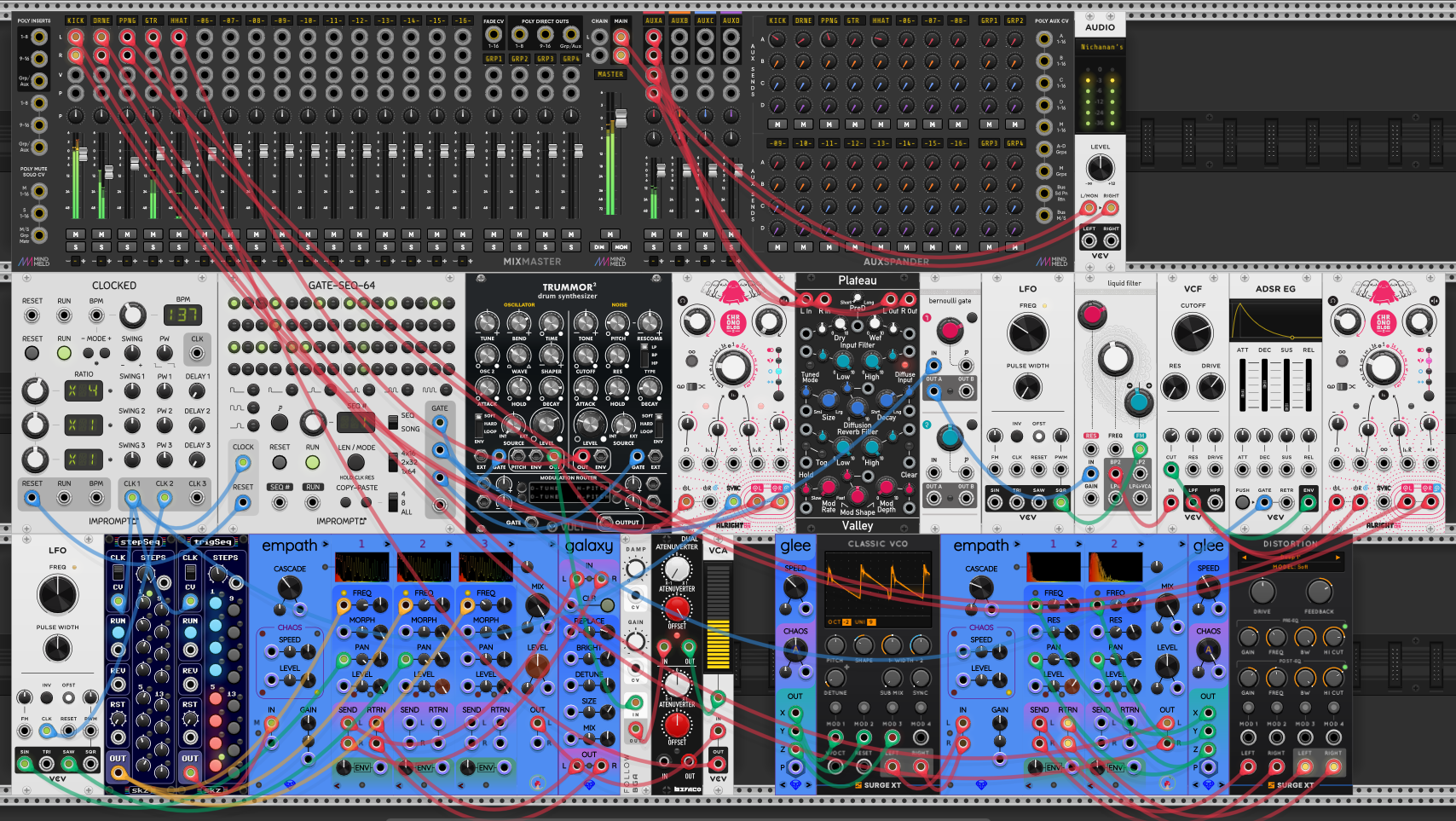
The starting point is a fork of the session 32 drone patch — five voices already running through a MindMeld MixMaster + AuxSpander: the sustained drone (DRNE), the pinged-filter static beat (GTR), the kick and hat (KICK, HHAT), and the probabilistic ping (PPNG). It’s a strong, full patch — and a completely static one. Every voice plays every bar; hit run and ninety seconds in it sounds exactly like the first bar. That flatness is the whole problem this session exists to fix: the patch has nowhere to go.
The one structural asset already on the panel is the mixer itself. The MixMaster has a POLY MUTE/SOLO CV input — a polyphonic cable where each channel mutes one fader — so presence can be driven from a single poly cable instead of a VCA buried in every voice’s path. The whole arrangement is going to live in that one input.
Sequencing the sections
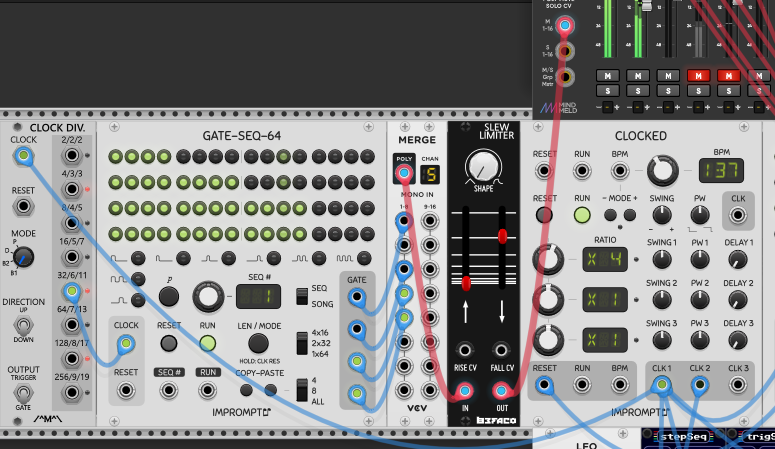
With the five voices left exactly as they were, the whole arrangement comes from one new chain bolted onto the side of the mixer.
The timeline. The master clock runs into a Clock Div (Count Modula), and I take its ÷16 output — one pulse every sixteen master pulses — to clock a second GATE-SEQ-64. That slow pulse is the song’s heartbeat: each tick steps the sequencer forward one place, and one step = one section. Where the playhead sits is where we are in the arrangement — the clock division is what turns the bar-rate clock into a section-rate one.
The muting grid. The GATE-SEQ-64 runs in 4×16 — four sixteen-step lanes — and each lane owns one voice: kick, ping, static beat, hat. Read across, the sixteen columns are the song’s sixteen sections; read down, the four rows are the four voices. Each cell decides whether its voice is muted in that section, so the grid is the arrangement, drawn by hand — the same gate-sequencing-as-on/off idea, aimed at whole voices instead of single events.
Drawing absence, not presence. The mixer’s mute CV is set to gate high/low with high = muted, so a lit cell silences its voice for that section and an empty cell lets it through. I’m drawing the gaps — where each voice drops out — rather than where it plays. It’s the inverse of what you’d guess, but it’s the natural way to carve a full patch down: start with everything lit (silent) and unlight cells to bring voices in.
Keeping the drone out of it. The four lanes are split into a Merge on channels 1, 3, 4 and 5 — matching the kick, ping, GTR and hat faders — with channel 2 left empty. Channel 2 is the drone, and an unpatched merge channel sits at 0 V, which the mixer reads as “never muted.” So the drone plays under every section as the constant bed while the other four come and go around it. The merged poly cable carries all four mute states at once into the MixMaster’s single 1-16 input.
Turning gates into held mutes. One catch surfaced the moment I ran it: a gate sequencer outputs pulses, not levels. Even GateSeq64’s fullest gate drops out at every step boundary, and it has no way to tie a gate across steps — so a voice meant to rest through several consecutive sections flickered back on at every column edge. The fix is a Slew Limiter (Befaco) on the merged cable, the same slew used elsewhere for glide, here repurposed to hold a level: a fast rise so a mute engages right on the section boundary, and a modest fall lag so the millisecond dips between consecutive lit steps are too brief for the voltage to fall back under the mute threshold. A genuine empty step lasts seconds, long enough that the voltage finally falls and the voice returns. It turns a string of gappy gates into one continuous, sustained mute — the difference between a sequencer that triggers events and one that holds a state.
Fading instead of cutting
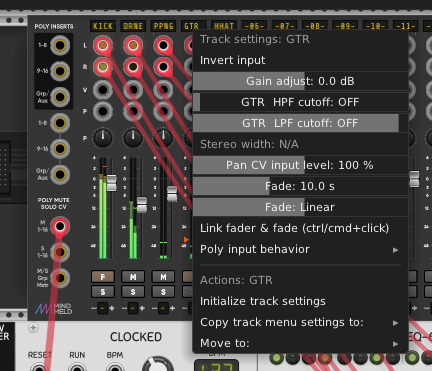
A hard mute snaps a voice in and out — fine for the hat and ping, but abrupt for the bigger elements. The MixMaster fixes that with a per-track fade: set a fade time in a track’s settings and every mute transition, entrance or exit, ramps over it instead of cutting. I gave the GTR and the kick a 10-second linear fade, so those two bloom in and ease back out over ten seconds rather than switching, while the hat and ping still snap in crisply. It’s a deliberate split — slow swells for the body of the sound, sharp entrances for the accents — and it only works because each section (on the slow clock division) lasts longer than the fade, leaving each voice time to fully arrive before the next change.
Hit run and don’t touch anything: the playhead crawls across the grid a step every few bars, and voices enter and leave on their own — the kick drops in, the hat joins, the beat falls away for a section, the ping surfaces alone over the drone. The loop has become an arrangement that plays itself, and not one thing about the individual voices changed — the development lives entirely in when each one is present.
The full patch
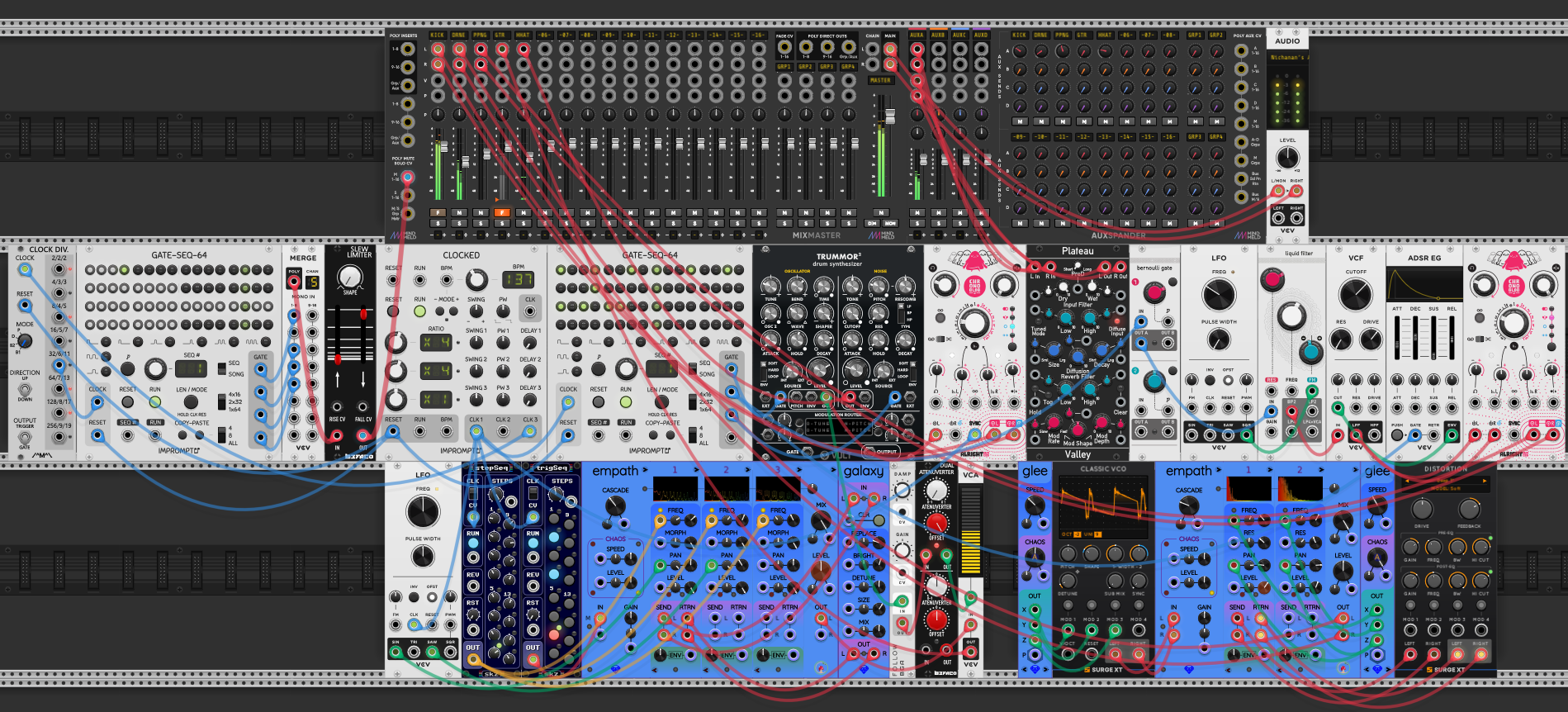
The finished piece is a two-sequence song. Rather than loop a single sixteen-section grid, I drew two different grids — one building the voices in and back out, a second with its own combination — and chained them in SONG mode, so the arrangement runs through both before it repeats. That roughly doubles the length and gives the arc more than one shape to pass through instead of a single rising-and-falling staircase on loop.
Across both grids the kick and the GTR never hard-cut — they fade gradually in and out on their ten-second fades, blooming up and sinking back while the hat and ping still enter sharply. And the whole thing is written to end on the drone alone: the last section mutes everything but the bed, so the track doesn’t snap back to full — it winds down, the voices peeling away one by one until only the drone is left holding the room. The development finally has a destination.
Reflection
This is the session where a loop became a piece. Nothing about the five voices changed from where session 32 left them, yet the patch now has a beginning, a middle and an end — and the only thing I added was a way to sequence which voices are present over time. That reframed arrangement as just another thing you sequence: the same gate grid I’d use for a drum pattern, pointed at whole voices instead of single hits, clocked slowly enough that each step is a section instead of a note.
The lesson that caught me out was that a gate sequencer triggers but doesn’t hold. It fires pulses, and an arrangement needs sustained states, so it took a slew limiter to turn those gappy gates into mutes that last a whole section. “Sequence presence” sounds simple, but presence is a held thing and gates aren’t — that gap between triggering an event and holding a state is the whole technical heart of this one.
And what made it feel finished was giving the track somewhere to go — writing the song to end on the drone alone, so it winds down to its bed rather than looping back to full. A loop has no destination; this does.