Controlled Randomness
Starter Voice
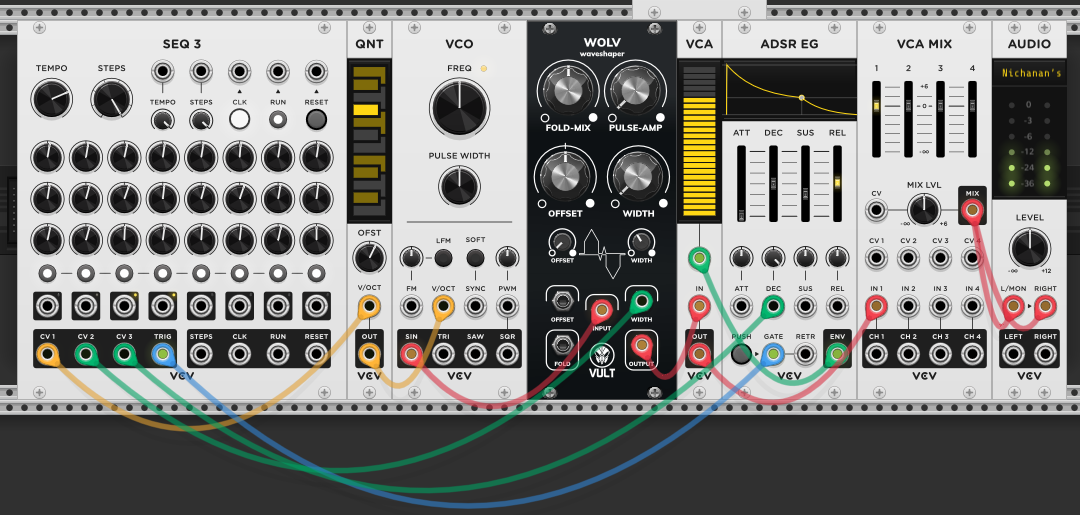
A single west coast voice where the sequencer controls more than just pitch. SEQ3’s three CV rows each drive a different parameter: CV1 sets the pitch (through a quantizer into VCO V/OCT), CV2 modulates the waveshaper’s width (controlling harmonic richness per step), and CV3 modulates the ADSR’s decay (controlling how long each note rings). The result is a sequence where every step has its own pitch, timbre, and duration — all composed, nothing random yet.
Adding Randomness to Pitch
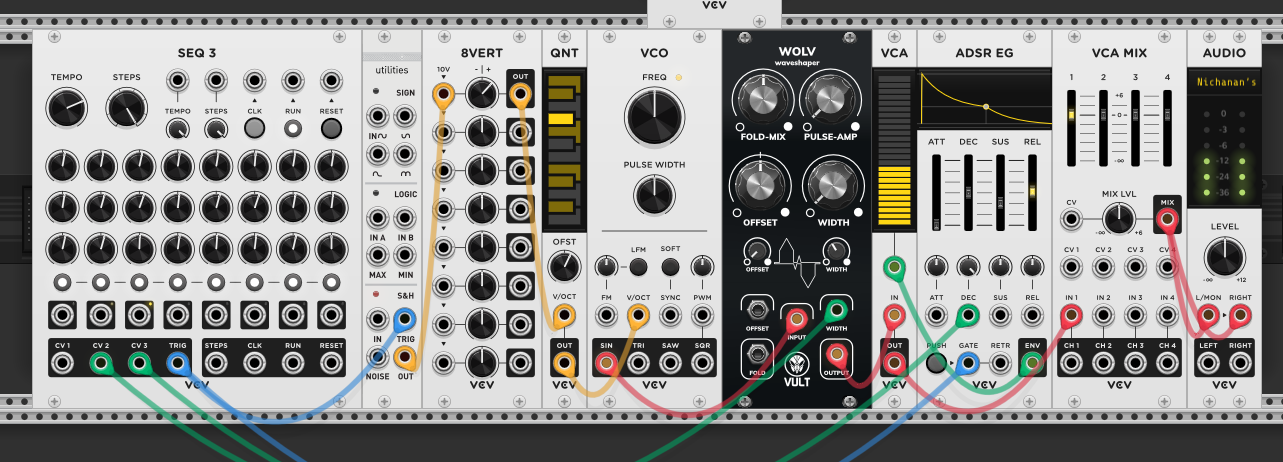
Replacing the sequencer’s pitch row with an S&H introduces randomness. The S&H samples noise on each trigger, but before reaching the quantizer it passes through 8VERT as an attenuator — the same attenuator-before-quantizer technique from session 7 — this controls the range of the random pitch. With the 8VERT turned low, the random voltages are compressed into a narrow range, keeping the melody within a small interval. Turned up, the melody leaps across octaves. The quantizer still constrains everything to a scale, so the notes are always in key — the attenuator just controls how far apart they land. The sequencer’s other CV rows still control the waveshaper width and envelope decay, so the timbre and duration remain composed while only the pitch is randomized.
Mixing Composed and Random Pitch
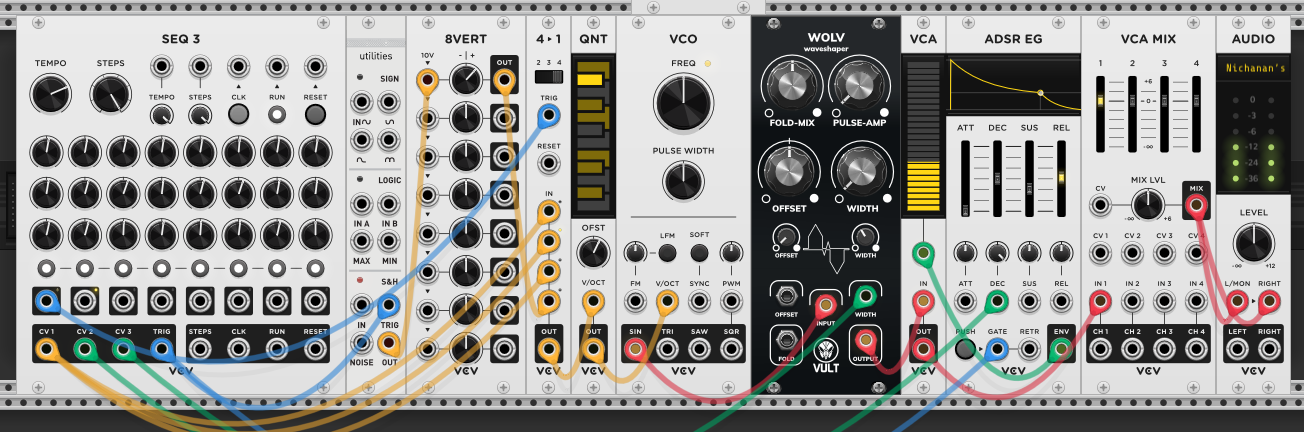
The same technique from session 20: a 4→1 sequential switch blends composed and random sources. The first three inputs come from SEQ3’s CV rows — deliberate, composed pitches. The fourth comes from the S&H — a random note. The switch cycles through on each trigger from SEQ3’s first row, so the pattern goes: composed, composed, composed, random, composed, composed, composed, random… The melody is 75% predictable and 25% surprising.
Cross-Modulated Wavetable Voices
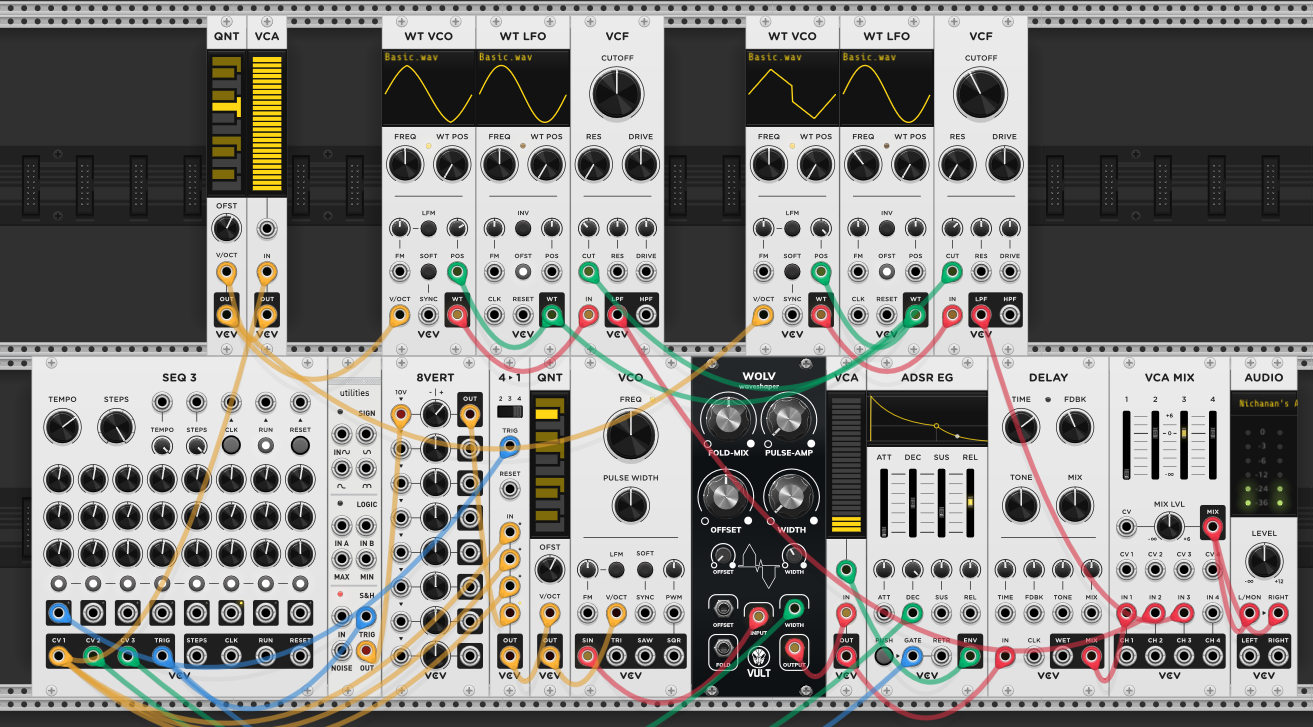
Another way to create controlled variation without S&H randomness: two additional wavetable voices where each WT LFO modulates its own VCO’s wavetable position and the other voice’s filter cutoff. This cross-modulation means neither voice’s timbre is independent — when one LFO opens the other’s filter, the brightness of both voices shifts in a connected but non-obvious way. The LFOs run at different rates, so the cross-modulation pattern never settles into a simple loop. All voices share the same sequenced pitch from SEQ3’s first row, so the harmony stays fixed while the timbral interplay creates the variation.
Attenuating Pitch with a VCA
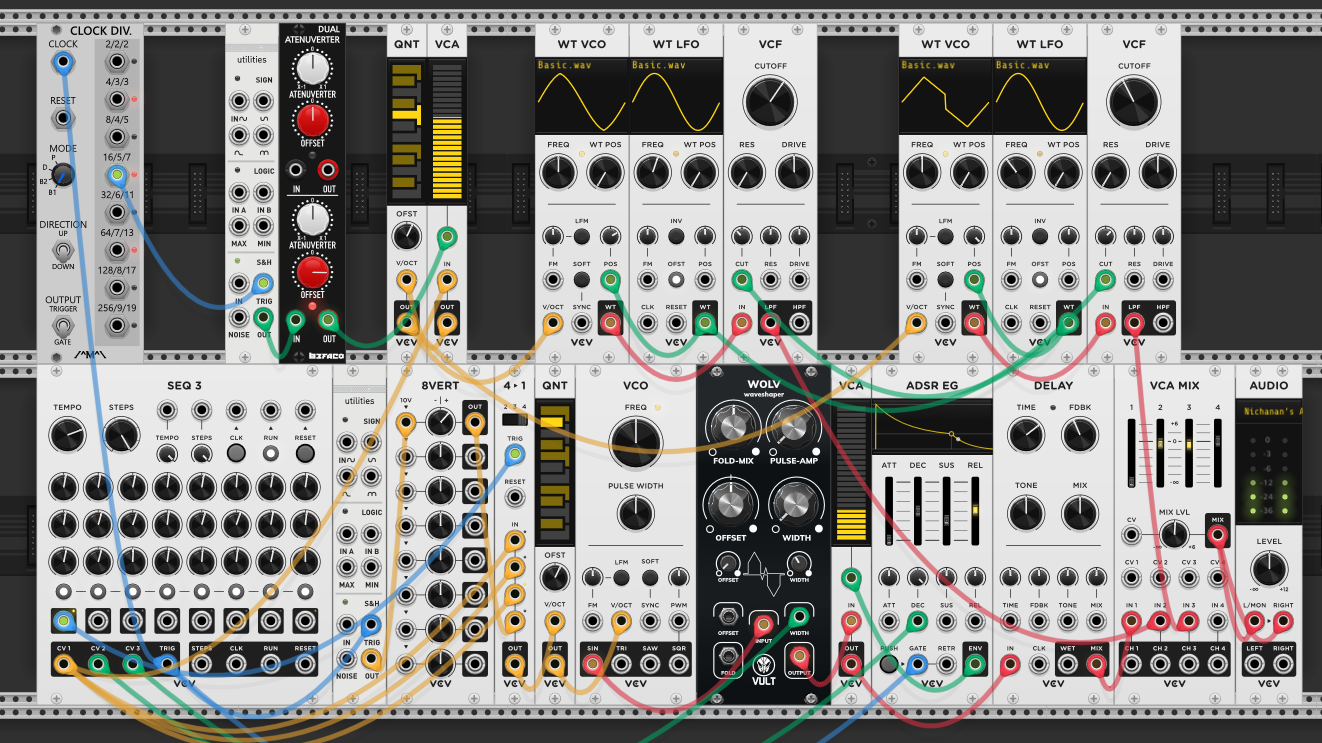
A VCA placed before the quantizer can attenuate the sequenced pitch CV, creating a variation of the same sequence — the intervals compress as the VCA closes, transposing the pattern into a narrower range. To control when this happens, an S&H triggered by a clock divider provides the VCA’s CV — so the attenuation only changes every Nth step, not on every note. The S&H output goes through an attenuverter with offset first, ensuring the VCA never closes to zero (which would flatten all notes to the same pitch). The offset sets a floor — the sequence always passes through, just at varying degrees of compression. This is controlled randomness applied to the shape of a sequence rather than individual notes.
Summary: The Randomness Spectrum
This session covered four points on the spectrum from fully composed to fully random:
- Fully composed — sequencer controls everything (pitch, timbre, duration). Repeats exactly.
- Selective randomness — S&H replaces one parameter (pitch), attenuator controls the range. Other parameters stay composed.
- Blended — sequential switch alternates between composed and random sources. The ratio (3:1 here) sets how predictable the pattern feels.
- Structural variation — VCA attenuates the pitch CV before quantizing, compressing the intervals of an existing sequence. The sequence’s shape changes, not its individual notes.
The cross-modulated wavetable voices show a fifth approach: deterministic complexity — no randomness at all, just LFOs at different rates creating patterns too complex to hear as repetitive. 5. Quasi-periodic — sampling an LFO (not noise) with an S&H produces melodies whose repetitiveness depends on the ratio between the sampled LFO’s rate and the sampling trigger rate. When the rates are related (e.g. 2:1), the melody repeats predictably; when unrelated, it evolves endlessly. This sits between fully composed sequences and fully random S&H noise.
The common thread: controlled randomness means defining the boundaries (scale, range, rate of change) and letting the system fill in the details.