Generative Harmony
Starter Patch
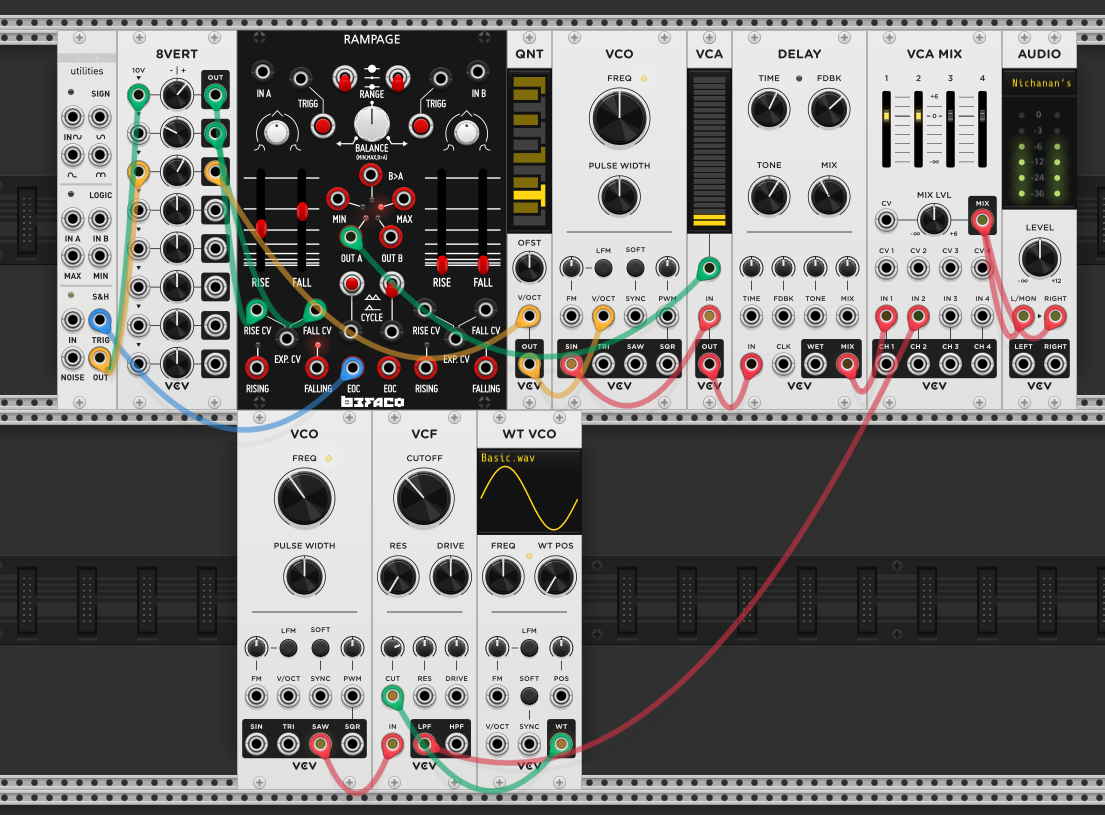
Two voices as a starting point. The top voice is generative — 8VERT provides static voltages to modulate Rampage’s rise and fall times, Rampage’s output controls the VCA’s amplitude, and the S&H (sampling noise, triggered by Rampage’s EOC) provides random pitch through a quantizer into the VCO. This is the Krell-style self-playing voice from the previous session. A delay adds spatial depth to the generative voice.
The bottom voice is a second VCO (saw wave) through a VCF, with a wavetable VCO modulating its FM input for timbral complexity.
Harmonizing with Clock Division
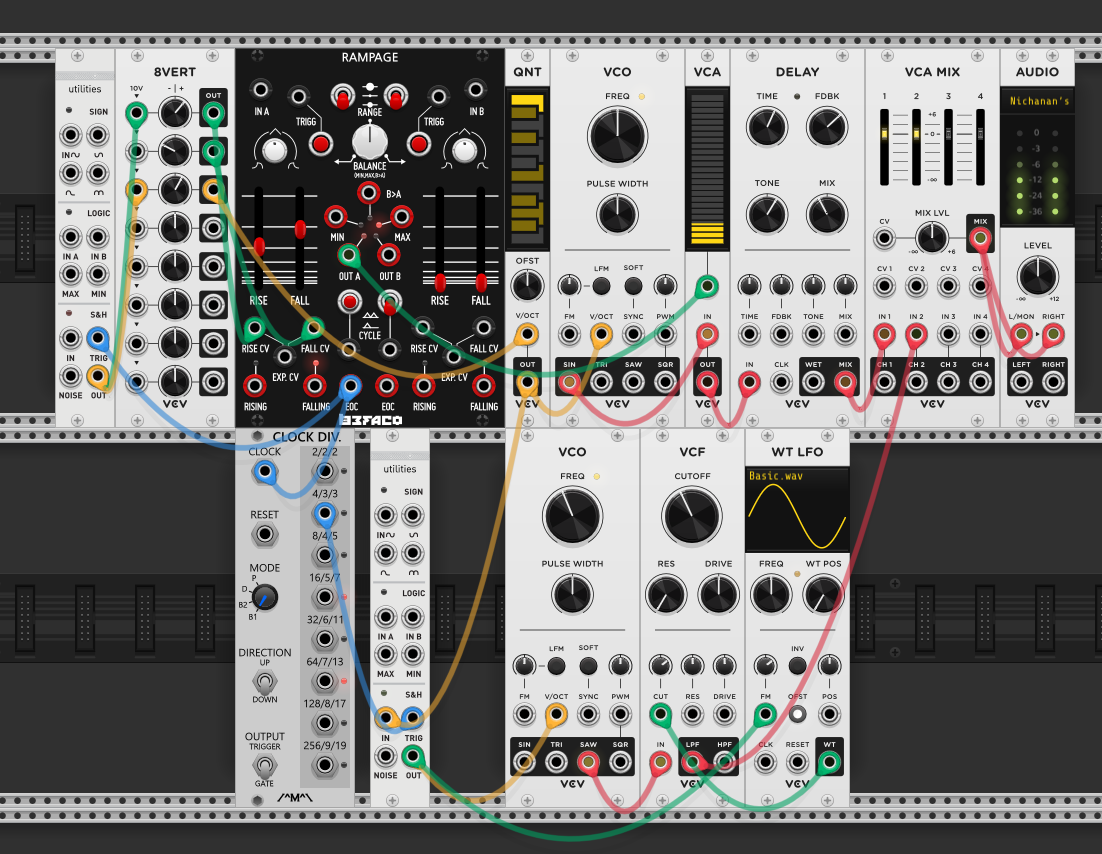
To harmonize the bass voice with the generative melody without it changing on every note: the Rampage’s EOC — which is already an ever-changing clock since the function generator’s timing shifts constantly — feeds a clock divider. A divided output (e.g. /4) triggers a second S&H. The S&H’s input is the same pitch CV that’s driving the top voice, so it takes a snapshot of the melody’s pitch, but only every Nth note. The S&H output goes to the bass VCO’s V/OCT — the bass follows the melody’s pitch but changes less often, creating a harmonic relationship where the bass holds a note while the melody moves above it.
The same S&H output also modulates the wavetable LFO’s FM input, so the bass’s timbral modulation shifts each time it takes a new pitch — tying the timbral change to the harmonic change.
Generative Chords with Shift Register
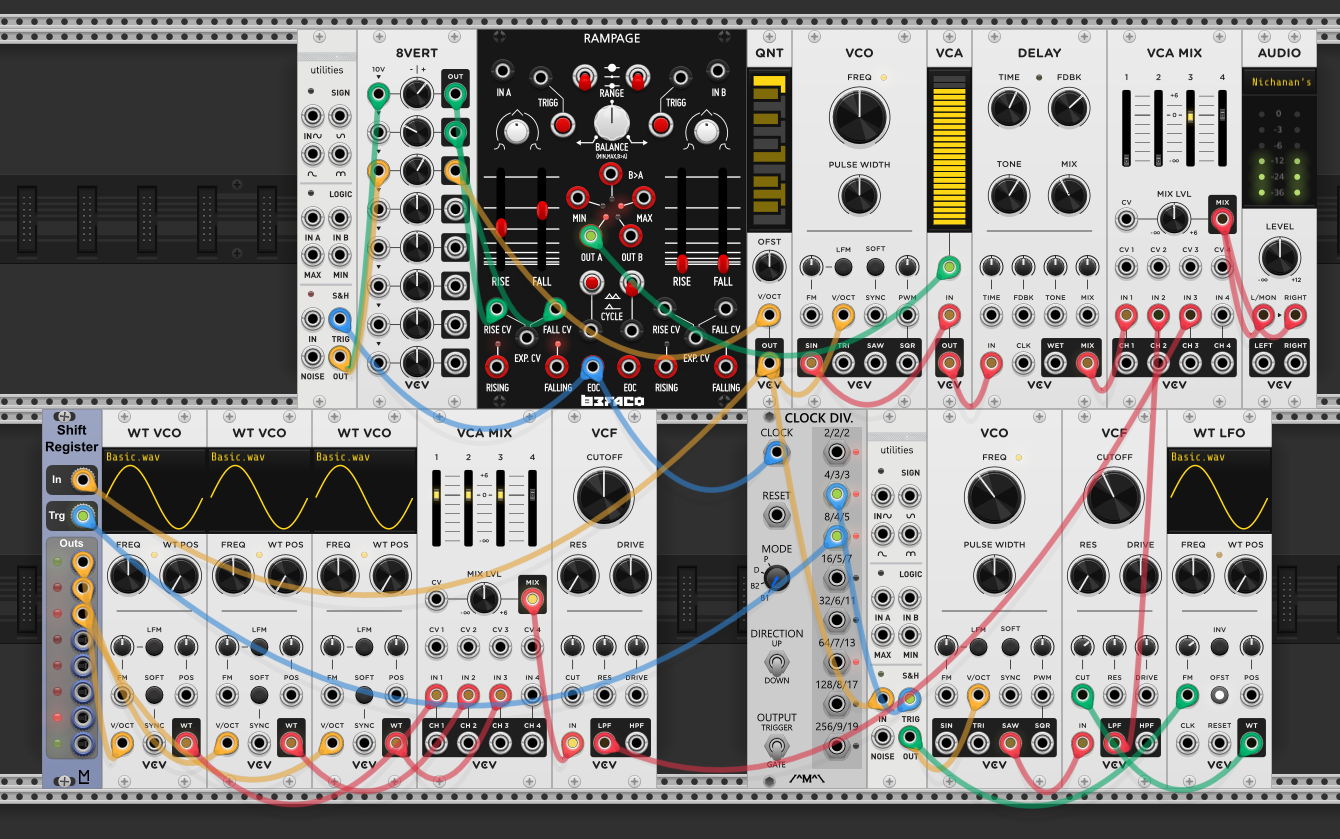
A shift register is fed the same quantized pitch CV as the melody, triggered by a clock division so the chord changes less frequently than the melody.
Three shift register outputs go to three wavetable VCOs — each one holds a different recent pitch from the melody, forming a three-note chord. The chord voices are mixed together, passed through a low-pass filter to soften them, and sent to the main output. Because the shift register samples from the quantized melody, the chord notes are always in key. And because each output holds a different recent note, the voicing shifts naturally as new pitches push through the register — generative chord progressions that follow the melody without being composed.
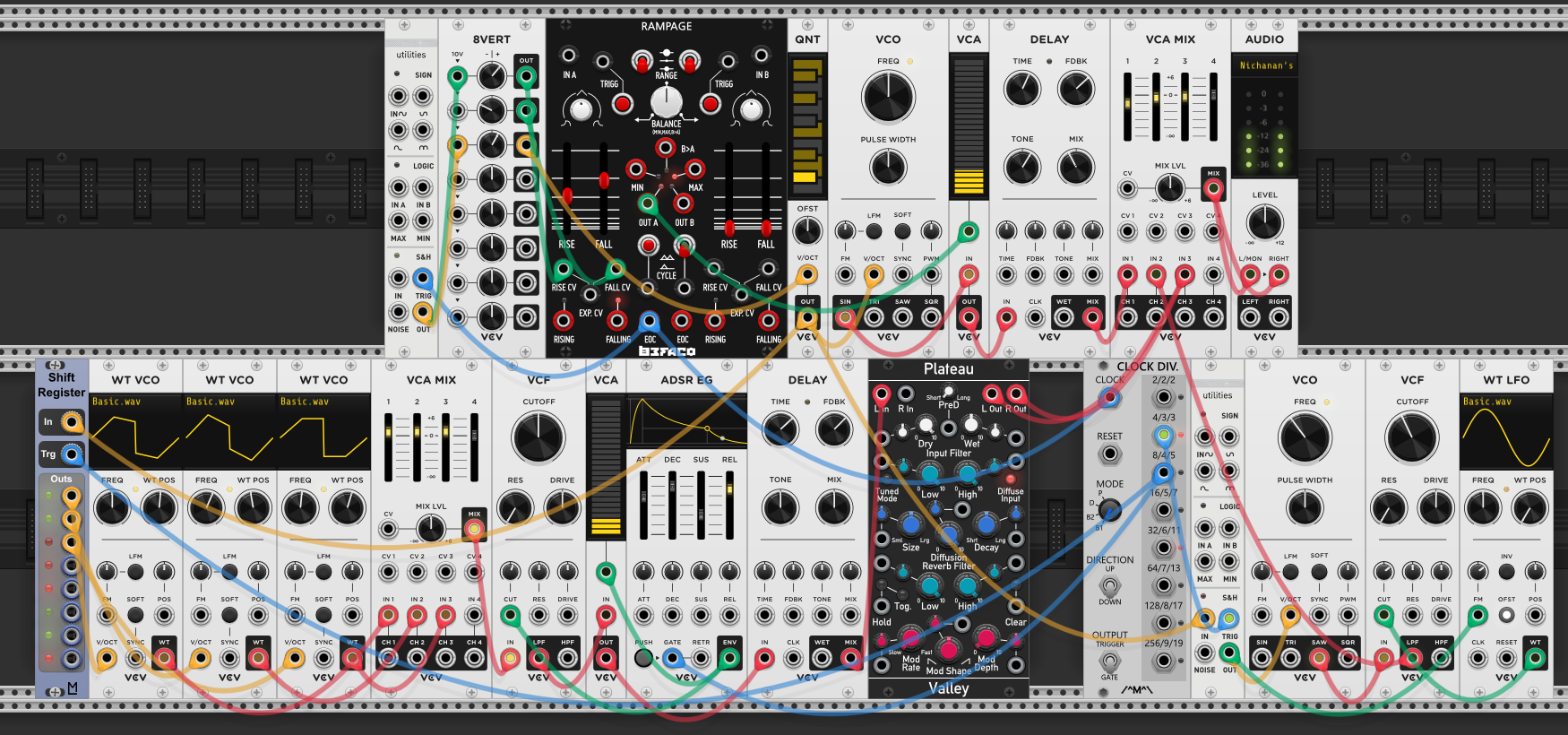
The chord voices go through a VCF with an ADSR envelope controlling both the VCA amplitude and the filter cutoff — so each chord swell opens the filter as it gets louder, brightening on the attack and darkening as it decays. The shaped chords then pass through delay and Plateau reverb, which blur the chord transitions together into an atmospheric wash. The delay repeats stretch the chords out in time, and the reverb’s long tail fills the space between notes. The result is an eerie, alien-like environment where three generative elements — melody, bass, and chords — are all harmonically related (derived from the same quantized pitch source) but moving at different speeds.
The core technique in this session: one pitch source, multiple time scales. The quantizer constrains everything to a key. The clock divider creates slower harmonic rhythm for the bass. The shift register creates chord voicings from recent melody notes. All three voices are musically related without any of them being composed — the harmony emerges from the structure of the patch, not from deliberate note choices.
Reflection
This is the first patch that feels like a playable soundscape rather than a demonstration. The generative chords especially — because they’re derived from the melody through the shift register, they always sound harmonically “right” even though no chord progression was planned. The insight: constraining random elements to the same pitch source and spreading them across different time scales creates coherence without repetition.