Pings, Resonators & Phasers
Intention
A theory session about resonance — picking up the thread from session 14, where I learned that a resonant filter doesn’t need an oscillator: strike it with a trigger and it rings at its cutoff frequency like a struck bell. That session treated the ping as a trick for building percussion. This session treats it as a doorway into a family of ideas: pinging filters revisited and deepened, resonators (modules built entirely around the ringing behavior — banks of tuned resonances meant to be excited), and phasers (allpass filters whose sweeping notches are resonance used as movement rather than pitch).
The question underneath all three: what happens when the filter itself is the sound source or the character of the sound, instead of a subtractive tool carving an oscillator?
Pinging the liquid filter
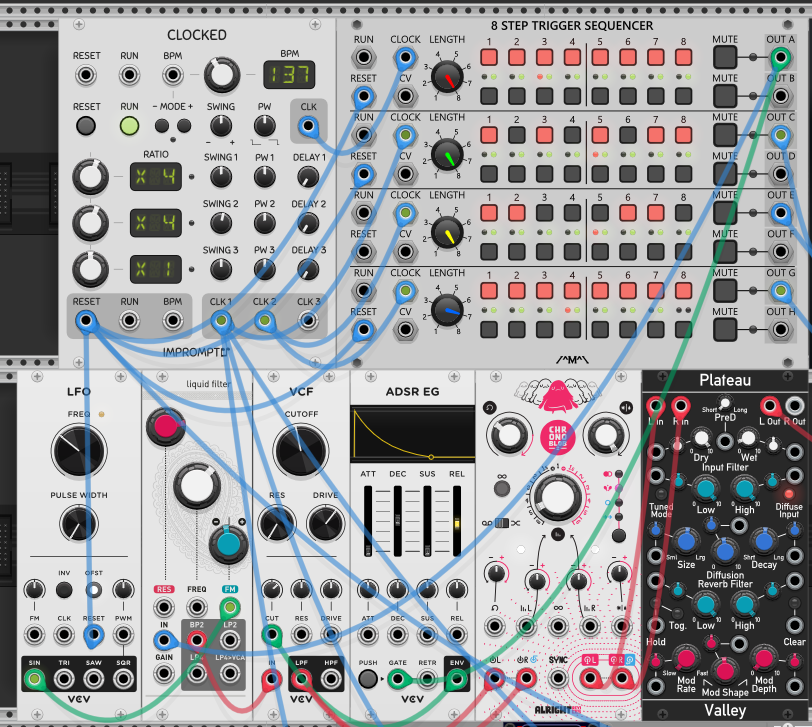
The first voice is a pinged filter again — but where session 14 pinged a basic VCF and took the sound raw, this one treats the ping as a sound source that then gets its own shaping and space, like any oscillator voice would.
The timing comes from Clocked at 137 BPM driving an 8 Step Trigger Sequencer — the same trigger-not-gate discipline session 14 established. One row with all eight steps on strikes the Liquid Filter (Audible Instruments’ port of Mutable’s Ripples) at its input — a steady, unbroken stream of strikes, so the rhythm is deliberately plain and all the movement in this voice comes from elsewhere. The output I take is BP2, the bandpass: where session 14 used the LPF output, the bandpass rings as a narrower, more focused band around the cutoff — less low-end thump under the ring, more pure tone.
Resonance sets what kind of strike it is. Sweeping the resonance knob with the same trigger repeating, the ping lives in a narrow band of the knob’s range. Much lower and the strike has nothing to ring with — it’s a thud, a damped knock that dies the instant it lands. At the sweet spot it’s a ping: a clear pitched strike with a short natural ring. Push higher, toward self-oscillation, and the ring stretches out until it sounds like pressing a high note on a piano — the strike sustains into a held tone with its own slow decay. One knob walks the sound from drum hit to mallet to piano key, and the musical choice is just where on that continuum to sit.
The LFO keeps the pitch moving. A slow sine from the LFO modulates the liquid filter’s frequency, so each trigger lands wherever the LFO has drifted the cutoff at that moment — the pings trace a slow melodic contour up and down without any pitch sequencer involved. Since the cutoff is the pitch of a pinged filter, modulating cutoff here is modulating melody.
From there the ping goes through a second filter — a standard VCF, taking its LPF output — with the ADSR EG shaping the cutoff. The same sequencer row that pings the liquid filter also fires the ADSR’s gate, so the second filter opens in lockstep with each strike: the envelope lets the ping’s brightness through at the moment of impact, then closes down as the ring decays, darkening the tail the way an LPG couples brightness to decay.
The shaped ping then hits the Chronoblob2 delay for the bouncing-room effect — a stereo ping-pong, each echo hopping between the left and right side as it repeats — and lands in the Plateau reverb, which is dedicated to this voice alone: the delay supplies the discrete bounces, the reverb supplies the room they bounce in. The Chronoblob’s SYNC input is fed by the same trigger row as everything else, so the delay time is tap-tempo’d to the step interval — every echo lands on the grid of the strikes rather than smearing between them.
Twin Peaks — a true resonator
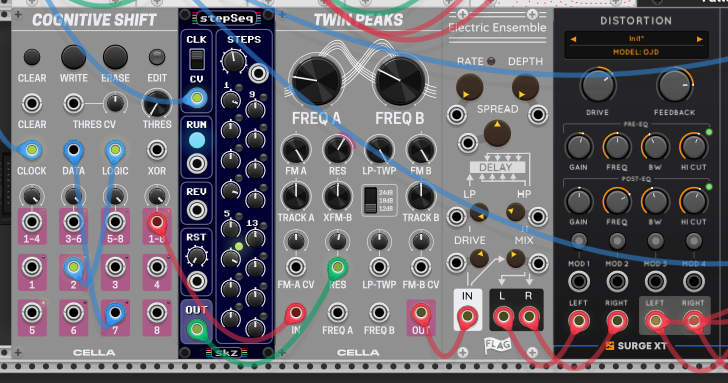
The second voice steps from a pinged filter to a dedicated resonator. This corner of the rack runs on a x4 multiplication of Clocked, so it moves four times faster than the master tempo — the busy, driving layer against the first voice’s steady pings.
Twin Peaks (Cella) is the centerpiece, and it’s a direct descendant of Rob Hordijk’s TwinPeak resonator: the same input signal passes through two resonant low-pass filters, A and B, and their outputs are subtracted, which leaves a band-pass response with two peaks — one at each filter’s frequency. Where the liquid filter rings at one pitch, this rings at two. FREQ A and FREQ B are two independent tunings of the same struck object, like a drum that produces both a fundamental and an overtone, and the module is built to be pinged — its RES knob (shared by both filters) even marks the optimal pinging range with a pink band.
Cognitive Shift supplies the strikes. It’s an 8-bit digital shift register: eight slots of memory, each holding a 1 or a 0, and on every clock pulse the whole pattern shifts one slot along — a new bit enters slot 1 and the oldest falls off the end. The bit that enters is decided by what’s at the DATA input compared against a threshold, optionally combined with the LOGIC input through a selectable logic operation. The part that makes it playable is the manual write: the WRITE and ERASE buttons set each incoming bit by hand — tap WRITE and a 1 marches into the register, tap ERASE and a 0 does — so I can literally type a pattern into it while the clock runs, and CLEAR wipes all eight bits to start over.
What pings Twin Peaks is the register’s 1-8 DAC output — all eight bits read together as one stepped voltage, recalculated on every shift. Each clock, the pattern moves, the 8-bit value changes, and that voltage jump is the strike: a stepped signal into the resonator’s IN, exactly the excitation Twin Peaks is designed for. And because the DAC value depends on the whole bit pattern, every strike lands with a different intensity — big jumps hit hard, small jumps graze — so the chug pattern has built-in dynamics that were never sequenced anywhere.
The register feeds itself. Bit 7’s output patches back into DATA, and bit 2’s into LOGIC. That means each new bit is computed from the register’s own memory: the bit from 7 clocks ago, combined through the logic operation with the bit from 2 clocks ago. On its own, bit 7 → DATA would just recycle the contents as a fixed loop; the bit-2 tap scrambling it through the logic op turns it into a feedback shift register — the pattern evolves deterministically out of its own history, never purely random, never a static repeat. This is where the variety comes from: writing a bit by hand doesn’t edit one step of a loop, it injects a seed that cascades through the feedback taps and keeps re-combining with itself, reshaping the strike pattern — rhythm and intensity together — for many bars after a single button press.
The stepSeq (skz) accents the ring. With steps 1, 4 and 6 on, it modulates the shared resonance. Because resonance is what determines whether a strike thuds, pings, or rings — the same continuum the liquid filter walked — sequencing it means the ring length itself becomes a rhythm: on steps 1, 4 and 6 the strikes ring differently than on the rest, an uneven 3-against-the-bar accent pattern carved into the resonator’s decay rather than its volume.
From Twin Peaks the sound runs into the Electric Ensemble delay with its MIX at about 11 o’clock — just under half wet, so the dry chug stays in front with the effect thickening behind it — and on to the Surge XT Distortion, loaded with the OJD model, a guitar overdrive pedal emulation with pre/post EQ sections shaping the tone going in and coming out. Its DRIVE knob trades clarity for weight: pushing it up makes the distortion more muffled and each strike less discrete, the individual chugs smearing into a thicker, sustained wall — which is exactly the move for a buildup, where definition matters less than mass.
The combined result sounds like a palm-muted electric guitar played through an overdrive pedal: the resonator’s short two-pitch rings read as muted string chugs, and the distortion gives them grit and sustain. It’s an energy-buildup sound — the kind of driving, tense layer that wants to sit under a track as it climbs.
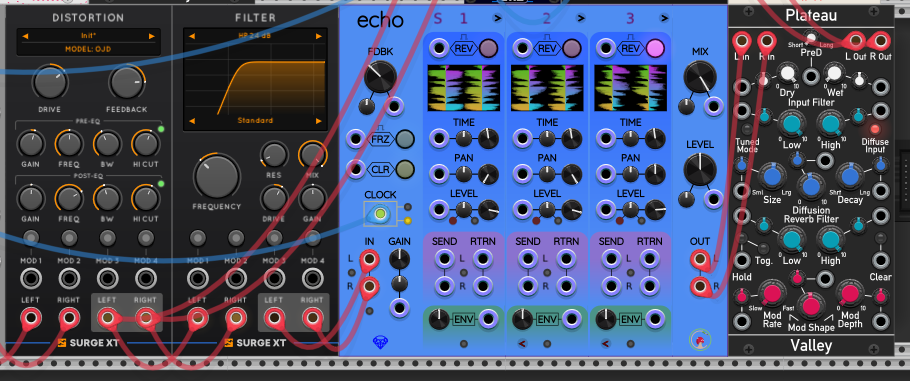
A back-of-the-room send. To make the voice feel less like a dry chug machine, a second stream splits off the distortion’s output into its own parallel chain: a Surge XT FILTER set to a 24 dB highpass, then the echo delay (Sapphire), then its own Plateau reverb on a separate mixer channel. The highpass strips the body out first — what survives is only the thin top of each strike, which is exactly what distant reflections sound like: the room returns the edge of a sound, not its weight. The echo then spreads those remnants out — it’s a three-tap delay, each tap with its own TIME, PAN and LEVEL, so instead of one repeating echo the strike scatters into several reflections arriving at different moments from different points in the stereo field, with the global FDBK knob setting how long the scatter regenerates before dying out. Its CLOCK input takes the same x4 clock as the rest of this voice, so the tap times are divisions of the groove — the reflections land in rhythm with the chugs they trail, spread in space but locked in time. The dedicated reverb diffuses what’s left into a wash.
Soloed, this channel sounds like hearing the riff from the back of the room after it’s already spread — or like the bleed of a speaker feeding back somewhere behind the band. Mixed under the dry distortion channel, it trails every pluck with that ambience, and the voice stops sounding like a synthesizer playing into silence and starts sounding like an instrument in a space — more organic, and more dynamic, because the tail responds to the strike pattern’s built-in intensity variations.
Resonators — pinging a chord
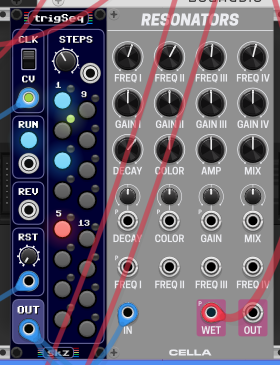
The third strike-able thing is Resonators (Cella), and it scales the idea up again: where the liquid filter rings at one pitch and Twin Peaks at two, this module holds four tuned resonators behind a single input — FREQ I through FREQ IV, each with its own GAIN. The four are tuned to D4, A#4, G4 and C4 — together a G minor triad with an added C (or a C7sus2, depending on which note your ear takes as the root), an open, suspended harmony that never quite resolves. Every strike sounds all four at once: the ping stops being a percussion hit and becomes a strummed chord, one trigger exciting a whole harmony.
Under the hood it isn’t a filter bank at all — it’s Karplus-Strong, four plucked-string delay lines. Session 18 built one string by hand from a noise burst, a short delay and high feedback; this module is four of those strings in a box, each FREQ knob setting a delay-line length (the pitch), with the same design intent: hit it with something percussive and let the strings do the sounding. Which makes the session’s through-line explicit — a pinged filter, a two-peak resonator and a plucked string are all the same gesture, excite a tuned thing and let it ring — just with different physics doing the ringing.
The strikes come from a trigSeq (skz) on the x4 clock, with steps 1, 3 and 5 on — an off-kilter three-strum pattern against the bar, sparser than the chug and denser than voice 1’s steady pings.
The global controls shape all four strings together. DECAY is the ring length — turning it up lets the chord hang a little longer after each strum before the strings damp out. COLOR is the material of the strings: low, the pluck softens into something like a classical guitar — round, woody, nylon; high, it turns metallic — bright and wiry, more harpsichord than guitar. It’s the same timbral axis the noise color comparison traced in session 18, where the brightness of the excitation set whether the string read as steel or nylon — here it’s one knob instead of a noise source swap. AMP is the output level, and MIX blends the dry trigger click against the resonated sound. The WET output — the four resonators on a polyphonic cable, one string per channel — is what goes to the mixer, summed there into the chord.
Benjolin into a phaser — the Rungler
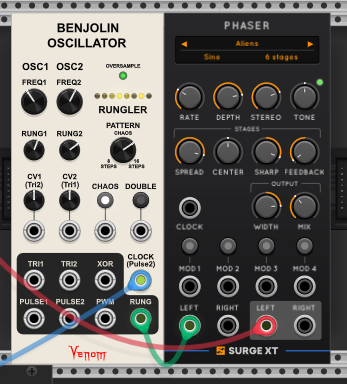
The last voice brings in the Benjolin Oscillator (Venom’s recreation of Rob Hordijk’s design — the same Hordijk whose TwinPeak filter is behind the chug voice), used here as a randomized sequencer on the x4 clock.
The Rungler is the Benjolin’s heart, and it turns out I’d already built one earlier in this patch without knowing it. Inside the Benjolin are two oscillators and an 8-step shift register: oscillator 2’s pulse clocks the register, oscillator 1’s triangle supplies the data bit on each clock — XORed with the bit falling off the end and fed back into the front — and a DAC reads the register’s bits as a stepped voltage with eight possible levels: Hordijk’s “stepped havoc wave,” on the RUNG output. The RUNG1 and RUNG2 attenuverters feed that voltage back to modulate both oscillators’ own frequencies, so the pattern reshapes the very oscillators that generate it: pseudo-random but never noise, orbiting between near-loops and escape. It’s exactly the Cognitive Shift feedback patch — a shift register eating its own output through logic taps, read by a DAC — fused with its own oscillators into one chaotic instrument.
The PATTERN knob sets how chaotic: fully counterclockwise the register locks into a repeating 8-step pattern, fully clockwise a 16-step mirrored one, and at noon the data input is a coin flip — full havoc. The CLOCK input is normalized to oscillator 2’s pulse, and patching the x4 clock in overrides it — so the havoc steps land on the grid.
The phaser as the resonant body. The RUNG output runs into the Surge XT Phaser. A phaser is a chain of allpass filters — filters that pass every frequency at full level but shift their phase; mixed back against the dry signal, the phase shifts carve moving notches into the spectrum, and FEEDBACK around the chain sharpens the regions between notches into resonant peaks. So a phaser with feedback is yet another tuned, ring-able thing — resonance again, this time as a comb of peaks rather than one pitch. Fed the Rungler’s stepped wave, every voltage jump excites those resonances — the same strike-a-resonant-thing gesture as every other voice in this patch, with the phaser as the struck object. The Surge phaser ships with presets that re-voice the whole character at once (the stage count, the LFO, the feedback all change together); the Aliens preset — a sine LFO sweeping six stages — is the keeper here, turning the havoc steps into a woody, high-pitched rattle, like a chaotic mallet line played on some unplaceable tuned percussion. The phaser’s output takes its own channel on the mixer, dry — the chaos doesn’t need any more processing to feel alive.
The full patch
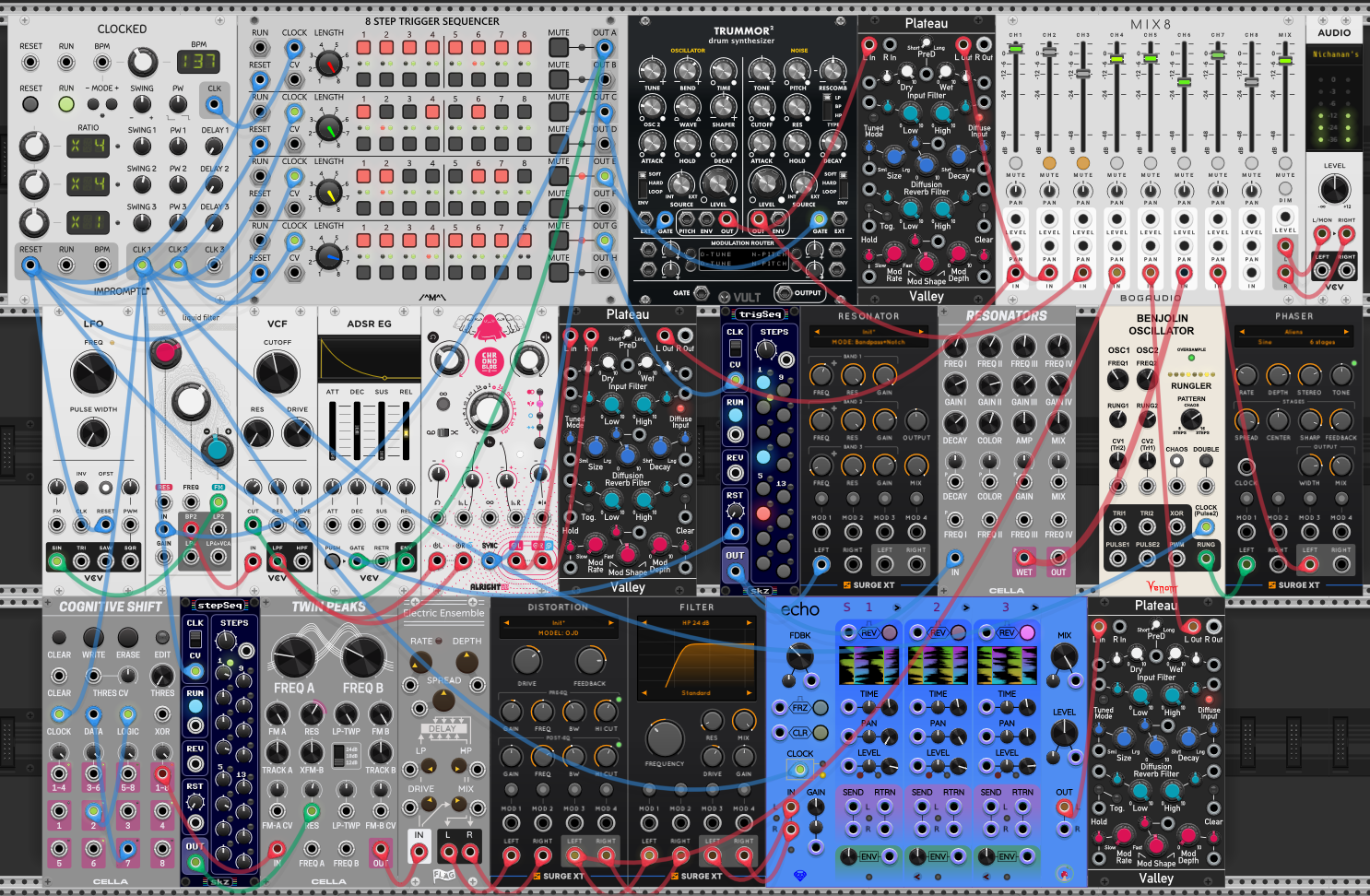
To give the resonator study something to hang on rhythmically, a Trummor² (Vult) — the drum synthesizer from session 29 — holds down a recurring kick and hi-hat pattern, triggered from its own rows of the 8 Step Trigger Sequencer and running through its own Plateau into the mixer. It’s the same split as last session — the oscillator section as the kick, the noise section as the hat — and I can already tell I’ll reach for this module a lot for those two sounds. It’s deliberately plain support here: the interesting rhythms in this patch live in the strike patterns (the evolving Cognitive Shift bits, the 1-3-5 strums, the Rungler havoc), and the drums just give the ear a grid to hear them against.
Also in the rack, kept for the record: a Surge XT Resonator (three parallel bands in Bandpass+Notch mode, each with its own FREQ, RES and GAIN) that I was testing alongside the Cella Resonators — it produces a similar pinged sound, three tunable resonant bands instead of four strings, another candidate for the same job.
Everything lands on a MIX8 (Bogaudio), one channel per stream — the pinged liquid filter in its room, the distorted chug, its back-of-the-room echo send, the Resonators chord, the phased Rungler, the drums — and out to audio. Five differently-resonant voices, four of them with no oscillator in the conventional role anywhere.
Reflection
The biggest gain from this session was learning how to patch a distorted palm-muted guitar sound — it gives a patch so much energy, and it came from nothing but a resonator being struck by its own evolving bit pattern. The Resonators chords earn their place as the bright half of the patch, hanging suspended over everything; the rest of it sits in a deeper, darker rock register. Together these are techniques I expect to keep using for percussion voices in future sessions — every one of these resonant strikes is a percussion sound with a pitch, and the spectrum from thud to ping to ringing string now feels like a palette rather than a trick.