FM Synthesis
Exponential FM
FM — frequency modulation — means one signal modulating the frequency of another. There are three types: exponential FM, linear FM, and linear through-zero FM.
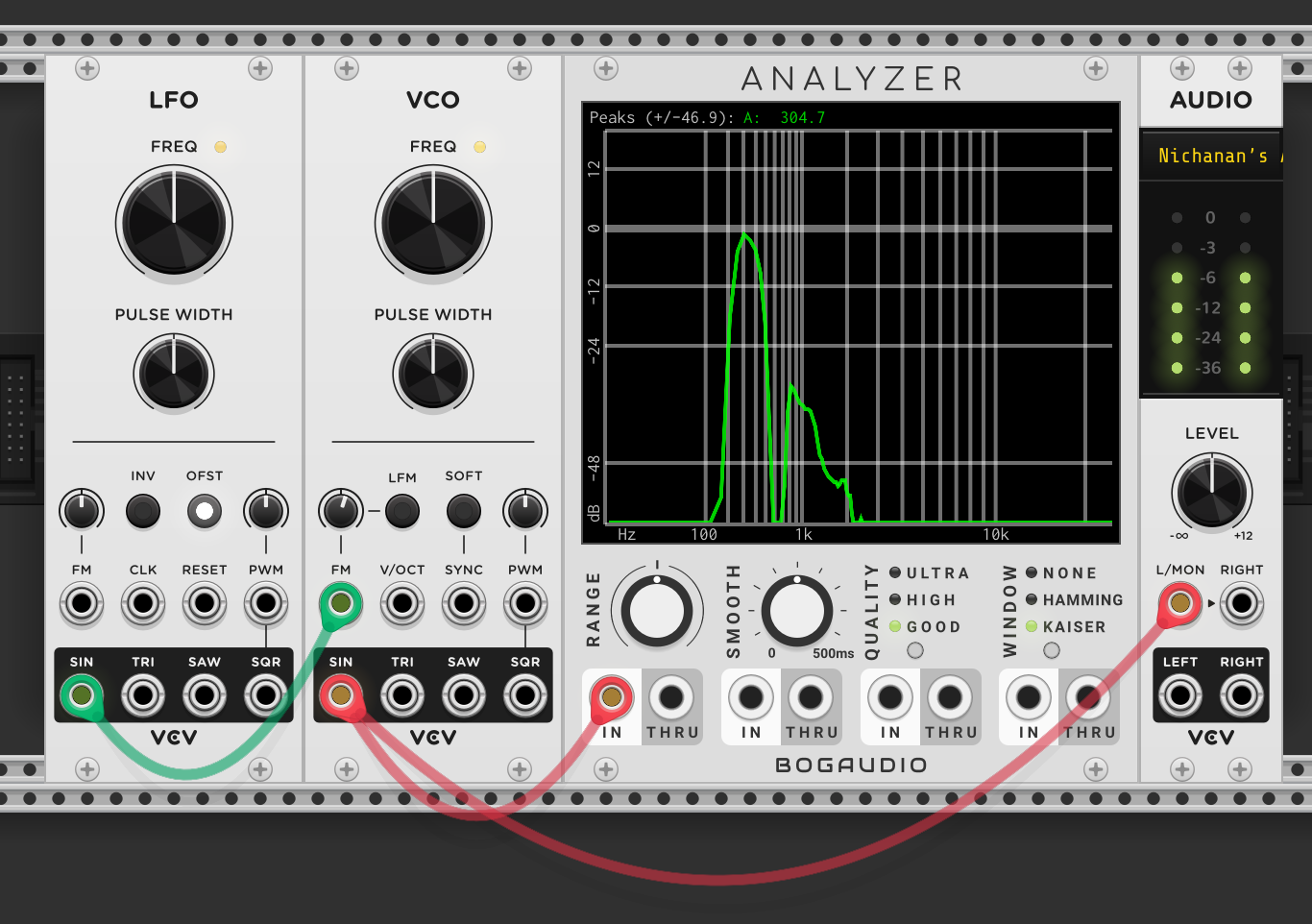
At its simplest, an LFO modulates the frequency of a VCO. The analyzer shows the VCO’s frequency being swept up and down by the LFO — the peak broadens because the pitch is constantly moving. The VCO’s FM attenuverter controls the modulation depth — how far the pitch swings above and below its center frequency. At low depth, the pitch wobbles slightly (vibrato). At high depth, it sweeps across a wide range. The LFO frequency controls how fast the pitch moves — a slow LFO gives a gentle sway, a faster LFO gives a tighter wobble. This is the standard way to add vibrato (see session 13 for vibrato with velocity and mod wheel): an LFO into the VCO’s exponential FM input, with the attenuverter set low for subtle pitch variation.
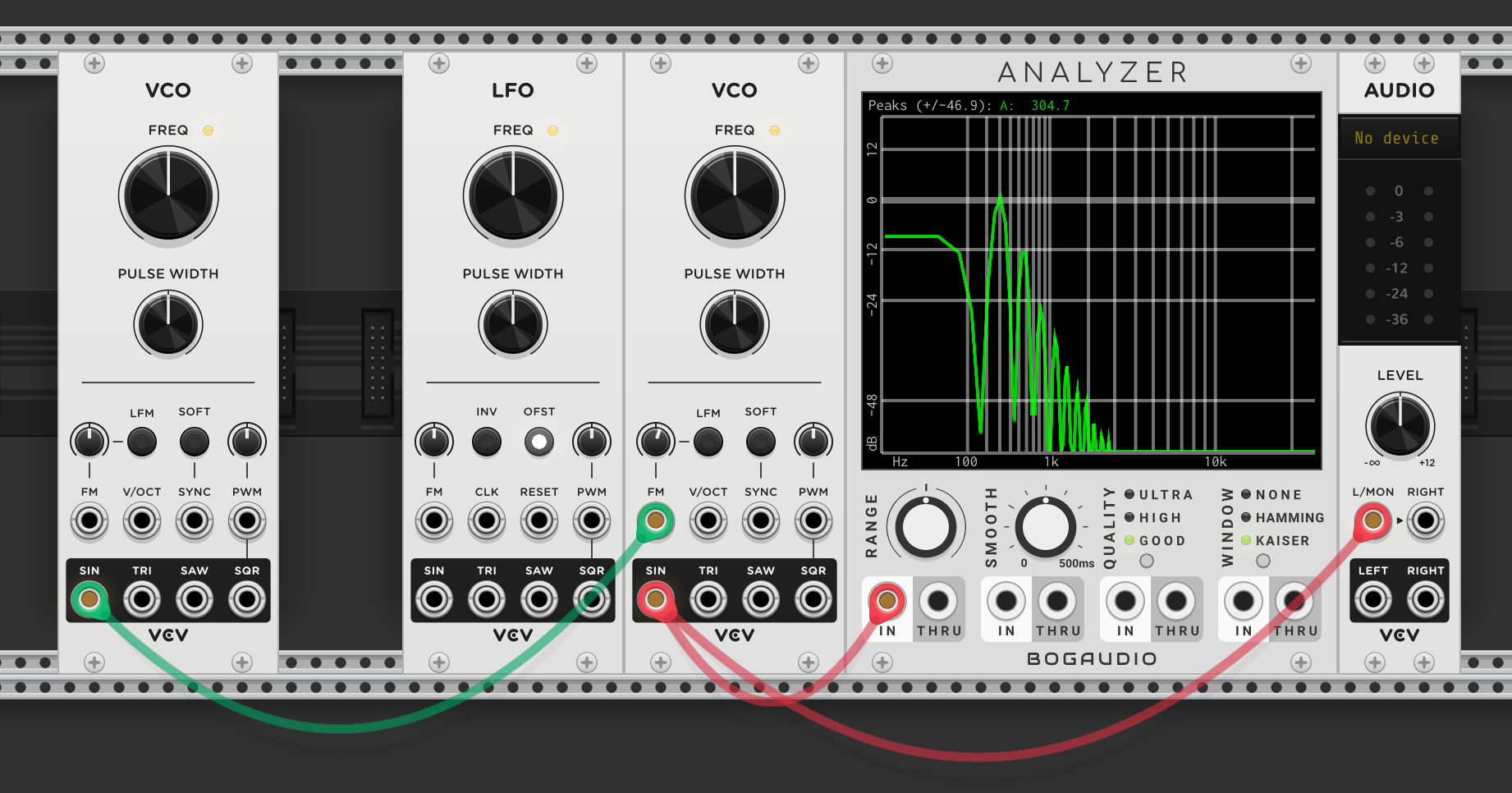
Things get interesting when the modulator runs at audio rate instead of LFO rate. Replacing the LFO with a second VCO means the carrier’s frequency is being pushed up and down hundreds or thousands of times per second. At that speed, the modulation stops sounding like pitch movement and starts creating new harmonics — sidebands — visible as additional peaks on the analyzer. The carrier is called the carrier and the modulating oscillator is the modulator. A single sine wave has one peak on the analyzer; with audio-rate FM, the spectrum fills out with harmonics that neither oscillator produces on its own. The sound becomes noticeably brighter as these sidebands add high-frequency content.
Since FM is modulating frequency, and frequency is pitch, the FM input and V/OCT input on a VCO do the same thing with exponential FM — both change the oscillator’s frequency exponentially. The only difference is that the FM input has a dedicated attenuverter for controlling modulation depth. Patching into V/OCT would produce the same effect, but you’d need an external attenuverter to control the depth. This is easy to verify: replace the modulator VCO with a sequencer, and with the FM attenuverter turned all the way up, stepping through the sequence produces the same pitch changes as patching the sequencer directly into V/OCT.
The problem with exponential FM is that modulating the frequency makes the pitch seem to drift upward. This is because pitch has an exponential relationship to frequency. An oscillator at 500 Hz modulated by one octave goes up to 1000 Hz (+500 Hz) but down to only 250 Hz (−250 Hz). The upward swing covers twice as much frequency range as the downward swing. The modulation is symmetric in pitch (one octave each way) but asymmetric in frequency — so the average frequency shifts upward. The more modulation depth you add, the more the perceived pitch rises. This is the fundamental limitation of exponential FM: it goes out of tune as you increase the modulation.
One technique to stabilize exponential FM is oscillator sync — syncing the carrier to the modulator resets the carrier’s phase each cycle, preventing drift and producing harmonically related FM tones.
Linear FM
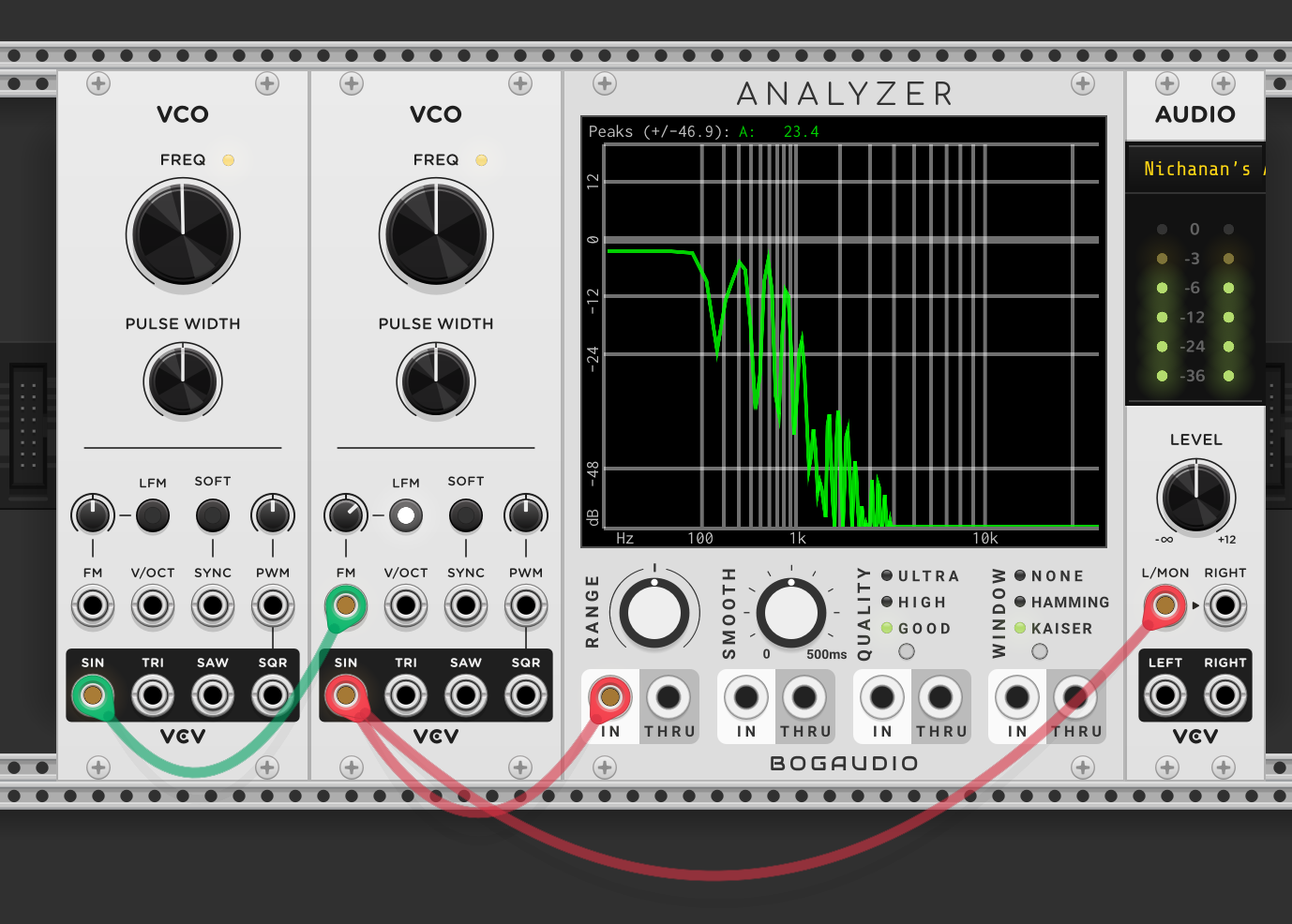
Linear FM operates in frequency space rather than pitch space. The VCO has an LFM switch to select this mode. Instead of the exponential pitch-to-frequency relationship, linear FM modulates the frequency by a fixed number of Hz in both directions equally. A 500 Hz carrier modulated by 250 Hz swings symmetrically — down to 250 Hz and up to 750 Hz. Because the swing is equal in both directions, the perceived pitch stays stable as you increase modulation depth. Only the brightness changes as more sidebands appear.
This stability breaks down at extreme depth. If the modulation amount exceeds the carrier frequency — say a 500 Hz carrier modulated by 600 Hz — the downward swing tries to go to −100 Hz. Frequency can’t go below zero, so the oscillator bottoms out. The upward swing still reaches 1100 Hz unimpeded, so the average frequency shifts up and the pitch rises. Linear FM stays in tune as long as the modulation depth doesn’t push the frequency below zero.
Linear through-zero FM
Through-zero FM solves linear FM’s floor problem. When the modulation pushes the frequency below zero, instead of bottoming out at 0 Hz, the oscillator passes through zero and comes back up the other side — the waveform inverts and continues. A 500 Hz carrier modulated by 600 Hz swings up to 1100 Hz and down to −100 Hz, which through-zero treats as 100 Hz with an inverted phase. The result is symmetric modulation even at extreme depths — the pitch stays stable no matter how hard you modulate, and the sound just gets brighter with more sidebands.
Operators
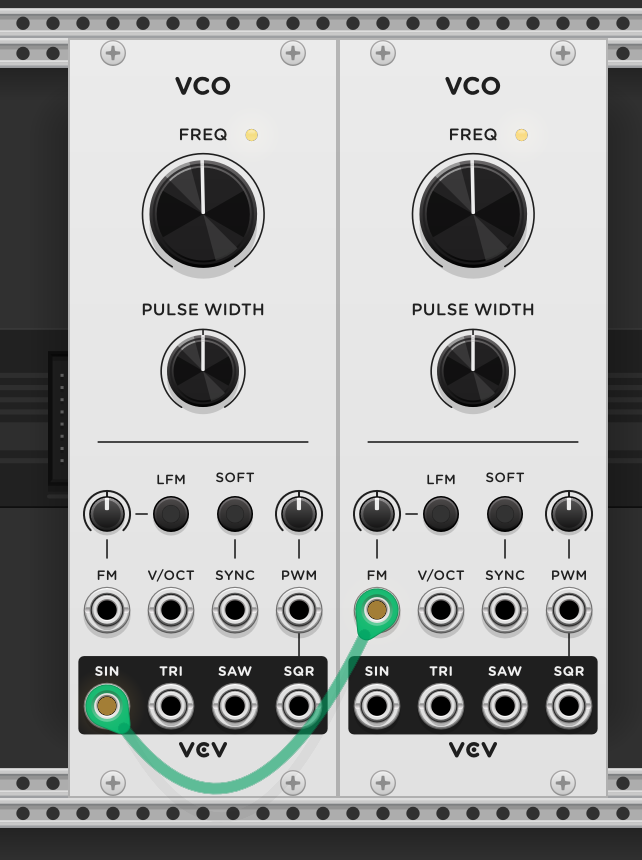
In FM, the two oscillators have distinct roles: the modulator controls the modulation (its frequency and amplitude shape the timbre), and the carrier is the one being modulated (its frequency is the pitch you hear). The modulator’s output goes into the carrier’s FM input.
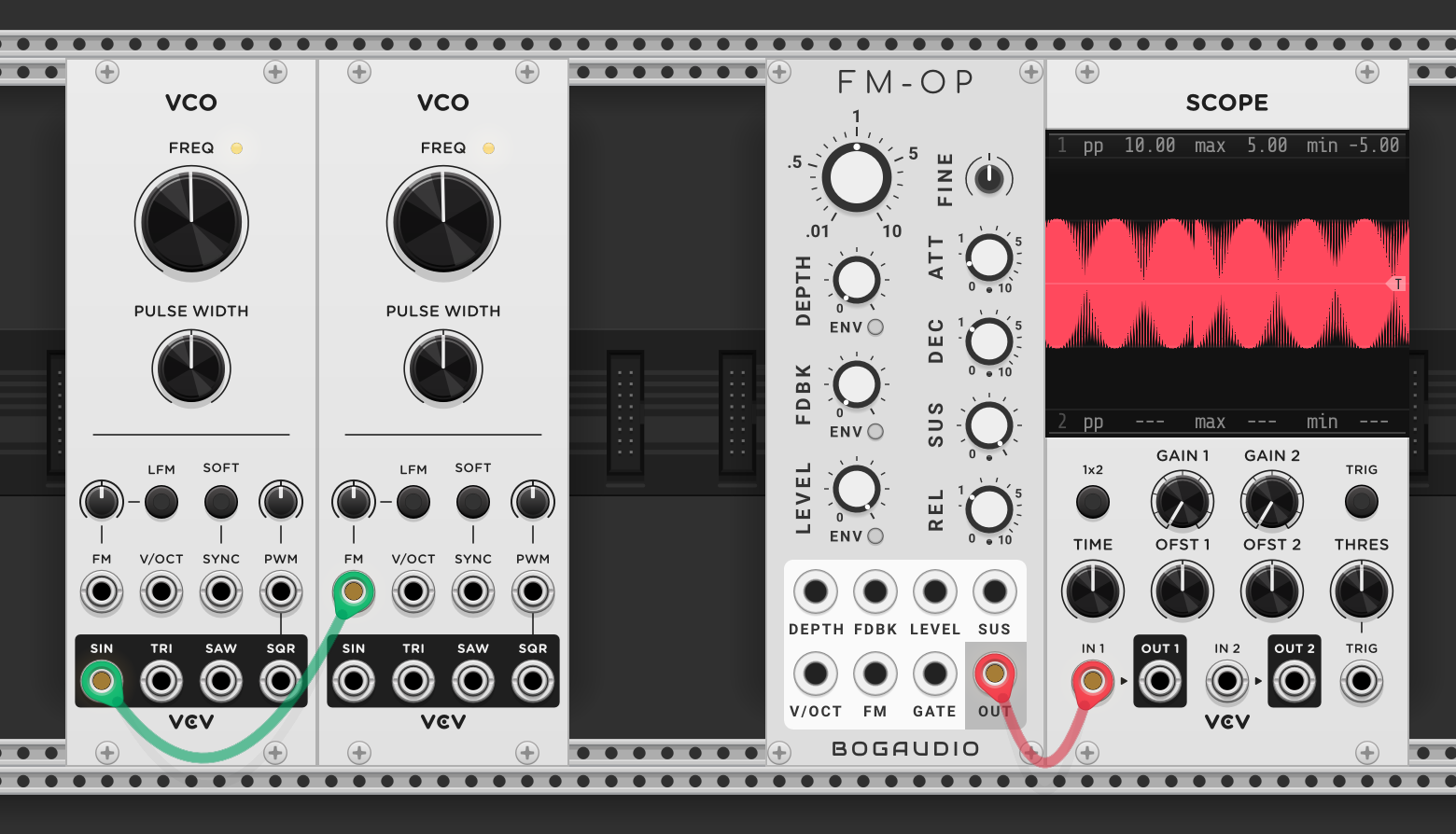
FM synthesizers don’t use oscillators — they use operators. An operator bundles an oscillator with a built-in VCA and envelope, so each operator is a complete voice element on its own. The other key difference is tuning: where oscillators tune by frequency in Hz, operators tune by ratio relative to each other. A ratio of 1 means the modulator matches the carrier’s frequency; a ratio of 2 means it’s twice the carrier’s frequency. Integer ratios produce harmonic, musical timbres. Non-integer ratios produce inharmonic, metallic or bell-like sounds.
Operators also have a feedback control — the operator modulates its own frequency, feeding its output back into itself. This self-modulation adds brightness, pushing a pure sine toward increasingly complex, noise-like timbres as the feedback increases.
The routing between operators is called an algorithm. With four operators A, B, C, and D, you could have A modulating all of B, C, and D simultaneously (with feedback on itself) — each carrier gets the same modulation character but at its own frequency. Or you could chain them: A modulates B, which modulates C, which modulates carrier D — a serial stack where each stage adds complexity to the next. Different algorithms produce fundamentally different timbral possibilities from the same set of operators. Classic FM synths like the DX7 offered 32 fixed algorithms to choose from.
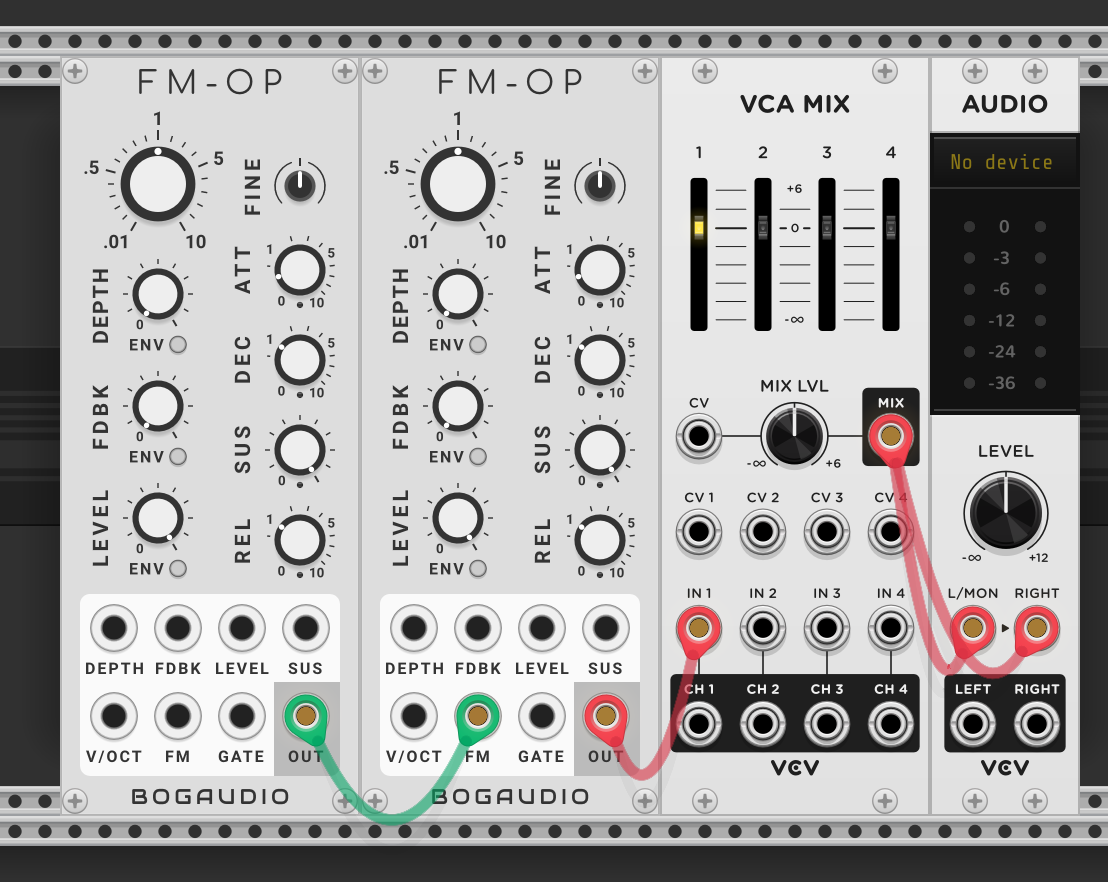
Two operators patched as modulator into carrier, both set to a ratio of 1 — running at the same frequency. Changing the modulator’s ratio shifts the relationship: at ratio 2, the modulator runs at twice the carrier’s frequency, producing a different set of sidebands and a brighter, more complex timbre. At ratio 0.5, it runs at half, giving a darker, sub-harmonic character. Integer ratios (1, 2, 3, 5) produce harmonic timbres — the sidebands fall on musically related frequencies. Non-integer ratios (1.5, 3.7) produce inharmonic spectra — metallic, bell-like, or dissonant tones where the sidebands don’t align with the harmonic series.
FM percussion
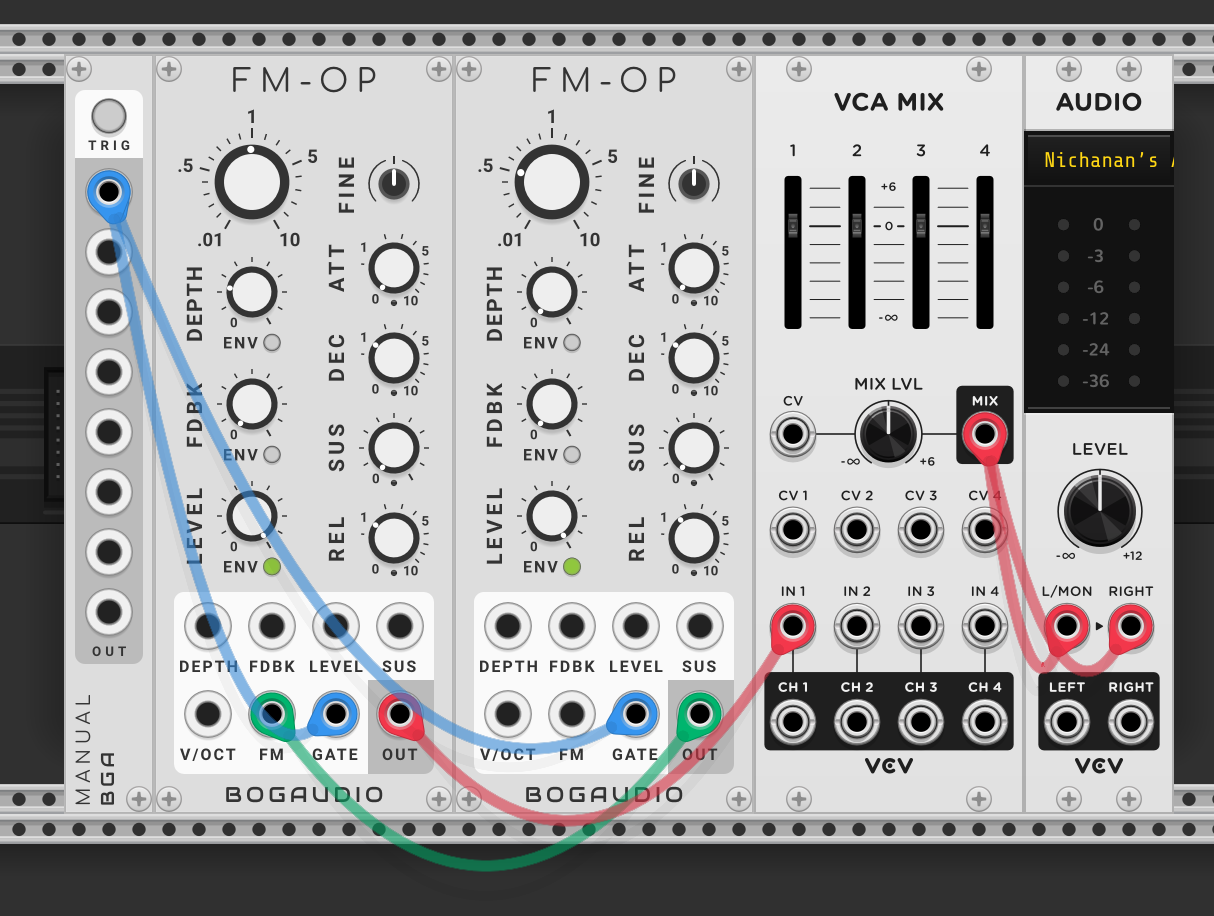
Activating the built-in envelopes on both operators and setting attack and sustain to zero turns each trigger into a percussive hit. The gate from a manual trigger fires both operators simultaneously — the sound starts instantly and decays away. Setting the modulator’s decay and release shorter than the carrier’s creates a key FM percussion technique. The modulator’s envelope controls the brightness over time — as it decays, the FM sidebands disappear and the sound darkens. The carrier’s envelope controls the volume — it sustains longer, so the sound continues after the brightness has faded. The result is a woody, percussive tone: a bright attack that quickly darkens into a simpler thud. This is the same coupled brightness/volume decay that makes the LPG sound organic — but here it’s achieved by giving two operators independent envelope times instead of relying on a vactrol.
A short envelope sent directly to the FM input creates the characteristic “snap” or “click” at the beginning of percussive sounds — the brief burst of FM sidebands adds an attack transient that decays into the cleaner carrier tone.
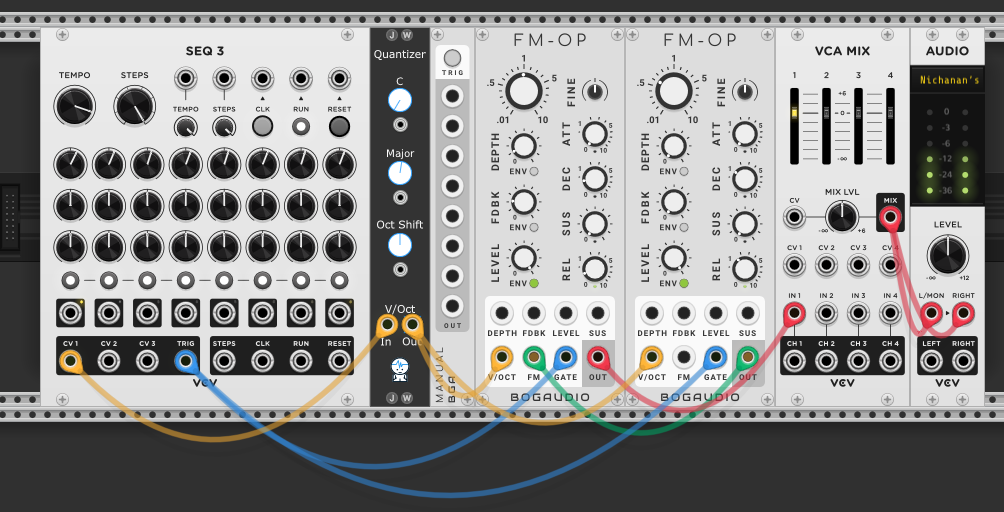
Adding a sequencer and quantizer turns the FM percussion into a melodic voice. SEQ3’s pitch row goes through a quantizer into both operators’ V/OCT inputs so they track the same pitch. The trigger output fires both gates, and each step produces a percussive FM hit at the sequenced pitch. The modulator’s depth knob controls how bright each hit is — more depth means more sidebands, a harsher attack. The feedback knob adds self-modulation on top, pushing the timbre from clean and woody toward gritty and metallic. Between ratio, depth, and feedback, the modulator has three independent controls over the character of the sound, all without touching a filter.
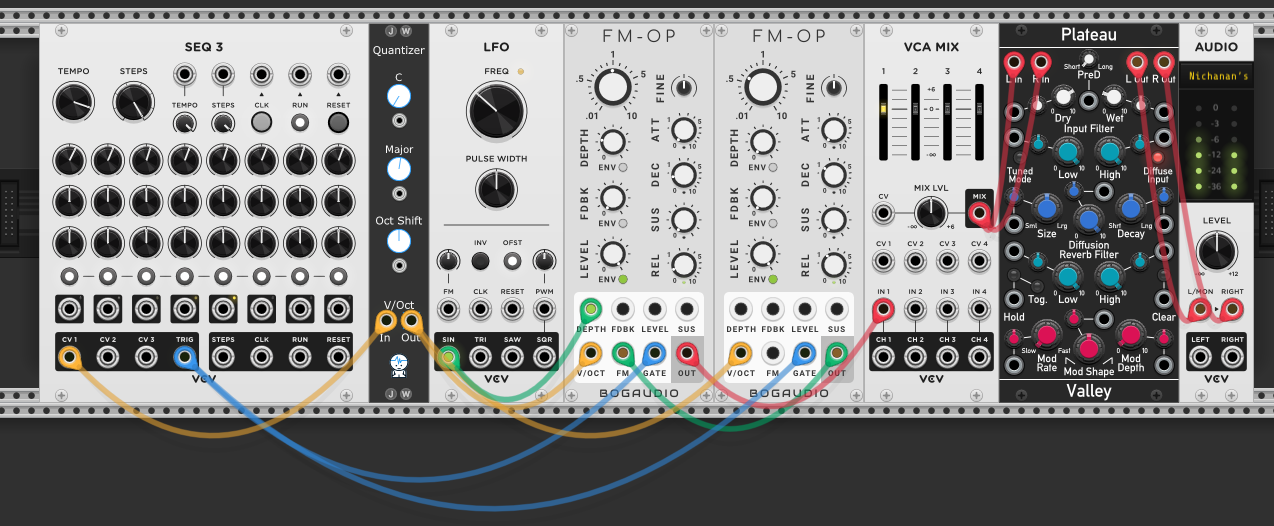
An LFO modulating the modulator’s depth creates a slowly shifting brightness — each hit in the sequence has a slightly different timbral character as the modulation depth rises and falls. Plateau reverb on the output adds space and lets the percussive hits ring out, smoothing the short FM bursts into something more atmospheric.
Patching FM with VCOs
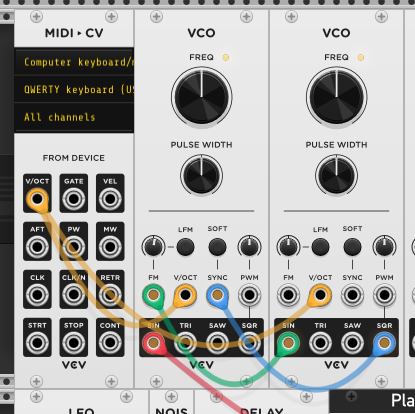
When patching FM with regular VCOs instead of operators, sending the same V/OCT signal to both oscillators keeps the pitch more stable as you open up the FM depth. The MIDI-CV V/OCT output goes to both VCOs’ V/OCT inputs so they track together — without this, increasing the modulation depth causes the two oscillators to drift apart in pitch.
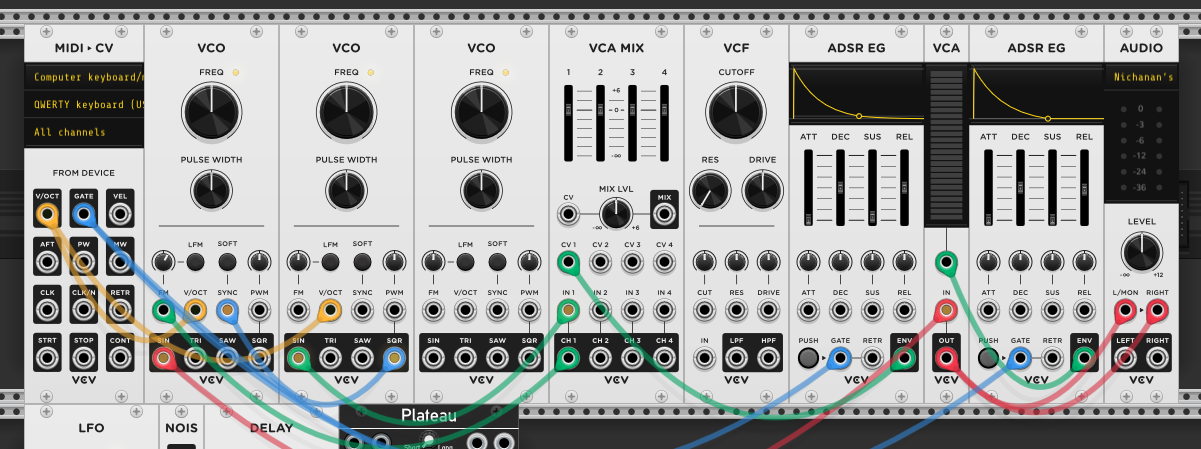
Using an envelope to control the FM depth gives per-note timbral shaping. The modulator’s sine wave goes into VCA MIX channel 1, and the first ADSR’s envelope output goes into that channel’s CV input — the mixer doubles as a VCA here, scaling the modulator’s signal by the envelope. The channel 1 output, now envelope-shaped, feeds the carrier’s FM input. On each key press the envelope opens, the FM depth increases, brightness peaks, then as the envelope decays the modulation drops and the sound darkens. The carrier goes through its own subtractive chain — VCF and VCA with a second ADSR — so both the FM brightness and the overall volume/filtering are independently shaped per note.
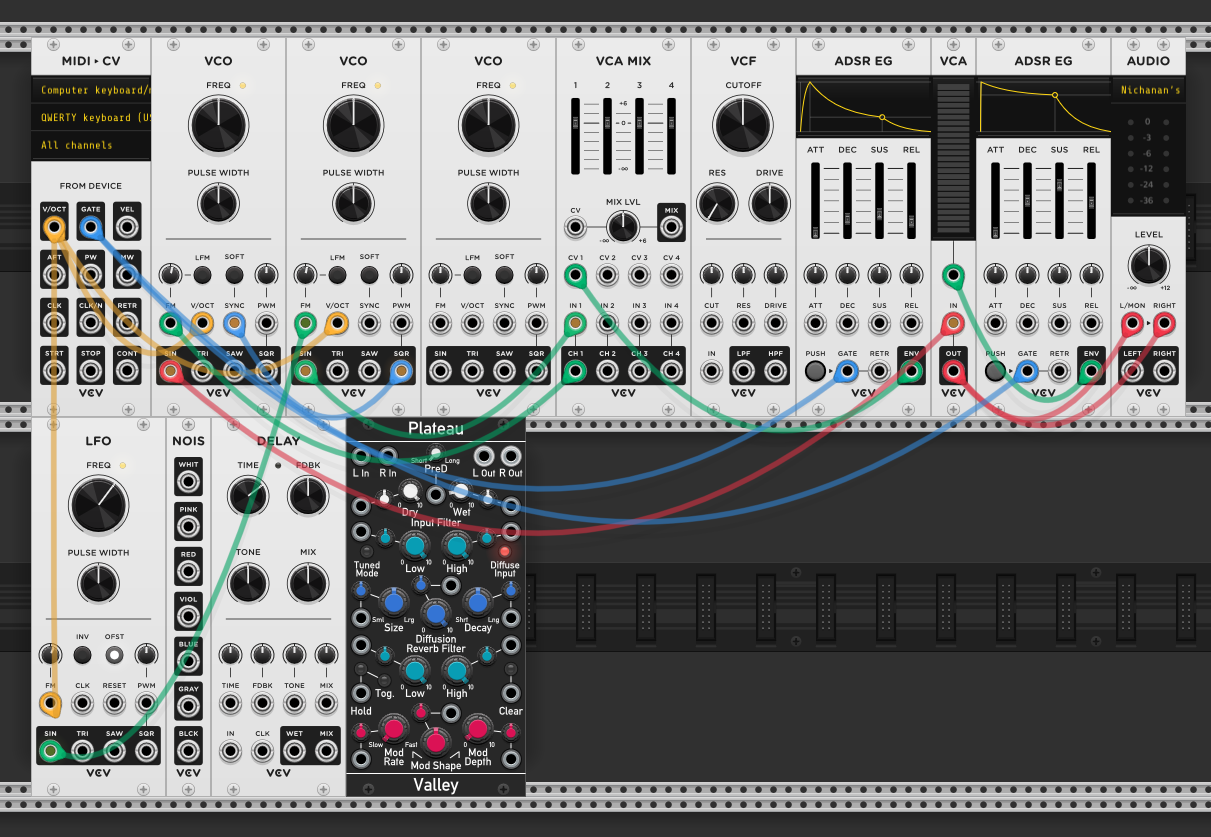
Adding vibrato to the FM patch: an LFO sine wave goes into the modulator VCO’s FM input, gently wobbling the modulator’s frequency. Since the modulator is synced to the carrier, the pitch relationship between them stays locked — the LFO modulates the modulator’s frequency, which in turn modulates the carrier’s timbre with a slowly shifting character. This is vibrato applied to the modulation source rather than the carrier’s pitch directly, so instead of the pitch wobbling, the brightness and harmonic content shimmer.
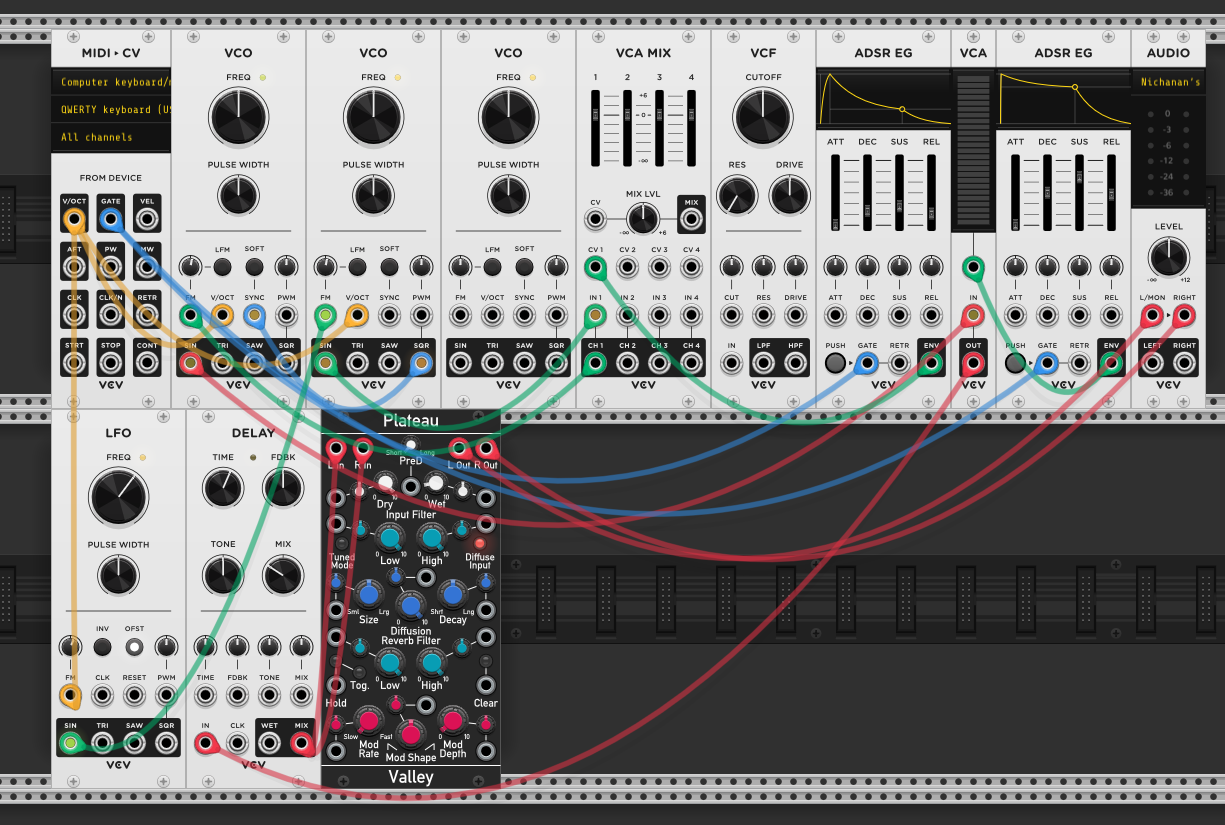
Adding delay before the Plateau reverb and increasing the LFO’s vibrato depth creates a larger, more spatial sound. The delay repeats spread the FM notes out in time, and the reverb wraps everything in a chamber-like ambience. The wider vibrato gives each note a more expressive, wavering quality that the reverb tail sustains and blurs together.