Sample and Hold
Sample and Hold basics
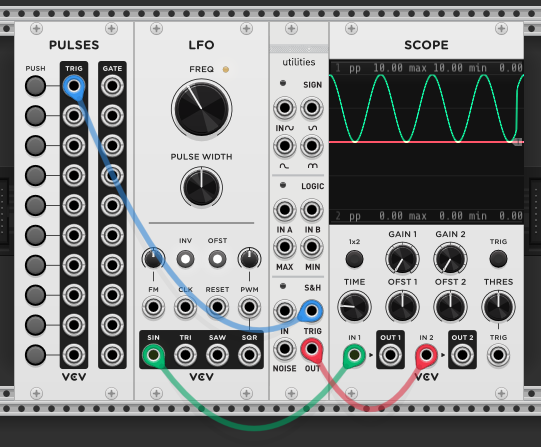
The Utilities (Kinks) module includes a sample and hold (S&H) section. S&H needs two things: an input signal to sample, and a trigger to tell it when to take a snapshot. On each trigger, the S&H captures the input’s voltage at that exact moment and holds it steady until the next trigger arrives.
Here the LFO’s sine output is the input (green cable to S&H IN), and the Pulses module provides a manual trigger (blue cable to S&H TRIG). Each time the trigger button is pressed, the S&H grabs the sine’s current value and locks it. The scope shows both: the smooth sine wave on top (the input), and the stepped output below (the held values) — each plateau is a snapshot, held until the next button press. The S&H output uses a red cable to the scope so the two traces are visually distinct.
The key idea: S&H converts a continuous signal into discrete steps. The input determines what values are possible, the trigger determines when a new value is captured.
Noise as random source
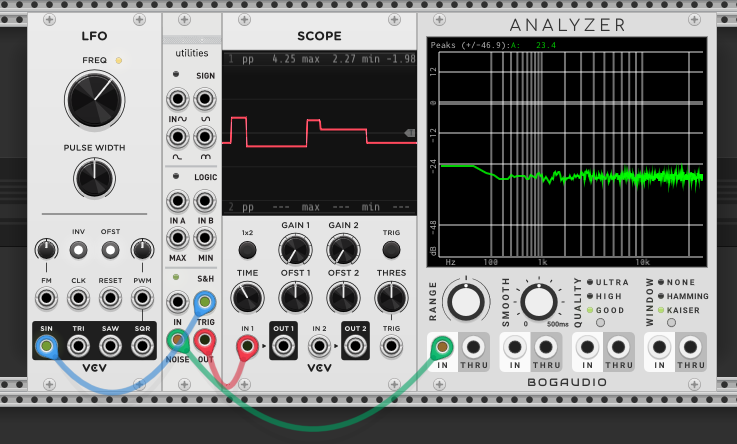
The Kinks module has a built-in white noise output (NOISE). White noise has equal energy across the frequency spectrum — the analyzer confirms the flat distribution. This makes it an ideal source for random modulation: at any given moment, the voltage could be anywhere in its range, with no bias toward any particular value.
The LFO’s square output now triggers the S&H (blue cable) instead of the manual button. On each LFO cycle, the S&H snapshots the noise voltage and holds it. The scope shows the result: a staircase of random values, each step held for one LFO period. The steps are random in height (because the noise is unpredictable) but regular in timing (because the LFO is steady).
This is the classic S&H patch: noise in, clock trigger, random stepped voltage out. In Session 5 noise was an audio source or modulation signal — here it’s a randomness source, providing the raw material that S&H samples from.
S&H modulating filter cutoff
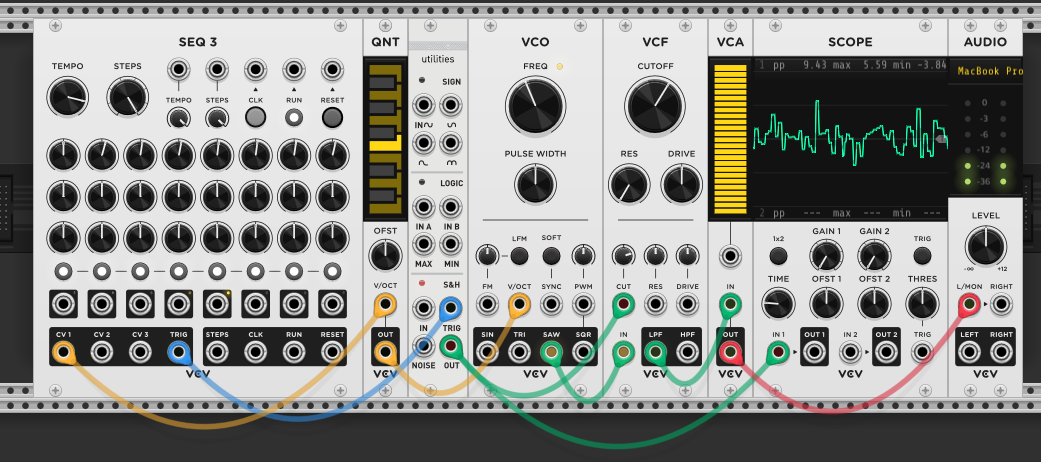
SEQ 3 sequences the VCO (via quantizer) and triggers the S&H on each step. The VCO’s sawtooth goes through a low-pass filter (VCF) to a VCA. The S&H output is patched to the filter’s cutoff CV — on each sequencer step, the S&H grabs a new random noise value and holds it, shifting the filter brightness.
The result: a sequenced melody where each note has a different random cutoff — some bright, some dark — changing in sync with the rhythm. The scope shows the jagged S&H output driving the cutoff. Compare this to Session 5 where raw noise modulated the cutoff continuously for a gritty, jittery texture. Here the S&H quantizes that randomness in time — one random value per step, held steady, rather than constant jitter. Stepped randomness vs continuous randomness.
S&H for random pitch
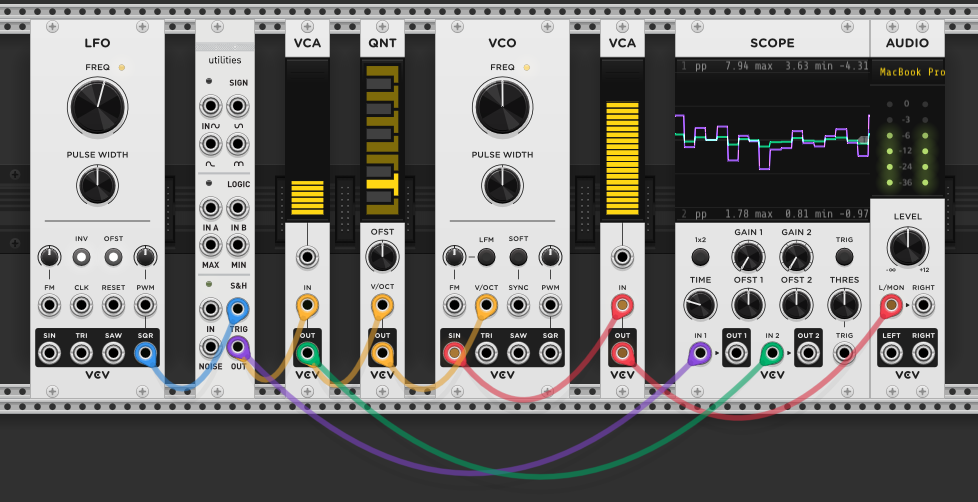
The S&H can also generate random pitch information. The patch: noise into S&H input, LFO square output as trigger (blue cable). But instead of patching the S&H output directly to the VCO’s V/OCT, it goes through a quantizer first (yellow cable). The quantizer snaps whatever voltage the S&H outputs to the nearest scale degree, so every random value becomes a valid musical pitch.
Without the quantizer, the S&H output would be arbitrary voltages — microtonal, out-of-tune, between the cracks of the keyboard. The quantizer is what makes this musically useful: random but always in tune. The scope shows the staircase output after quantization — each step sits exactly on a note, with no in-between values.
An attenuator before the quantizer is also useful here: the raw S&H output can span a wide voltage range, meaning the random pitches could jump across several octaves. Attenuating the signal narrows that range — less voltage swing means smaller intervals, keeping the melody in a tighter register instead of leaping wildly across the keyboard.
The purple and green cables go to the scope for monitoring only — they don’t affect the sound. The scope traces show the quantized S&H voltage (discrete steps at exact pitch levels) and the VCO’s output responding to each new pitch.
This is the same S&H + noise combination from the previous section, but routed differently: there it controlled filter brightness, here it controls pitch. Same random engine, different destination — that’s the power of modular routing. Any S&H random output can modulate anything: pitch, filter, amplitude, timing, wavefold amount.
Track and hold
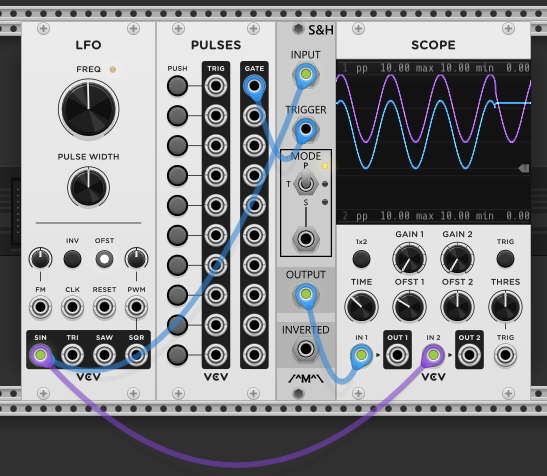
The S&H module has a mode switch: S (sample and hold) and T (track and hold). Track and hold works the opposite way. While the incoming gate stays low, the input signal passes straight through to the output — the module tracks it in real time. When the gate goes high, the output freezes at whatever value it had at that moment and holds it until the gate closes again.
The scope shows it: the blue trace is the LFO sine input, and the output follows it faithfully during the low portions of the gate. When the gate from Pulses opens, the output locks to a flat line — held steady — then resumes tracking when the gate drops.
Compare this to sample and hold from the first section: S&H grabs one snapshot per trigger and holds between triggers. Track and hold does the reverse — it follows the input most of the time and only freezes on command. S&H is mostly holding with brief samples; T&H is mostly tracking with brief holds.
T&H can also freeze a running pitch sequence — while the gate is high, the pitch holds on the current note even as the sequencer continues stepping, creating moments of stillness against the moving pattern.
Note: some T&H modules reverse the convention (tracking when gate is high, holding when low) — check the module’s behavior, as manufacturers aren’t consistent about which polarity does what.
Track and hold modulating filter cutoff
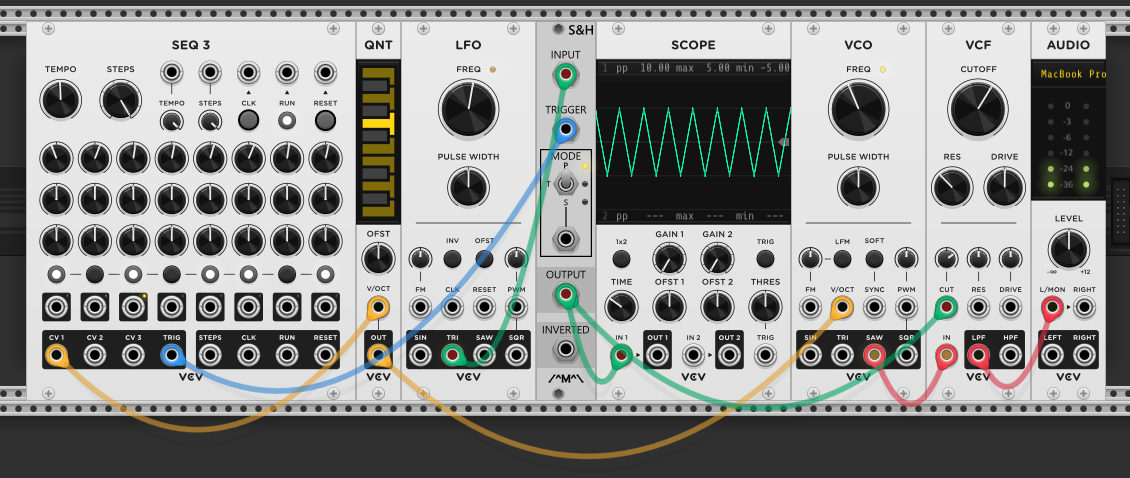
Here the track and hold modulates the VCF cutoff in a larger patch. SEQ 3 sequences the VCO through a quantizer (yellow cables), while the LFO sine goes into the S&H module (set to T mode). The S&H output (green cable) is patched to the filter’s cutoff CV input.
The result: the filter cutoff follows the LFO’s smooth sine movement most of the time, but periodically freezes when the gate opens — creating a mix of sweeping and held filter states. Compare this to the S&H version earlier in the session, where the cutoff jumped between random discrete values on each step. Track and hold gives a different character: smooth motion interrupted by frozen moments, rather than a staircase of random jumps.
S&H adding variation to voice and filter
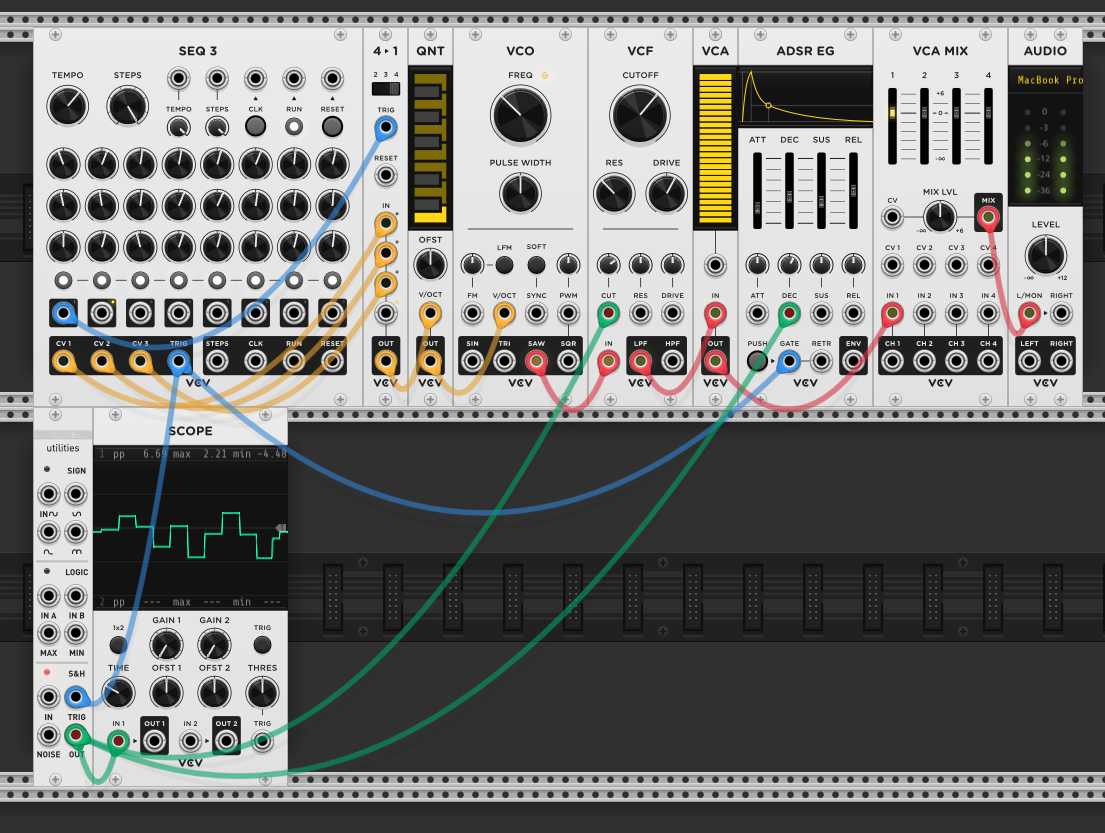
To recap, S&H can add variation to multiple parameters at once. Here the Kinks noise feeds the S&H, triggered by the sequencer (blue cable). The S&H output is split (green cables) to two destinations: the VCF’s cutoff input and the ADSR’s decay input. On each sequencer step, one random value controls both filter brightness and envelope decay time.
SEQ 3 sequences pitch through a quantizer to the VCO (yellow cables), and the VCO goes through the VCF and VCA chain to the mixer. The scope shows the S&H’s stepped random output — each plateau is one note’s worth of random modulation. The result: every note in the sequence has a different brightness (cutoff) and a different sustain length (decay), all from a single S&H output. Some notes are bright and snappy, others are dark and lingering.
This is S&H as a variation engine — one random source, multiple destinations, synchronized to the rhythm. Each parameter it touches gets the same random value per step, so the variations are correlated: a note that’s bright is also short, a note that’s dark is also long. Splitting to independent S&H channels would decorrelate them — different random values for each parameter.
Second voice with delay
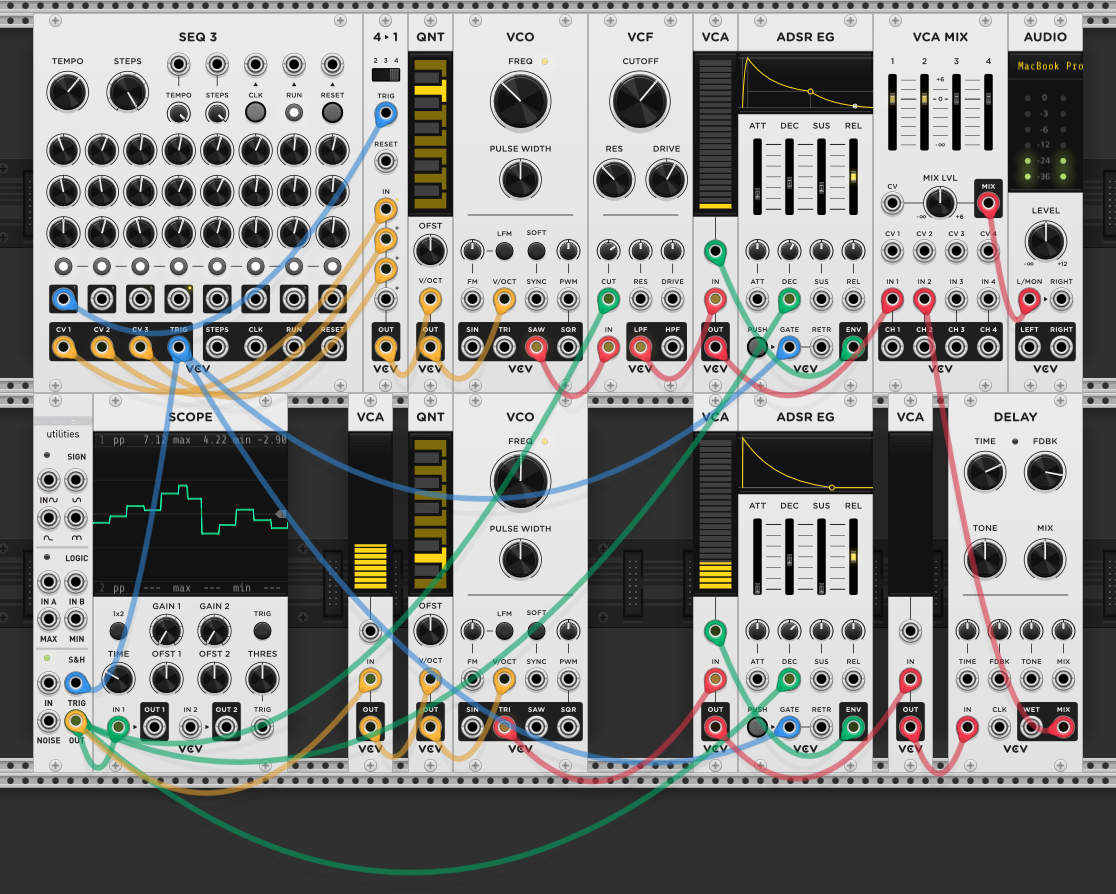
A second voice is added in the bottom row, running in parallel to the first. Both voices are driven by the same SEQ 3 — the sequencer’s pitch CV is split to both quantizers (yellow cables), and the trigger gates both ADSRs (blue cables). The S&H still modulates the first voice’s filter and decay as before.
The second voice has its own signal chain: quantizer → VCO → VCA → ADSR, routed through a delay module with high feedback. The bottom-right VCA acts as a manual level control for the second voice — turning it up blends the second voice in, turning it down lets the delay’s feedback trail carry the sound out gradually rather than cutting it off abruptly.
This is a performance technique: the VCA becomes a manual fade control. Bring the second voice in when you want density, then drop the VCA and let the delay’s feedback tail do the fade-out. The high feedback means each repeat decays slowly, so the second voice lingers and dissolves rather than stopping dead.
Adding reverb
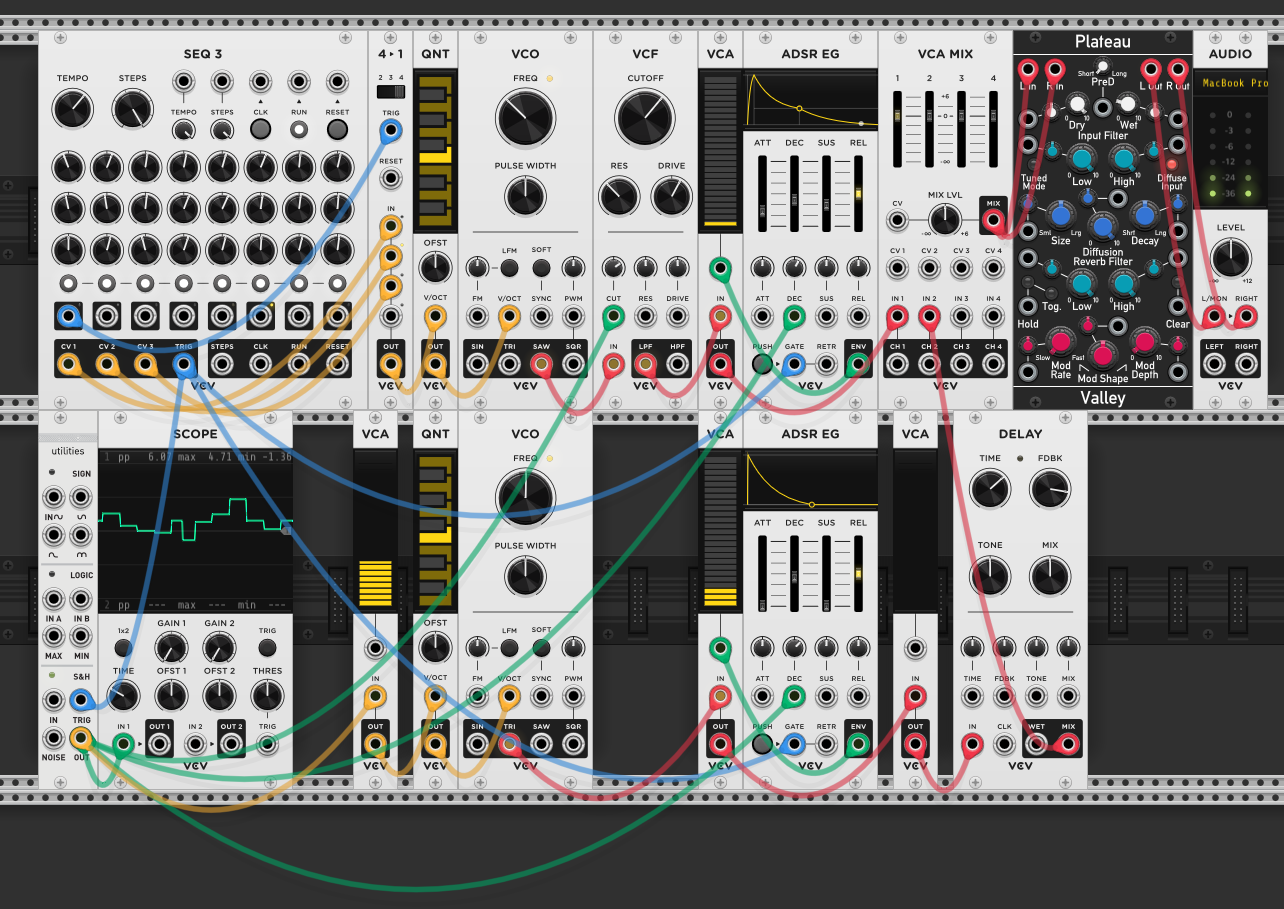
A Plateau reverb is added between the mixer and audio output. Both voices pass through it, adding space and atmosphere to the whole patch. The reverb smooths out the delay feedback tail — instead of discrete echoes fading away, the sound dissolves into a wash. Combined with the high-feedback delay on the second voice, the fade-out becomes a long, atmospheric decay rather than a series of repeats.