Generative Thriller Score
Intention
An eerie, high-tension sound that would score a thriller movie scene; suspense building, something lurking. The sonic world — sparse, unpredictable events in dark space, slow creeping modulation, dissonant intervals that never resolve, sudden stabs of sound that vanish into reverb.
Starting patch
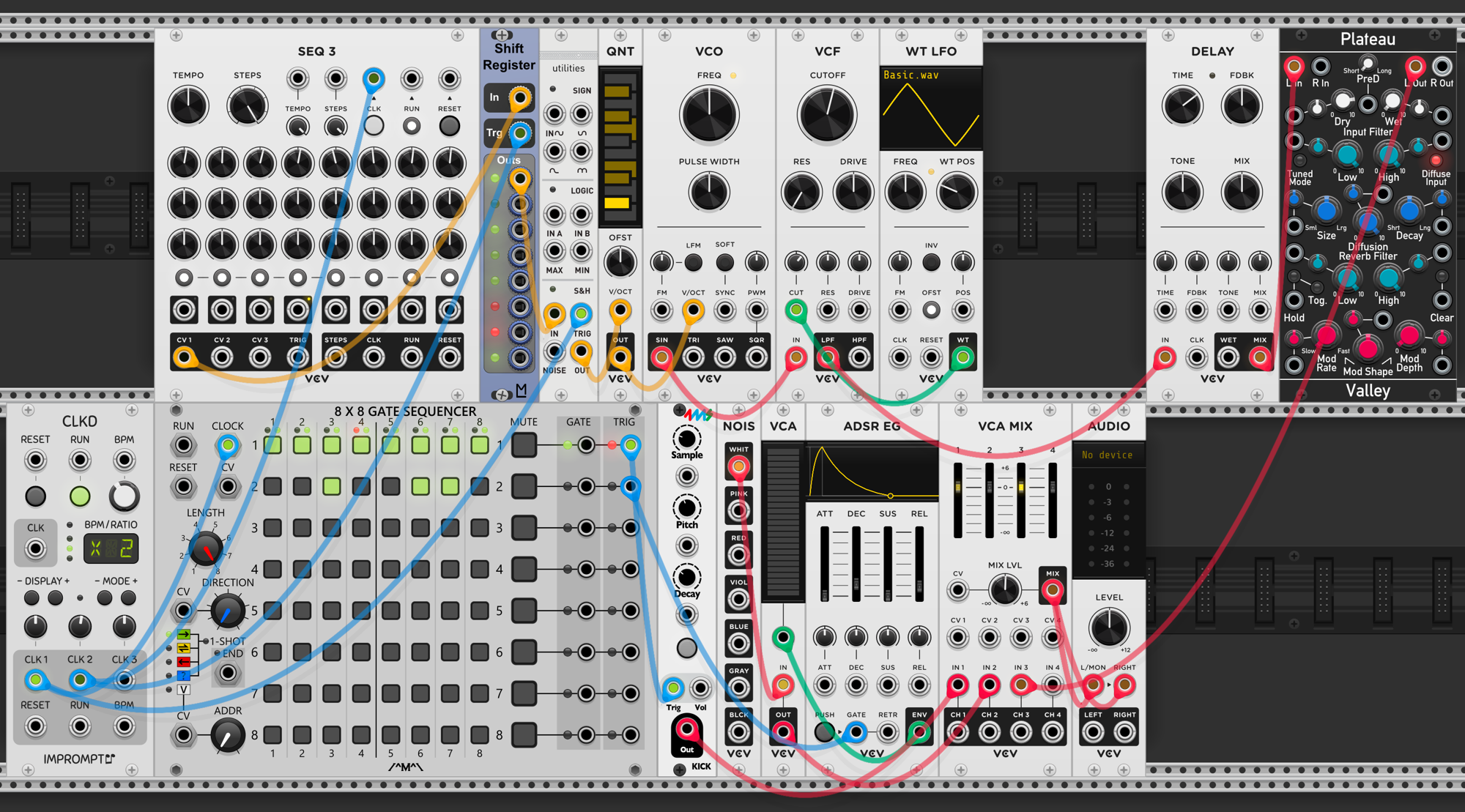
Melodic voice: CLKD → SEQ 3 → Shift Register → QNT → VCO → VCF → Delay → Plateau → VCA MIX. A WT LFO modulates the filter cutoff (green cable). The shift register already drifts the pitch sequence — the one generative element so far.
Drums: CLKD → 8x8 Gate Sequencer → kick drum (noise module) and hi-hat (noise → VCA gated by ADSR). Fixed programmed patterns.
Mix: VCA MIX → Audio output.
The patch sounds like a loop. Everything repeats. Nothing breathes. A thriller scene should feel alive and uneasy. Events should arrive at unexpected places, textures shifting underneath, and the space vast and dark.
What was built
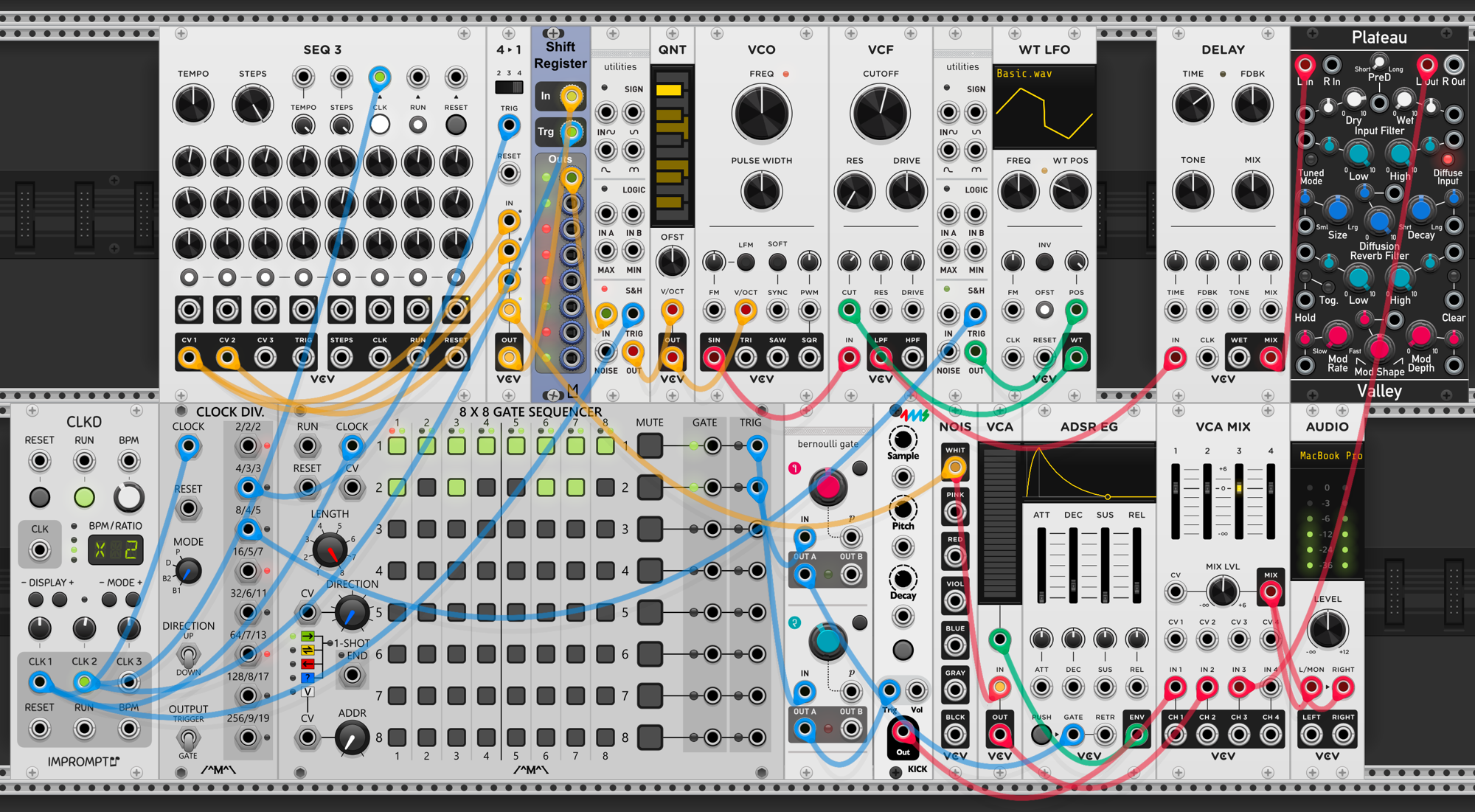
Three layers of generativity added to the starting patch:
Pitch mutation via 4→1 sequential switch. The 4→1 switch sits between SEQ 3 and the shift register. Inputs 1 and 2 come from SEQ 3 row 1 (the main composed melody), input 3 from row 3 (a second composed variation), and input 4 from white noise through S&H (random pitch). A clock division triggers the switch to advance between sources. Most of the time the shift register receives composed notes — but every fourth step, a random value enters the chain and propagates through the register’s outputs over subsequent clocks. The sequence mutates gradually rather than changing all at once. A dual attenuverter between the switch and the shift register compresses and offsets the pitch CV range, keeping the mutations to small, creeping movements rather than wide leaps.
Rhythmic unpredictability via Bernoulli gates. The gate sequencer’s outputs pass through Bernoulli gates before reaching the kick and hi-hat. Gates are probabilistically dropped — some hits land, some don’t. The programmed pattern is still the skeleton, but the actual rhythm heard is a thinned, breathing version of it. The master clock is also slowed, so events arrive sparsely and silences open up between them.
Timbral variation via S&H on WT LFO. A second S&H module feeds the WT LFO’s wavetable position input. Each time it samples, the LFO’s waveshape changes — which changes the character of the filter cutoff modulation. The filter still sweeps at the same rate, but the shape of each sweep cycle is different. Sometimes a smooth sine-like roll, sometimes a sharper ramp.
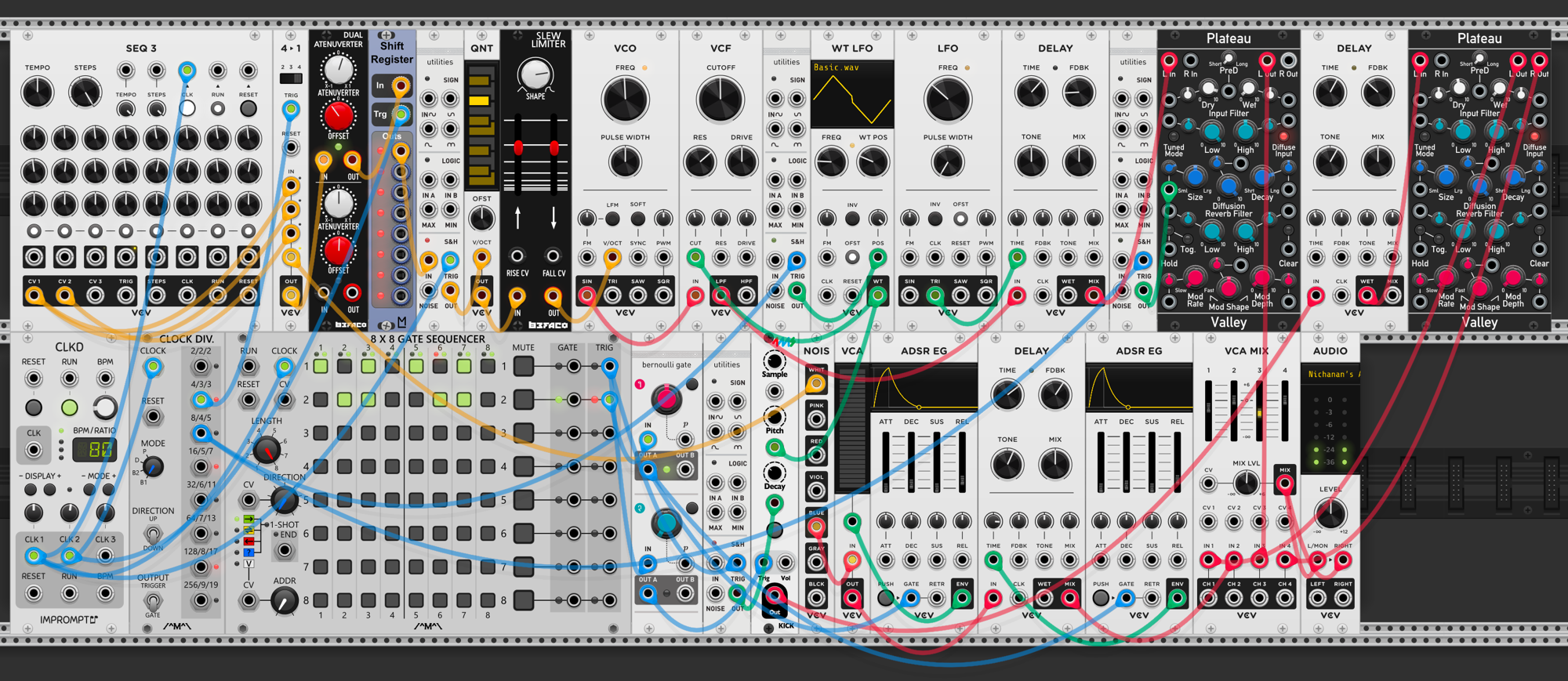
Glide via slew limiter. A Befaco Slew Limiter between the quantizer and VCO V/OCT input smooths discrete pitch steps into continuous slides. With long rise and fall times, the voice stops sounding like a sequence playing notes and starts sounding like wind — a slow, eerie pitch drift that’s always moving, never arriving. The quantizer still constrains pitches to locrian scale degrees, but the transitions between them are continuous.
Kick drum as heartbeat. The kick routes through its own delay and a dedicated Plateau reverb, panned in the stereo field. The delay repeats give each kick hit a double-pulse quality — a heartbeat buried in the mix. Bernoulli gates thin the pattern so the heartbeat appears and disappears unpredictably.
Hi-hat with accelerating delay. The hi-hat runs into a delay whose time is modulated by an envelope, so each hit spawns a burst of repeats that accelerate as they decay — like a ping-pong ball bouncing to a stop.
Static texture from wet reverb. The Plateau’s wet output picks up the reverb’s own noise floor and internal feedback, producing a faint crackling static that fades in and out. An unintended texture — it sounds like a bad radio signal or electrical interference, adding grit and unease between the musical events.
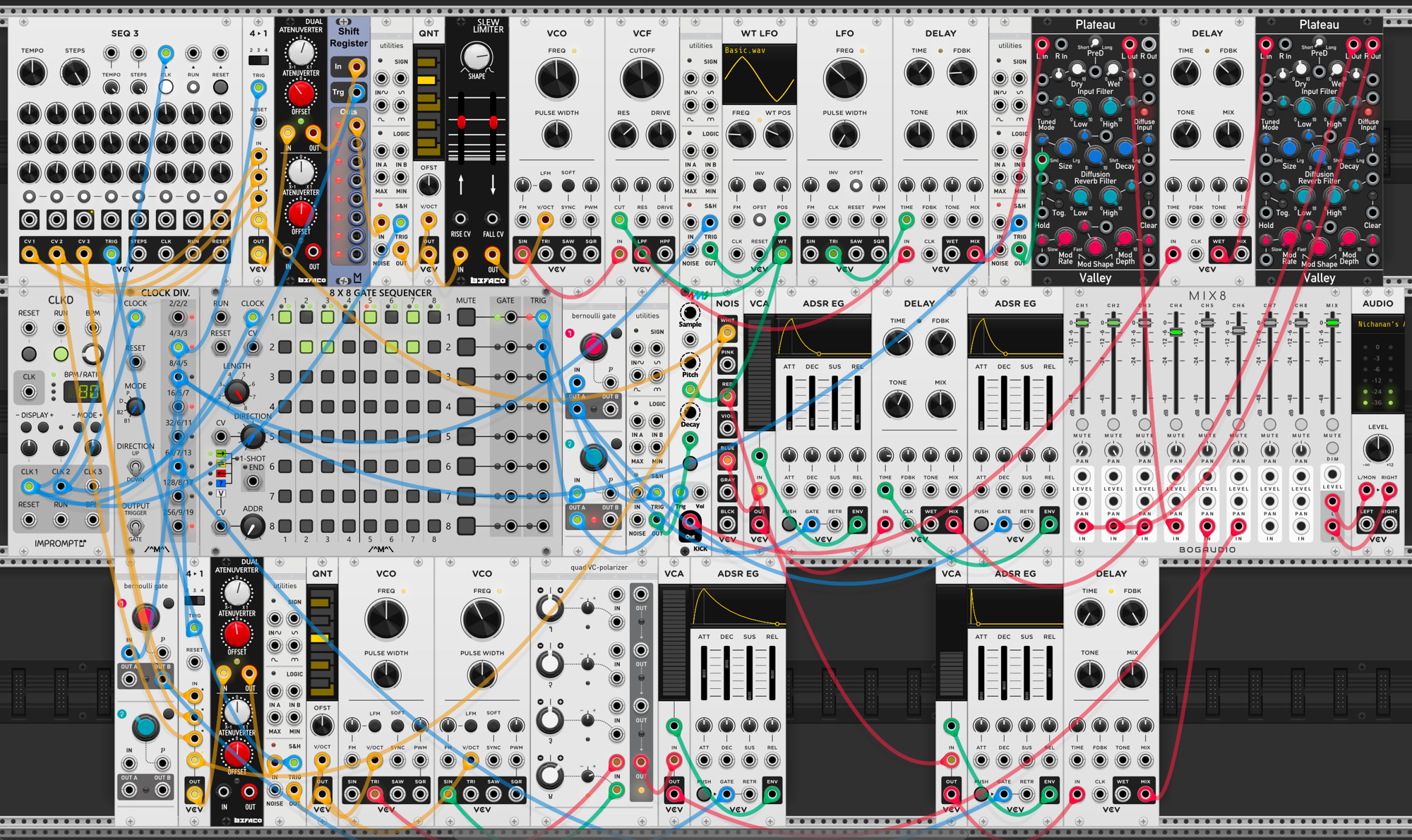
Ring mod bell voice. A second voice built from two VCOs through a quad VC-polarizer (ring mod), producing inharmonic metallic overtones. Both VCOs track the same quantizer set to a subset of locrian — root, flat 2, flat 5 — whose tritone (root to flat 5) never resolves, so every chime lands on unresolved dissonance. The second VCO is detuned to a non-integer ratio for cold, alien sum/difference frequencies. The ring mod output goes through a VCA shaped by an ADSR with near-zero attack and long decay — a bell struck and left to ring. A Bernoulli gate on a slow clock division triggers it sparsely, so the chime appears unpredictably against the continuous wind voice. A second ADSR and VCA shape a separate plucking sound — short, sparse transients that cut through the reverb wash. Both route through a delay into the MIX8 mixer, which replaced VCA MIX to accommodate the additional voices and panning.
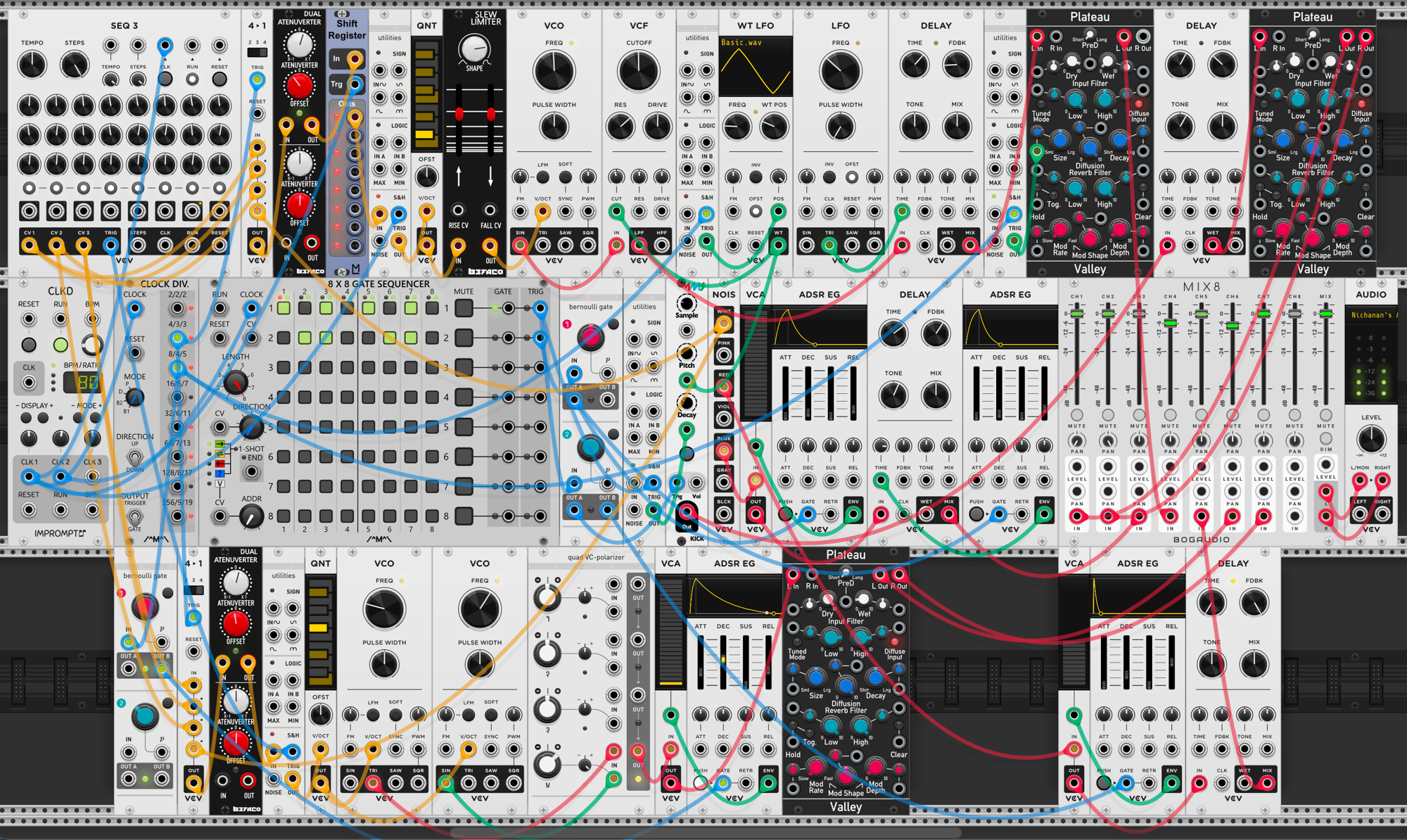
Bell reverb and tuning. The bell voice gets its own Plateau reverb — a third reverb instance in the patch. Each sound source lives in its own spatial treatment: the wind voice in one Plateau, the kick in another, the bell in a third. An S&H modulates a Plateau’s size so that reverb’s space shifts slowly over time rather than staying fixed. The bell’s VCO frequencies are lowered for a deeper, more ominous metallic tone rather than a bright chime.
Reflection
First patch built from an intention. The gap between “thriller suspense” as a concept and the actual modules needed to produce it was larger than expected — translating an emotional quality into specific signal flow decisions (which scale, which clock rate, which modulation depth) is the goal here. The patch sounds rough but the approach works: start with a composed skeleton, then layer generative techniques on each axis (pitch, rhythm, timbre, space) until nothing repeats exactly. The weird quality is partly from having so many independent random sources. Next time, I will try fewer sources of randomness but let each one affect more parameters, so the patch feels more unified in its variation.