Clock Dividers & Polyrhythm
Clock divisions + boolean logic
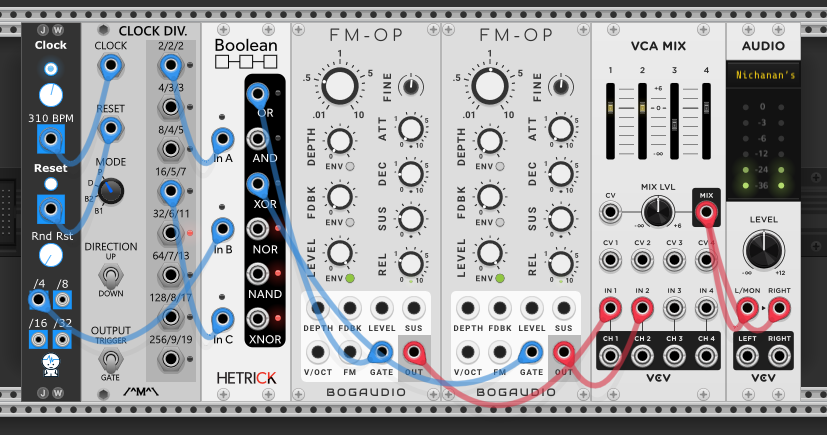
A clock feeds a Clock Div module. The /2 output from Clock Div goes to Boolean In A, and the /4 output from the master clock module goes to In B. The OR and AND outputs each gate a separate FM-OP voice.
The /2 division fires every other beat, /4 fires every fourth beat. OR produces a hit whenever either fires — every other beat, with the /4 hits already covered. AND only fires when both coincide — every fourth beat, since that’s where /2 and /4 align.
Using divisions that share common factors (/2 and /4) means they always re-align quickly — every 4th beat. Divisions without common factors create longer polyrhythmic cycles: /3 and /4 would align every 12 beats, /3 and /5 every 15 beats, /4 and /7 every 28 beats. The higher the least common multiple, the longer the pattern feels before it repeats. Prime-number divisions (like /5 and /7) produce the longest cycles relative to their values.
Clock modules also offer multiplication — generating faster clocks from a slower source (x2, x3, x4) for double or triple-time patterns, the complement to division’s slower subdivisions.
LFO-clocked two-voice patch
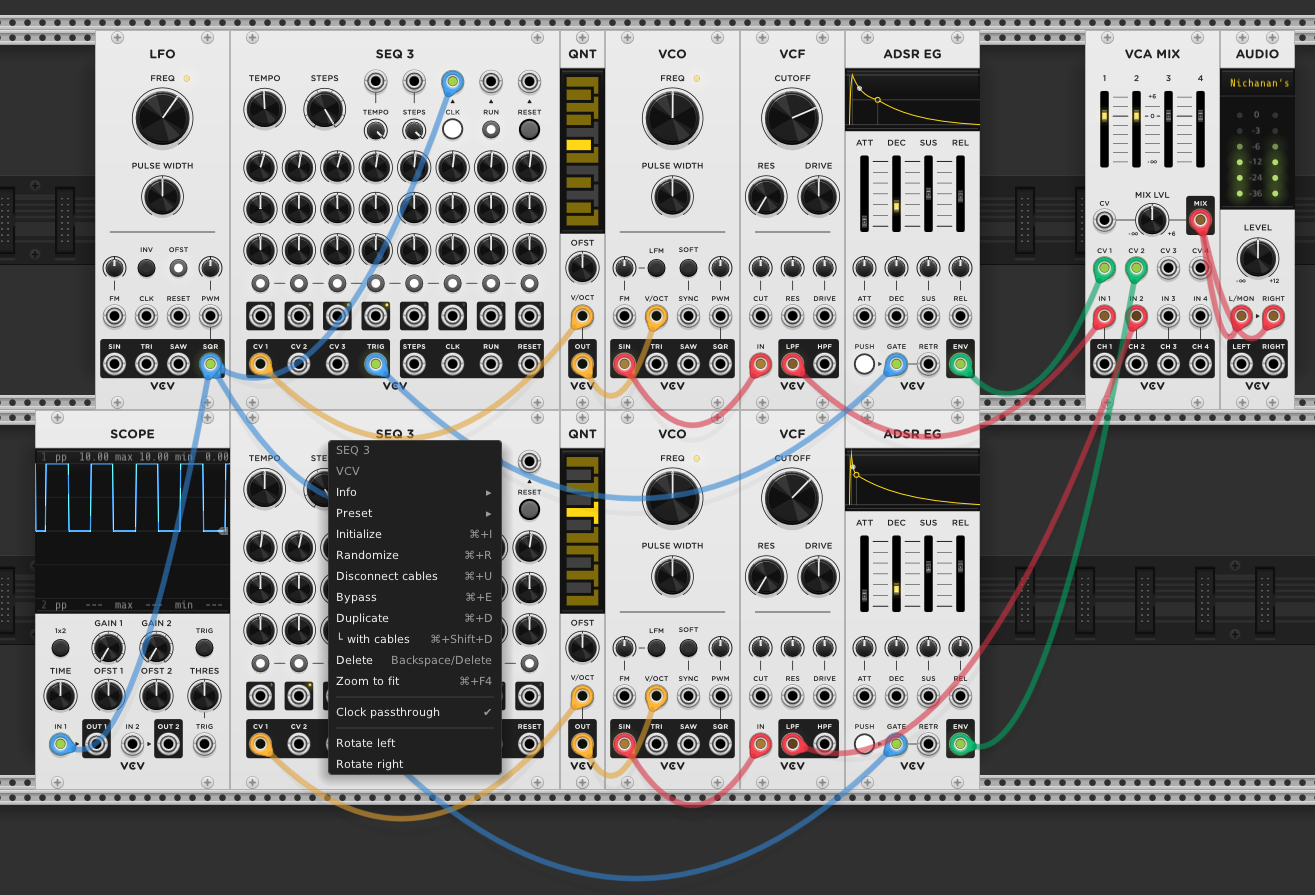
Two voices, each with the same signal chain: SEQ3 → QNT → VCO → VCF → ADSR EG → VCA MIX → Audio. An LFO’s square output clocks both SEQ3 modules. The LFO rate becomes the master tempo — turning the LFO frequency knob speeds up or slows down both sequences together.
Clock passthrough (right-click the SEQ3 to enable): when checked, the SEQ3 ignores its internal tempo knob and advances steps only when it receives an external clock pulse. Without this, the SEQ3 runs on its own clock and the external input just resets or syncs — not what you want when the LFO is meant to be the single clock source.
The scope shows the two voices’ waveforms. Each voice passes through a quantizer so the sequencer CV values snap to scale degrees — keeps both voices in tune even with rough knob settings on the SEQ3 rows.
Resetting sequencers + static voltage as clock
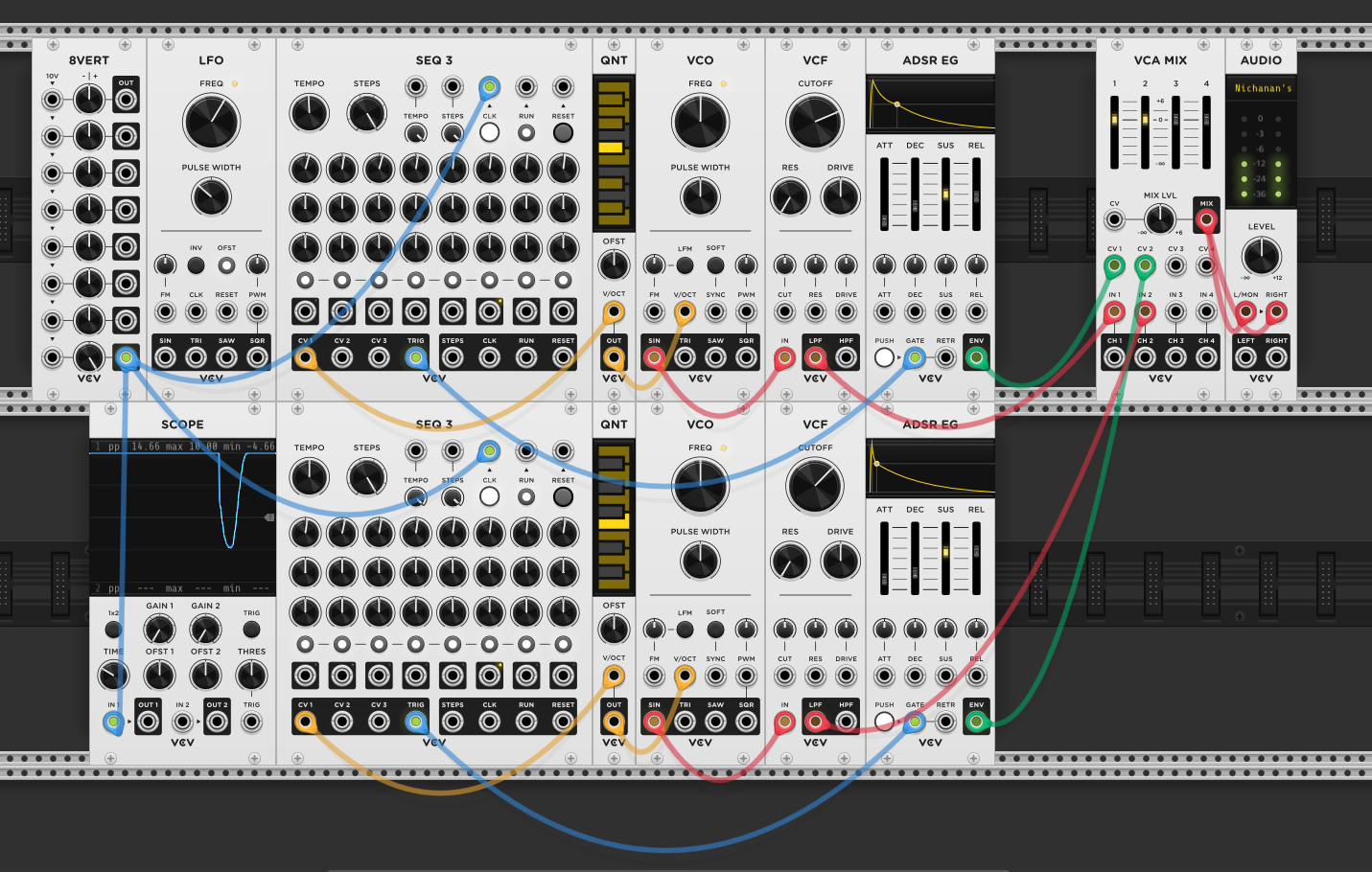
To sync both sequencers back to step 1, send a trigger to their RESET inputs. A Pulses module works for one-shot resets. Here the 8VERT (an offset/attenuverter) serves a different trick: sending a static voltage as a clock signal. The SEQ3’s CLK input is edge-triggered — it advances one step when the incoming voltage crosses a threshold on the way up. Turning an 8VERT knob from zero past that threshold counts as one rising edge, so the sequencer advances exactly one step. This gives manual, knob-controlled step-by-step advance — useful for auditioning what each step sounds like without the sequence running.
The 8th row of the SEQ3 controls this behavior — it’s the row patched to the TRIG output, providing the gate/trigger signal for the voice’s ADSR envelope on each step.
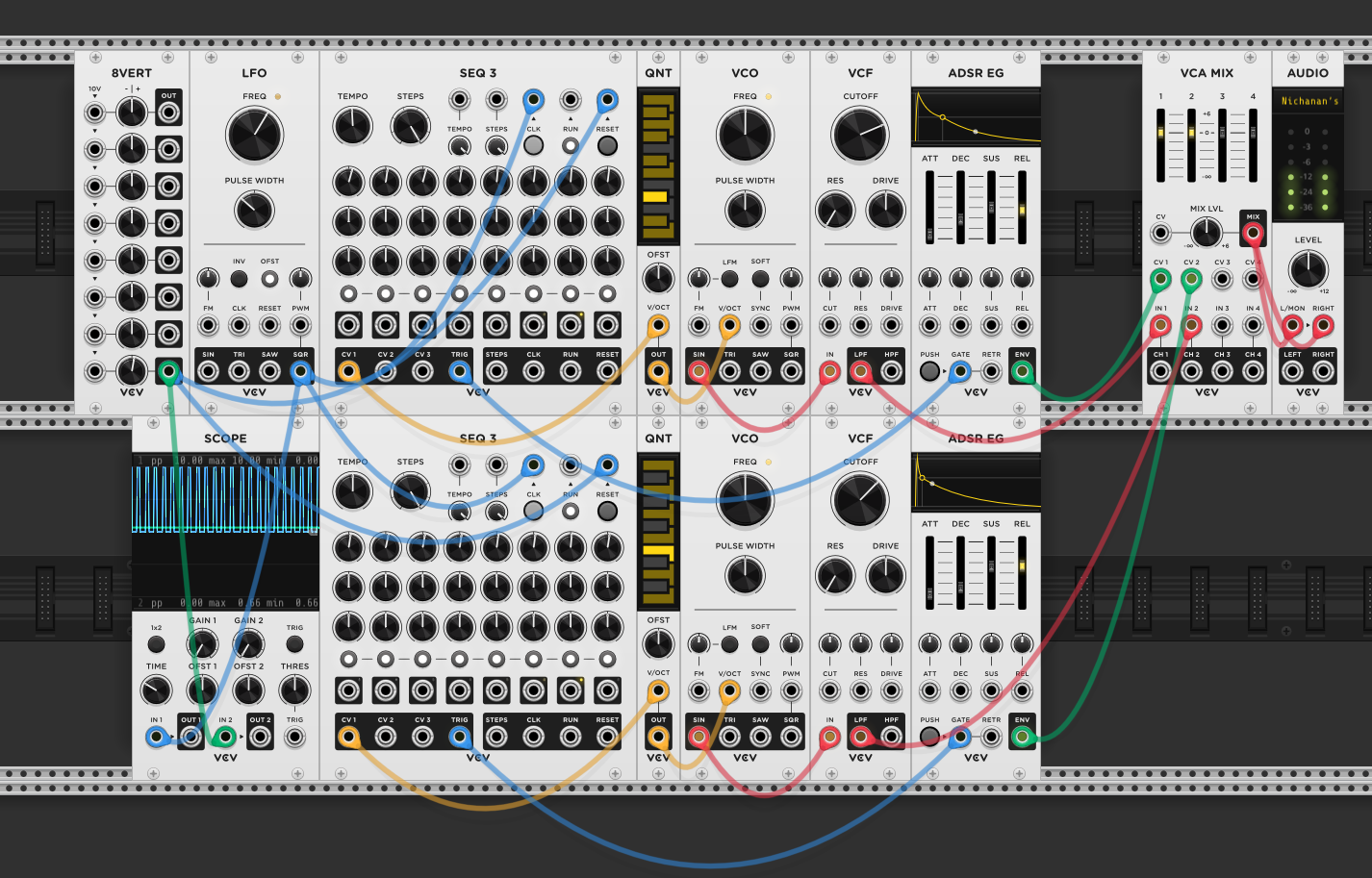
The same static-voltage trick works for reset: patch the 8VERT output to both SEQ3 RESET inputs. When the knob crosses the threshold, both sequencers jump back to step 1 simultaneously — instant sync. The LFO keeps clocking them forward from there in lockstep. This is useful when the two sequences have drifted out of phase (e.g. different step counts) and you want to re-align them on the fly.
LFO modulating filter cutoff — opposite polarity
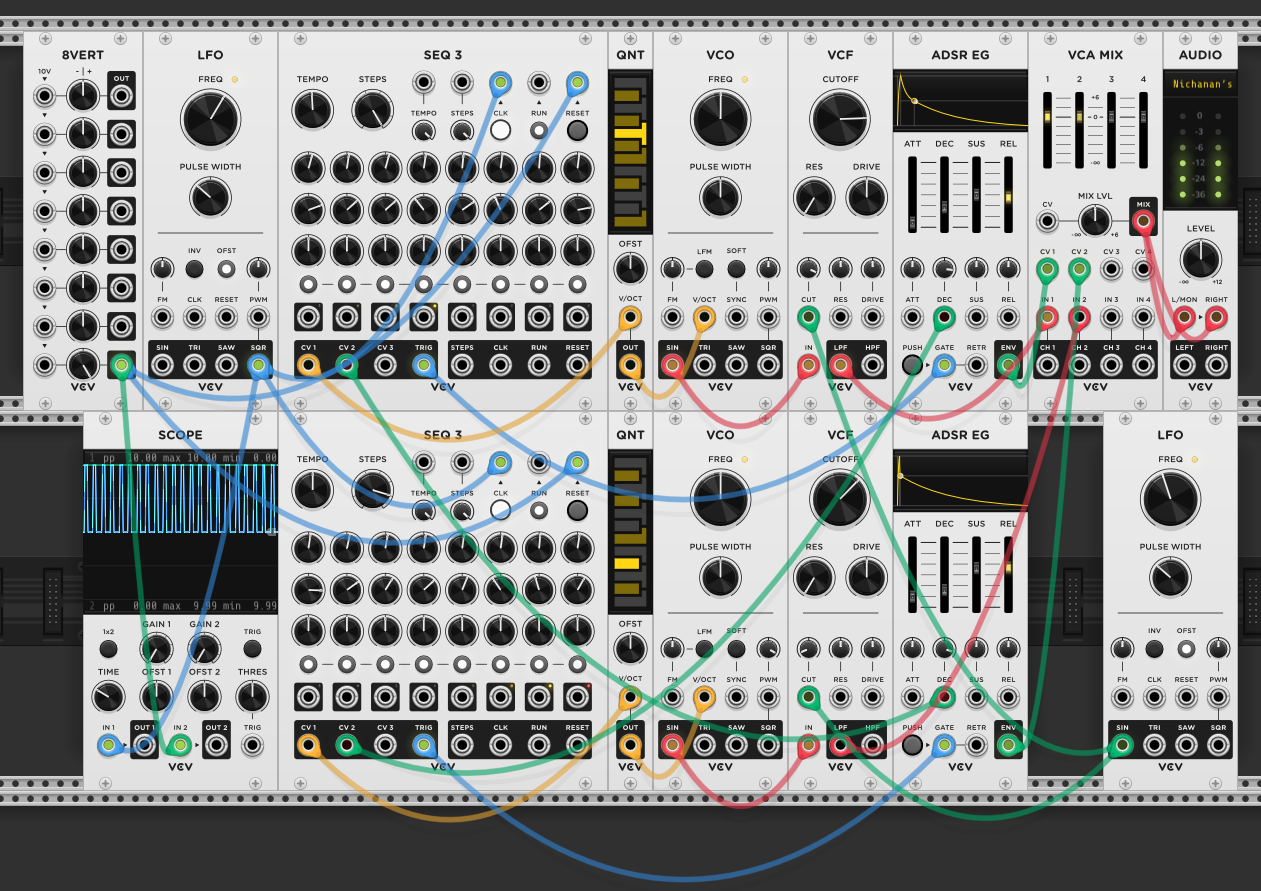
A second LFO (bottom right) sends its sine wave to both VCF cutoff inputs. The first voice receives the signal with positive polarity — as the sine rises, the cutoff opens and the sound brightens. The second voice receives it with negative polarity (inverted) — as the sine rises, its cutoff closes and the sound darkens. The two voices breathe in opposite directions: when one is bright and open, the other is muffled and closed, then they swap. This creates movement that feels wider than a single modulation source — the stereo field shifts as the timbres alternate.
Adding reverb — Plateau
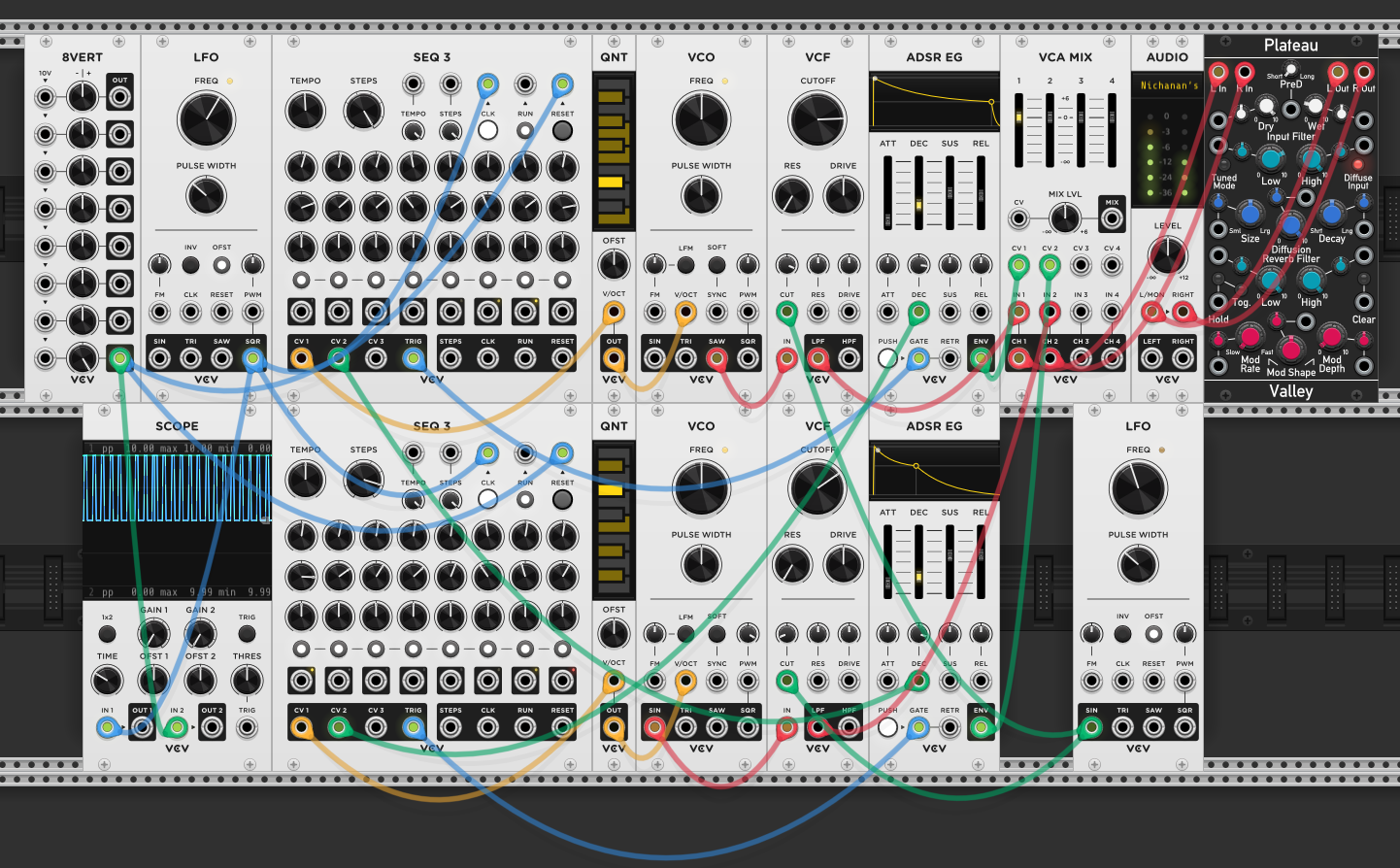
Plateau (by Valley) is a stereo reverb. The two voices from VCA MIX go to Plateau’s L and R inputs — one voice per channel — so each voice sits in its own side of the stereo reverb field. The reverb blends them in the tail while keeping the dry signals separated left and right. Combined with the opposite-polarity cutoff modulation, this gives the patch a sense of space: the two timbres alternate brightness in stereo, and the reverb tail lets them bleed into each other naturally rather than cutting off abruptly between steps.
Not yet explored: using clock dividers or variable-length sequencers to create deliberate irregular timing — swing, triplets, or uneven step durations. The sessions so far cover random irregularity (S&H, Comparator, probability) but not systematic, intentional unevenness. This is the difference between a groove that swings and a groove that wanders.