Oscillator Sync
Hard sync basics
Sessions 1-3 used subtractive synthesis — start with a harmonically rich oscillator and filter it down. Oscillator sync is a different approach to timbre: instead of removing harmonics, it creates new ones by forcing one oscillator to reset at another’s rate.
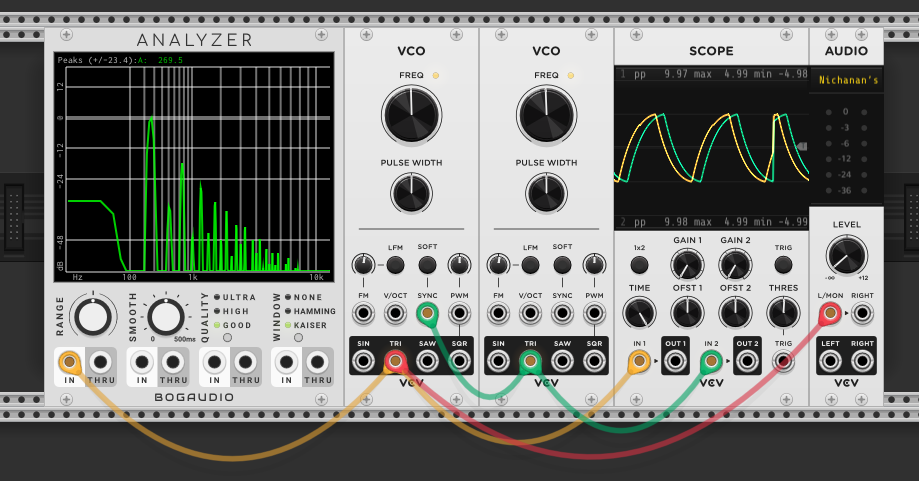
Two VCOs patched for hard sync. The right VCO is the primary (sets the pitch), the left VCO is the secondary (sets the timbre). The primary’s SQR output feeds the secondary’s SYNC input — every time the primary completes a cycle, the secondary’s waveform resets to the beginning, regardless of where it is in its own cycle.
The primary controls pitch, the secondary controls timbre. Changing the primary’s frequency changes the note you hear. Changing the secondary’s frequency changes the harmonic content — how bright or complex the sound is — without affecting the pitch.
The scope shows both: the yellow wave (primary) is a steady sawtooth. The green wave (secondary) has a more complex shape from the forced resets — incomplete cycles that create rich harmonic content. The analyzer confirms this: a strong fundamental with a dense spread of overtones.
The secondary’s frequency must be higher than the primary’s. If it’s lower, it resets before completing a full cycle, collapsing toward silence.
Hard sync vs soft sync: Hard sync forces a complete reset — the secondary snaps back to the start of its waveform on every primary cycle, regardless of where it is. This creates the aggressive, harmonically rich character. Soft sync is gentler — instead of resetting, the secondary’s waveform reverses direction (if it was rising, it starts falling). The result is subtler timbral variation without the hard discontinuities. Most sync sweep sounds use hard sync for the dramatic effect.
| From | To | Cable | Role |
|---|---|---|---|
| Right VCO SQR | Left VCO SYNC | green | Primary resets secondary on each cycle |
| Left VCO SAW | Scope IN 1 | green | Secondary waveform to scope |
| Right VCO SAW | Scope IN 2 | yellow | Primary waveform to scope |
| Left VCO SAW | Audio | red | Synced output to speakers |
Sweeping the secondary frequency
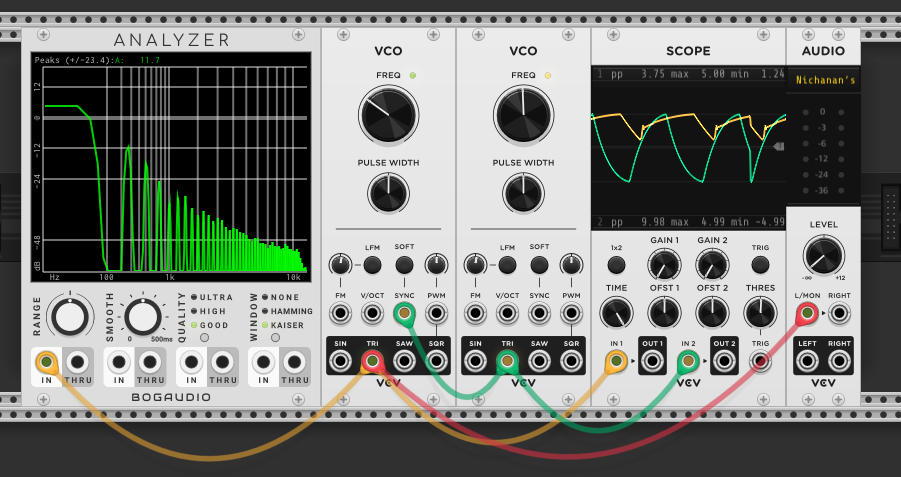
Lowering the secondary’s frequency brings it closer to the primary’s rate. It completes fewer cycles before each reset, so the waveform is simpler — fewer “teeth” per cycle. The analyzer shows fewer harmonics and the peak frequency drops. The sound is darker and more fundamental.
This is the range a sync sweep moves through: low secondary frequency = dark, simple tone. High secondary frequency = bright, harmonically rich. The classic sync sweep sound is just automating this frequency change with an envelope or LFO.
LFO sync sweep
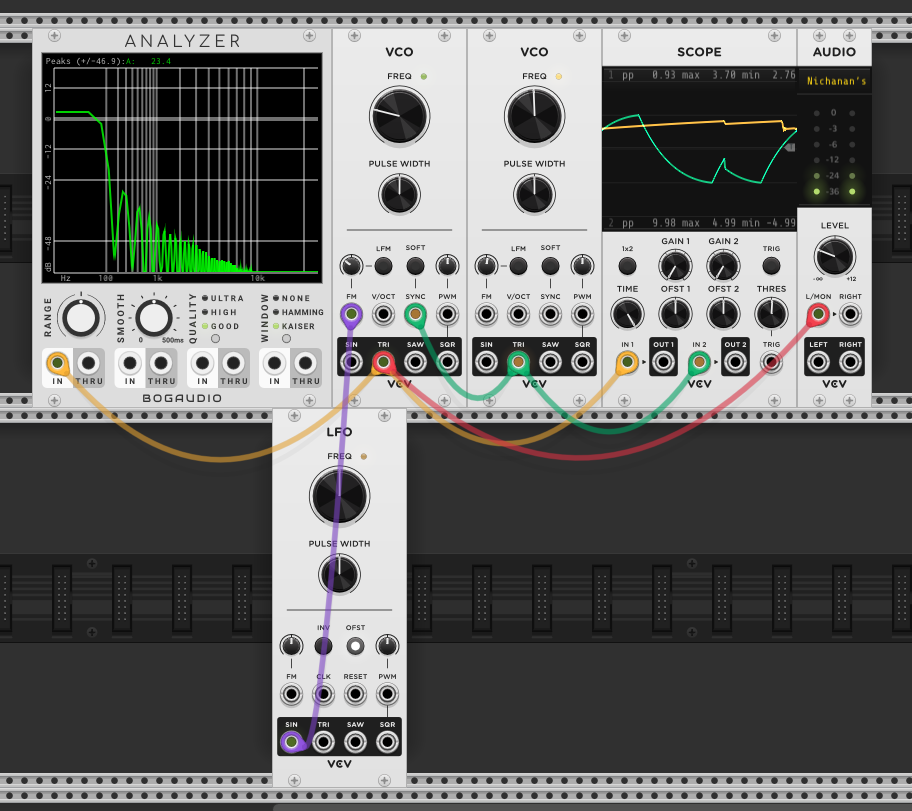
An LFO’s TRI output patched to the secondary VCO’s FM input (purple cable). The LFO continuously sweeps the secondary’s frequency up and down, cycling the timbre between bright and dark. The scope shows the green waveform constantly morphing as the harmonic content shifts. The analyzer is smeared — no stable spectrum because the harmonics are always moving.
The result is a buzzy, mosquito-like drone. The LFO rate controls how fast the timbre pulses. This is the free-running version of the sync sweep — it cycles regardless of whether notes are playing.
| From | To | Cable | Role |
|---|---|---|---|
| LFO TRI | Left VCO FM | purple | Sweeps secondary frequency continuously |
Envelope sync sweep
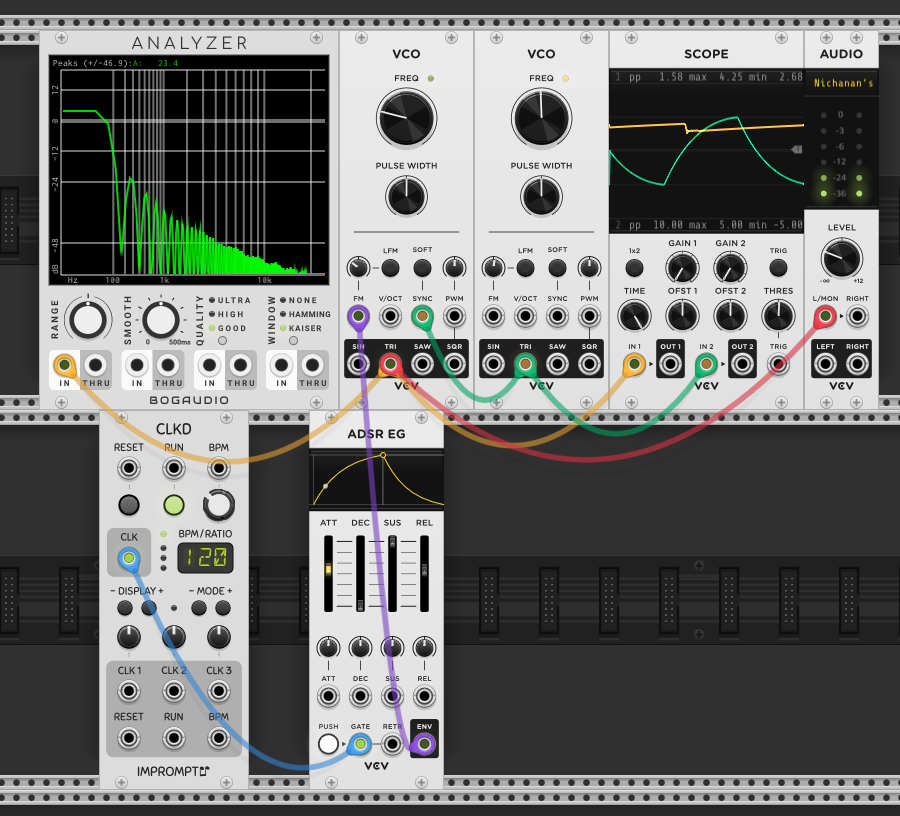
Replacing the LFO with a clock and ADSR. CLKD sends a gate to the ADSR (blue cable), and the ADSR’s envelope output feeds the secondary VCO’s FM input (purple cable). Each clock pulse fires the envelope once, sweeping the secondary’s frequency through the attack-decay-sustain-release shape — the timbre brightens and fades back on every beat.
The ADSR knobs shape the sweep’s character: fast attack with short decay gives a sharp “wow” per note, longer attack makes it swell, higher sustain holds the brightness. This is the same timbral range as the LFO version but event-driven — rhythmic and locked to the clock rather than free-running.
The comparison: LFO = continuous drone that buzzes regardless of timing. ADSR = per-note sweep that responds to the rhythm. Same modulation destination, completely different musical result — the same distinction from Session 1 (event-driven vs free-running) applied to oscillator sync.
| From | To | Cable | Role |
|---|---|---|---|
| CLKD CLK | ADSR GATE | blue | Clock triggers envelope on each beat |
| ADSR ENV | Left VCO FM | purple | Envelope sweeps secondary frequency per note |
Sync and exponential FM
Oscillator sync can also stabilize exponential FM — syncing the modulated oscillator to the modulator prevents the pitch drift inherent in exponential FM, giving harmonically related FM tones without tuning issues.