Noise-Based Percussion
Noise colors
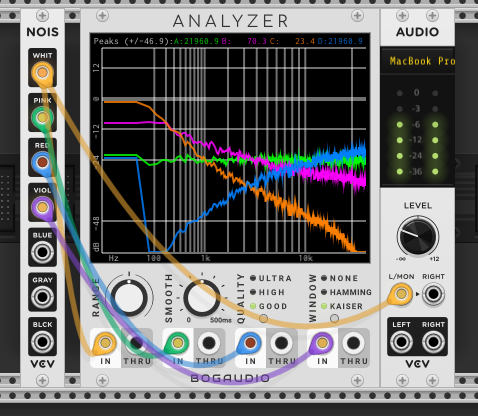
Bogaudio NOIS generates seven noise colors, each with a different frequency distribution visible as distinct spectral curves on the analyzer.
White — bright, hissy, static-like. Equal energy at every frequency — flat line on the analyzer. The densest, most present sound.
Pink — fuller, warmer, more natural. Energy rolls off 3dB per octave toward the highs — gentle downward slope. Sounds more balanced to the ear than white, like a waterfall or steady rain.
Red (brownian) — deep, rumbly, thunderous. Rolls off 6dB per octave — steeper downward slope. Dominated by low frequencies, like distant thunder or heavy wind.
Blue — thin, bright, airy. The inverse of pink — energy increases 3dB per octave. The analyzer slopes upward toward the highs.
Violet — harsh, fizzy, sizzling. The inverse of red — energy increases 6dB per octave. Steeply upward-sloping. The most high-frequency-heavy noise.
Gray — perceptually flat. Shaped to match equal-loudness contours, so it sounds equally loud across the spectrum even though the analyzer shows a curve.
Black — near-silence. Almost no energy at any frequency.
The colors form a spectrum: red → pink → white → blue → violet, from bass-heavy to treble-heavy, with white as the flat midpoint. For percussion synthesis, this matters — white and blue noise supply the sizzle for hi-hats and snare tops, while red noise provides kick rumble and body.
Noise as modulation source
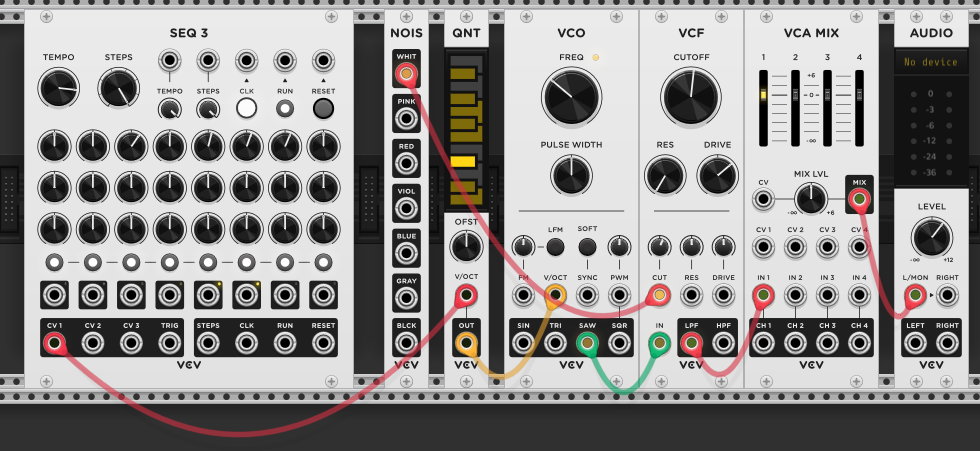
A sequenced voice: SEQ 3 → QNT → VCO sawtooth → VCF → VCA MIX → audio. The white noise output is patched into the filter’s cutoff CV input — instead of being heard as audio, the noise is a control signal that randomizes the cutoff frequency.
The result: the filter cutoff jitters on every sample, adding a rough, gritty, unstable texture to the filtered sawtooth. The cutoff knob sets the center point, and the noise pushes it randomly above and below that center. Different noise colors would produce different modulation characters — white noise jitters fast and evenly, pink would be slower and smoother, red would create a more lumbering, wandering drift.
This is the broader principle: noise is voltage, and any voltage can be a modulation source. Patch it to cutoff for filter grit, to pitch for detuning/drift, to pulse width for timbral instability. Anywhere a CV input accepts a cable, noise can inject randomness.
Two distinct uses for noise in a patch:
- Noise as modulation (CV): what this patch demonstrates. The noise controls a parameter — cutoff, pitch, pulse width. You don’t hear the noise itself, you hear its effect on the sound. Small amounts add analog-style imperfection and drift. Noise → pitch makes an oscillator wander slightly, mimicking the instability of real analog circuits.
- Noise as audio: mix the noise output directly into the signal path alongside an oscillator. The noise adds broadband energy to the sound itself — blend white noise with a sawtooth for a breathier, airier texture, or with a sine for a whispered quality. This is how snare drums and hi-hats get their character: the noise is the sound, shaped by filters and envelopes.
Synthesized kick drum — sine + envelope
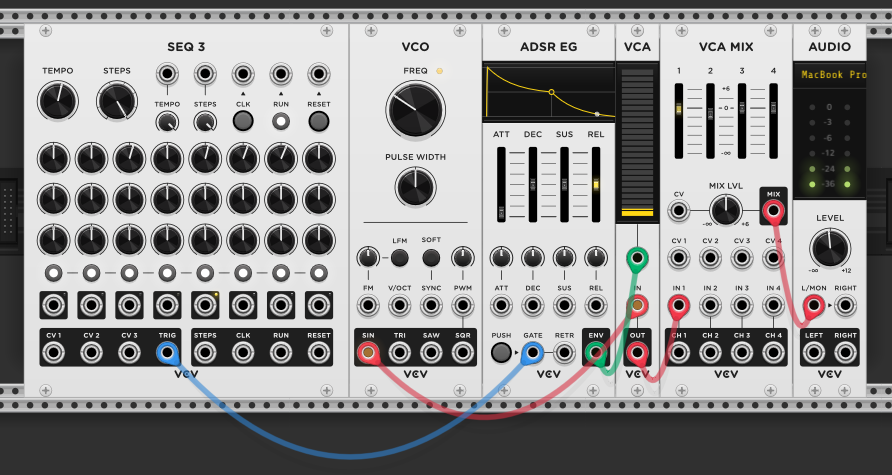
Before adding noise to a percussion voice, start with the tonal foundation. A kick drum is mostly a low-frequency thump — noise comes later for snare rattle and hi-hat shimmer.
The simplest synthesized kick: a low-frequency sine wave through a VCA, shaped by an ADSR envelope triggered from SEQ 3.
The ADSR attack must be low (session 3 — gate duration shapes the envelope). The sequencer’s trigger is short — if the attack is too slow, the envelope doesn’t reach its maximum voltage before the gate ends, so the kick is barely audible. Fast attack lets the full amplitude hit immediately, then the decay shapes the punch and body of the kick.
| From | To | Cable | Role |
|---|---|---|---|
| SEQ 3 TRIG | ADSR GATE | blue | Sequencer triggers envelope per step |
| VCO SIN | VCA IN | red | Low sine wave as kick body |
| ADSR ENV | VCA CV | green | Envelope shapes amplitude — fast hit, controlled decay |
| VCA OUT | VCA MIX IN 1 | red | To mixer |
| VCA MIX | AUDIO | red | Output |
Kick with pitch sweep — two envelopes
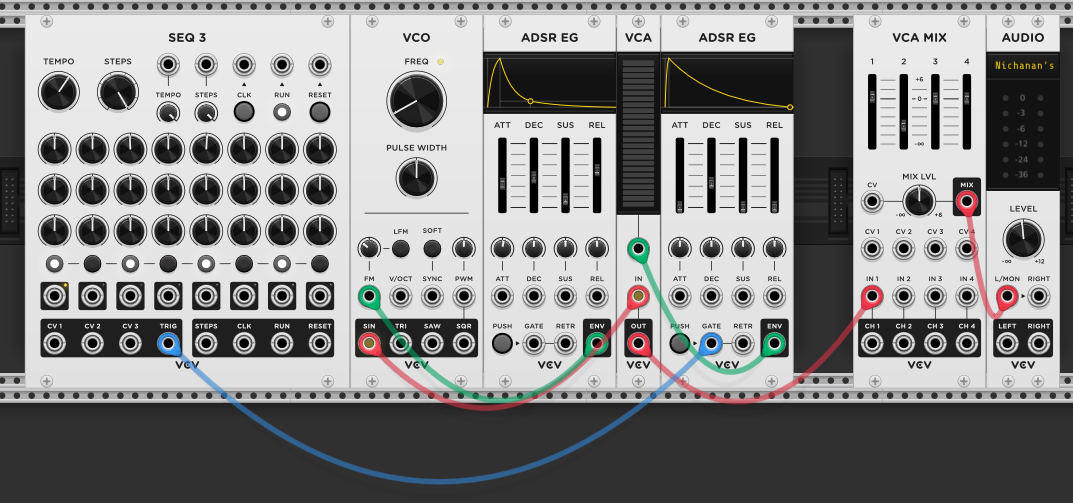
Same kick concept, but now with two independent envelopes both triggered by SEQ 3. Every second step of the 8-step sequencer is turned off to produce a four-on-the-floor pattern. The first ADSR modulates the VCO’s frequency (via FM input), the second modulates the VCA’s amplitude. This separates pitch contour from volume contour.
The first envelope creates a pitch sweep — the kick starts at a higher frequency and drops quickly. This is the characteristic “boing” of a synthesized kick. When the decay is too slow, the pitch drop is audible as a distinct downward slide. A fast decay makes the sweep happen so quickly that the ear perceives it as a percussive transient — a punchy attack rather than a tone bending down.
Two envelopes means independent control: the pitch envelope can have a very fast decay (snappy pitch drop) while the amplitude envelope has a longer decay (letting the low-frequency body ring out).
| From | To | Cable | Role |
|---|---|---|---|
| SEQ 3 TRIG | ADSR 1 GATE | blue | Triggers pitch envelope |
| SEQ 3 TRIG | ADSR 2 GATE | blue | Triggers amplitude envelope |
| ADSR 1 ENV | VCO FM | green | Pitch sweep — high to low on each hit |
| VCO SIN | VCA IN | red | Low sine as kick body |
| ADSR 2 ENV | VCA CV | green | Amplitude shape — attack and decay of the hit |
| VCA OUT | VCA MIX IN 1 | red | To mixer |
| VCA MIX | AUDIO | red | Output |
Adding a snare — same chain, different trigger pattern
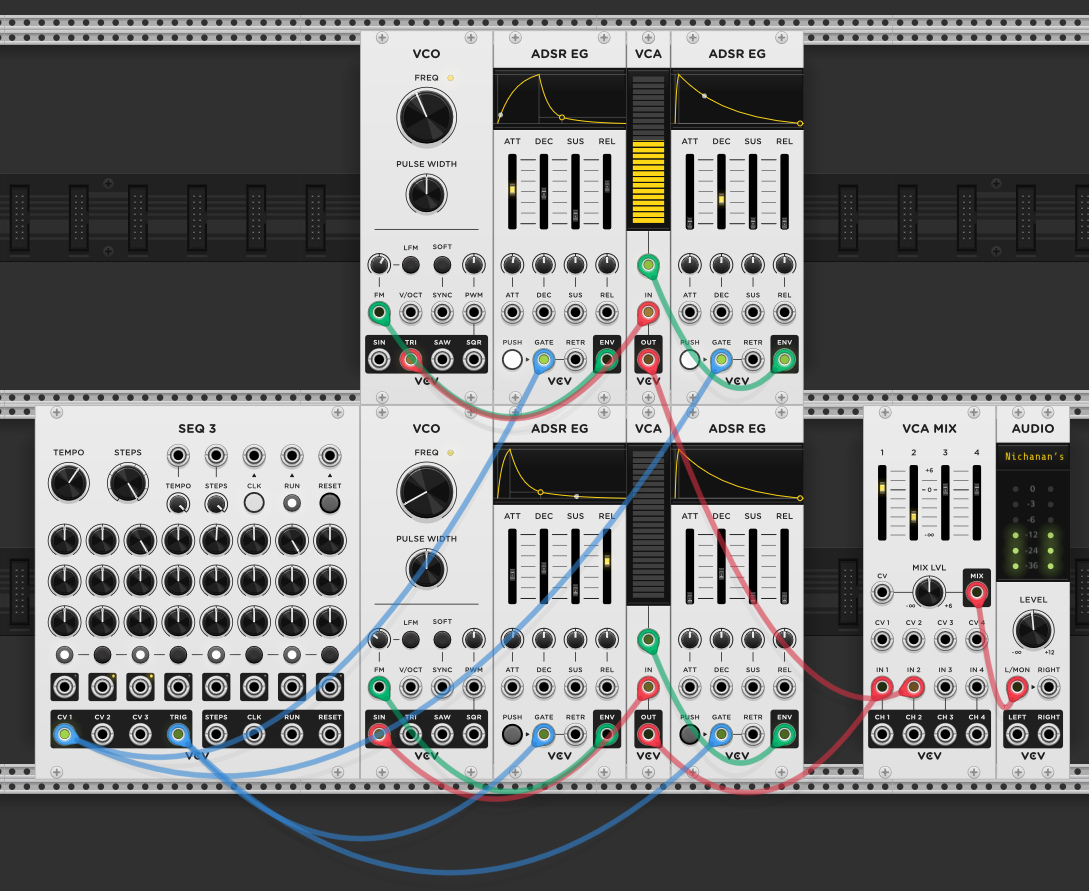
The snare uses the same signal chain as the kick: VCO → ADSR (pitch) → VCA → ADSR (amplitude). The SEQ 3’s CV1 output gates the snare envelopes. The 3rd and 7th steps of the CV1 row are turned up — this puts the snare on every second kick hit, producing a backbeat pattern (snare on beats 2 and 4 in 4/4 time).
The sequencer is doing double duty: its TRIG output fires the kick on every other step (four-on-the-floor), while its CV1 row selectively gates the snare on a subset of those steps. One sequencer, two independent rhythmic patterns.
The snare’s VCO is set to a higher frequency than the kick’s — snares have a higher-pitched tonal component. Both chains feed into the VCA MIX. At this point the snare is still a pure sine with a pitch sweep — it doesn’t sound like a real snare yet. That comes from adding noise.
Noise layer for the snare
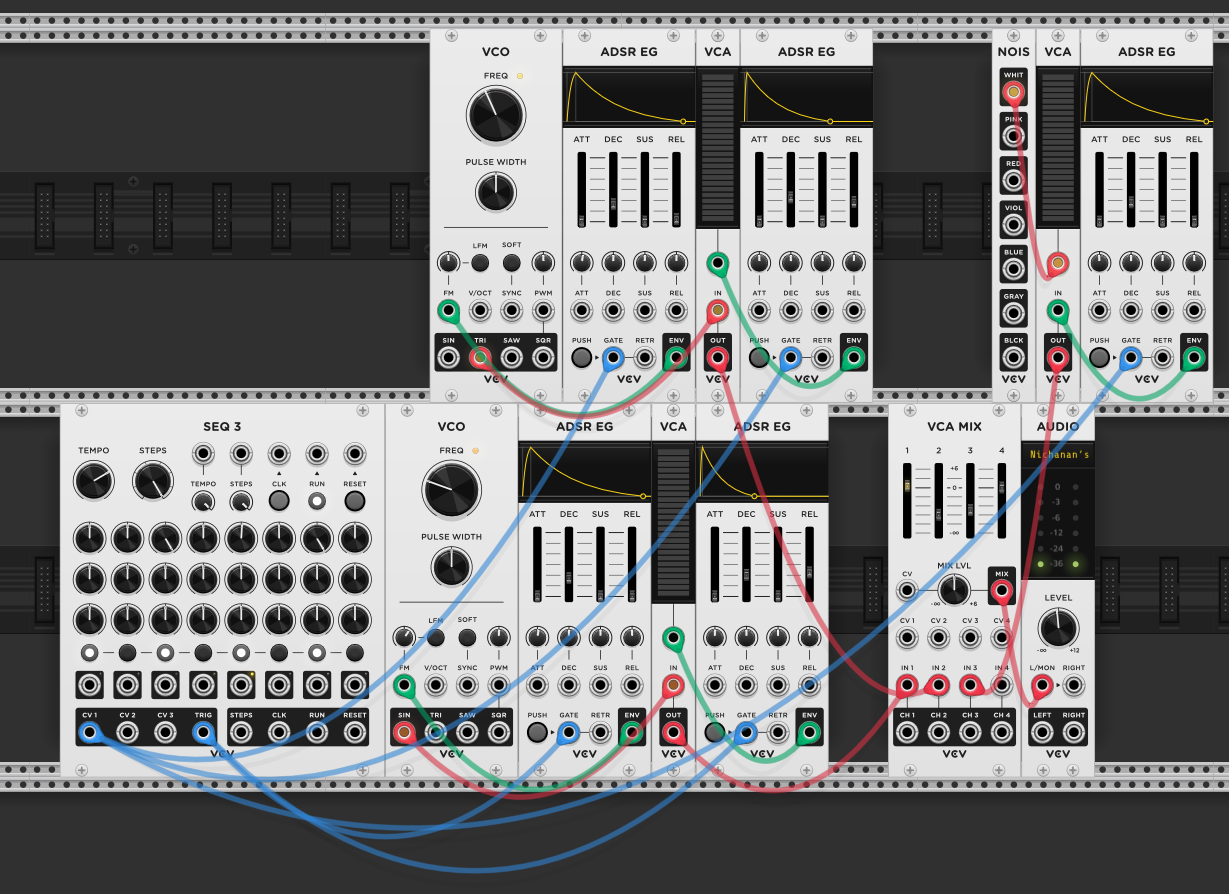
A NOIS module is added with its white noise output routed through its own VCA and ADSR — a separate amplitude chain just for the noise. This ADSR is gated by the same CV1 output that triggers the snare’s tonal chain, so the noise and the sine body hit at the same time.
This is noise as audio — the white noise adds the metallic, sizzling character that makes a snare sound like a snare. The sine provides the body (the low thump), the noise provides the snap and rattle. The noise ADSR can be shaped independently: a shorter decay gives a tight, crisp snare; a longer decay gives a looser, rattling sound.
The full drum kit is now three voices from one sequencer:
- Kick (bottom row): low sine + pitch sweep, triggered by TRIG on steps 1, 3, 5, 7
- Snare body (top-left): higher sine + pitch sweep, triggered by CV1 on steps 3, 7
- Snare noise (top-right): white noise shaped by its own envelope, same CV1 trigger as the snare body
Hi-hat — filtered noise with sequencer control
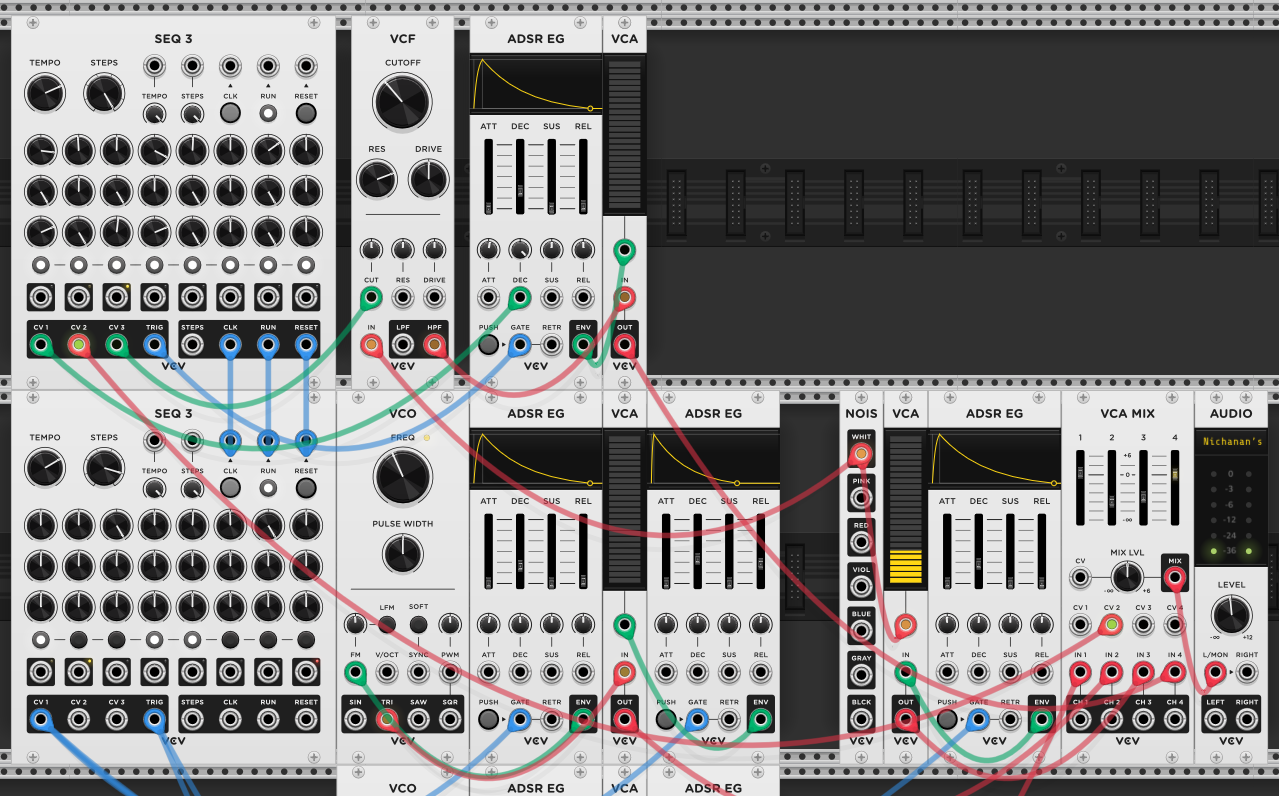
A second SEQ 3 is added for the hi-hat (top row), separate from the kick/snare sequencer (bottom). The kick/snare sequencer is changed from 8 to 7 steps while the hi-hat runs on 8 — different lengths mean the two patterns phase against each other, so the rhythmic relationship shifts on every cycle.
The hi-hat signal chain: NOIS white output → VCF (high-pass filter) → VCA → mixer. A high-pass filter is the right choice here — it strips out the low frequencies and keeps only the bright, metallic shimmer that makes a hi-hat sound like a hi-hat. This is the first time a filter appears in the drum kit: the kick and snare used raw sine waves and unfiltered noise, but the hi-hat needs the spectral shaping.
The hi-hat sequencer’s three CV rows each control a different parameter:
- CV1 → ADSR decay: varies the envelope length per step — short decay for closed hi-hats, longer decay for open hi-hats, all from the same sequence
- CV2 → VCA MIX CV input: controls the volume per step, adding accent and dynamics to the pattern
- CV3 → VCF cutoff: shifts the filter cutoff per step, so the brightness of the hi-hat changes across the pattern
This is the sequencer used as a per-step parameter controller — the same technique from Session 2, now applied to three parameters simultaneously. Each step doesn’t just trigger the hi-hat, it shapes how that hit sounds.
| From | To | Cable | Role |
|---|---|---|---|
| Hi-hat SEQ 3 CLK | Kick/snare SEQ 3 CLK | blue | Shared clock |
| Hi-hat SEQ 3 RUN | Kick/snare SEQ 3 RUN | blue | Shared run |
| Hi-hat SEQ 3 RESET | Kick/snare SEQ 3 RESET | blue | Shared reset |
| SEQ 3 TRIG | ADSR GATE | blue | Triggers hi-hat envelope |
| SEQ 3 CV1 | ADSR DEC | green | Varies decay per step — open vs closed hi-hat |
| SEQ 3 CV2 | VCA MIX CV | red | Volume accent per step |
| SEQ 3 CV3 | VCF CUT | green | Brightness per step |
| NOIS WHIT | VCF IN | red | White noise into high-pass filter |
| VCF HPF | VCA IN | red | Filtered noise to VCA |
| ADSR ENV | VCA CV | green | Envelope shapes amplitude |
| VCA OUT | VCA MIX | red | To mixer |