Karplus Strong
Karplus Strong Synthesis
Just as pinging a filter excites its resonance to create percussive sounds, Karplus Strong excites a delay line to create string-like textures. The principle: send a short burst of noise into a delay with high feedback and a short delay time. The noise excites the delay, which recirculates the signal — each pass through the feedback loop slightly dampens the sound, and the result is a decaying tone that sounds like a plucked string.
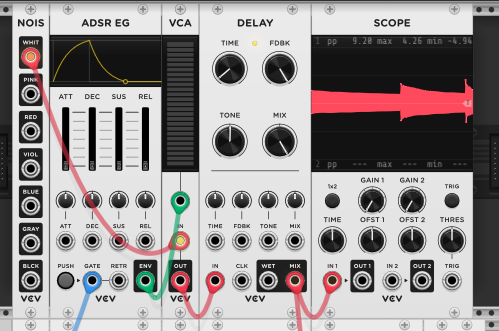
Two parameters control the sound: delay time sets the pitch — shorter delay = higher frequency, because the signal completes its feedback loop faster. Feedback controls the decay time — higher feedback means the signal recirculates longer before dying out, like a string that rings longer. At maximum feedback the tone sustains indefinitely; backing it off gives a natural pluck-and-decay envelope without needing an external envelope generator.
The noise color shapes the timbre of the pluck — white for a bright, crisp string, pink for a darker and warmer pluck, red for a muffled nylon-string character. The noise is the excitation source, so it determines what frequencies are present in the initial burst before the delay filters them through repetition.
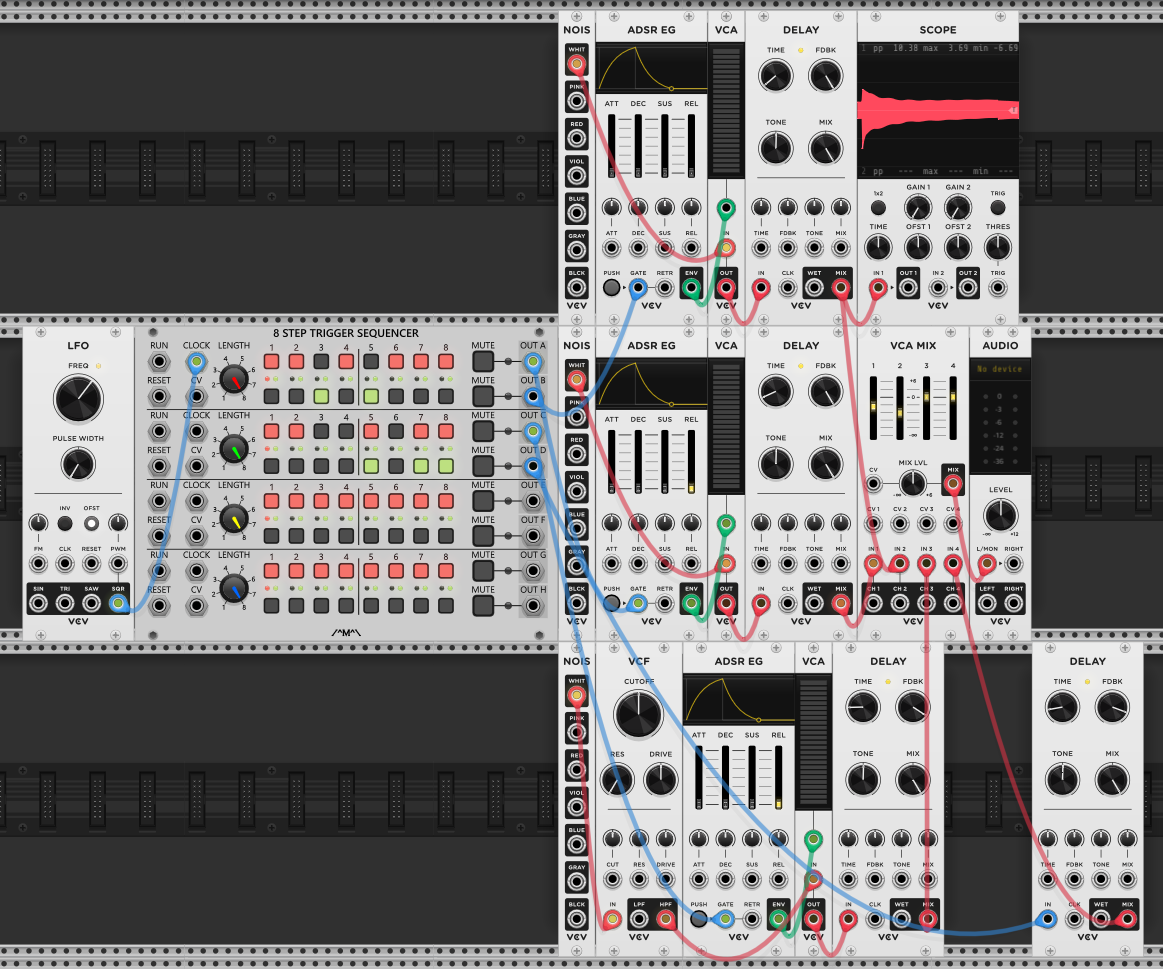
Multiple Karplus Strong voices can be layered with different noise colors and independent rhythms using separate rows of a trigger sequencer — each row gates a different voice, so the bright and dark strings interleave in the pattern.
Instead of using a noise → VCA → delay chain, triggers can also excite the delay directly — the trigger pulse itself is the burst of energy that the delay recirculates. This is simpler but requires reducing the pulse width on the LFO (clock source), otherwise the gate’s rising and falling edges each excite the delay separately, producing a double-plucked sound. A narrower pulse gives a clean single pluck. This is the same gate-vs-trigger issue as with pinging filters.
The bottom voice in this patch also adds a VCF before the delay, filtering the noise excitation for yet another timbral variation — shaping what frequencies enter the delay loop changes the character of the resulting string.
The delay’s tone knob (session 15) acts as a low-pass filter inside the feedback loop. In a Karplus Strong context this is critical: each time the signal recirculates, the tone filter shaves off high-frequency content — so the sound darkens as it decays, just like a real plucked string where the high harmonics die out first and the fundamental rings longest. Turning tone down gives a duller, more nylon-like decay; leaving it open gives a brighter, steel-string character.
What it sounds like: at very short delay times with high feedback, the sound is a tight, metallic pluck — almost like a harpsichord or kalimba. Lengthening the delay time lowers the pitch and softens the attack into something more guitar-like. With moderate feedback, each pluck rings for a beat or two and fades naturally. At maximum feedback the tone sustains indefinitely — bowed rather than plucked. Reducing feedback to near minimum gives a short, percussive tick with barely any pitch. The envelope on the noise burst controls the “hardness” of the pluck — a very short burst (fast attack, fast decay) gives a sharp, precise attack; a slightly longer burst gives a softer, fingerpicked quality.
Karplus Strong is a form of physical modelling — instead of synthesizing a waveform directly (subtractive, FM, AM), it simulates the physical behavior of a vibrating string. The delay line models the string’s length, the feedback models the string’s energy retention, and the tone filter models the damping that causes high frequencies to decay faster than low ones. Like self-oscillating filters, no oscillator is involved — the pitch emerges entirely from the delay time.