AM and Ring Modulation
Amplitude Modulation
AM — amplitude modulation — means one signal modulating the amplitude (volume) of another. Like FM, the effects range from subtle to extreme depending on the modulation rate.
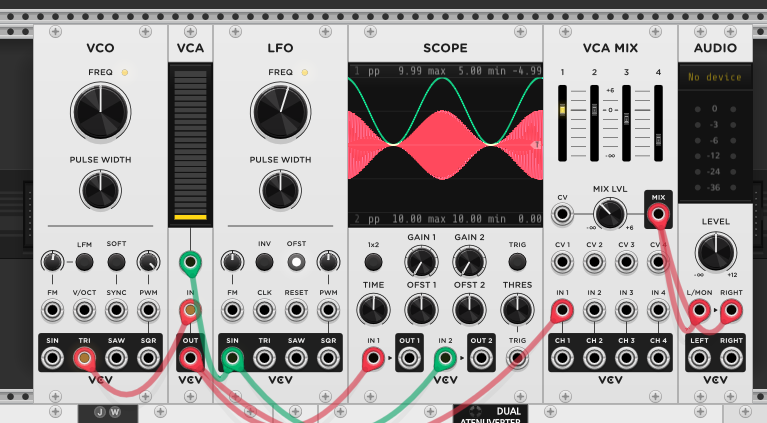
At LFO rate, an LFO modulating a VCA’s amplitude creates tremolo — a periodic variation in volume where the sound swells and fades rhythmically. (As opposed to vibrato, which is periodic variation in pitch — see session 13 for vibrato with velocity and mod wheel.)
The modulation signal can be bipolar (swinging above and below zero) or unipolar (staying positive). With a unipolar modulator (using the LFO’s offset), the amplitude smoothly rises and falls — true tremolo. With a bipolar modulator, the signal pinches to zero at the crossover point and then inverts — the waveform flips phase each time the modulator crosses zero. This bipolar behavior is what distinguishes ring modulation from AM.
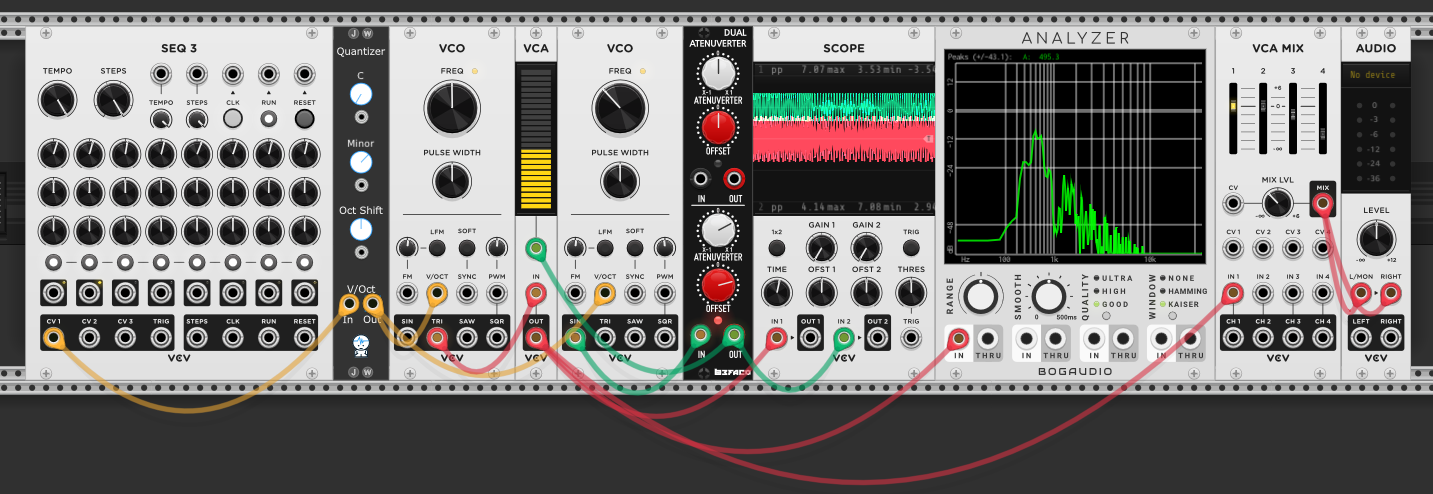
A basic VCA has no attenuation on the incoming control voltage, so the tremolo depth is fixed at whatever the modulator outputs. Routing the modulation signal through a dual attenuverter first gives two controls: the attenuverter knob sets the tremolo depth (how much the amplitude swings), and the offset knob shifts the signal into the positive range so the modulation stays unipolar. Standard VCAs only respond to positive voltages (0V and above) — a bipolar LFO’s negative half produces silence, not inverted signal. Offsetting into unipolar range ensures the VCA stays open throughout the modulation cycle. This keeps the sound from cutting out or inverting at the bottom of each cycle — just a smooth volume swell whose intensity you can dial in. Since VCOs output bipolar signals by default, this offset step is essential for predictable AM — without it, the modulation swings into the VCA’s unresponsive negative range.
Increasing the modulator from LFO rate to audio rate crosses the same threshold as in FM synthesis — the modulation is too fast to hear as a rhythmic volume change, and instead creates new frequencies. The analyzer shows sidebands appearing around the carrier’s fundamental. With AM, these sidebands are the sum and difference of the carrier and modulator frequencies. The scope shows the amplitude envelope tightening into a dense pattern as the modulation cycles happen hundreds of times per second. Importantly, the carrier’s fundamental stays put — in this case at 250 Hz, visible as the tallest spike on the analyzer. AM adds sidebands around it but doesn’t shift the perceived pitch.
What it sounds like: at low modulator frequencies, AM is a gentle pulse in volume — like someone slowly turning the volume knob back and forth. As the modulator frequency rises into the tens of Hz, the pulsing becomes a buzzy flutter. At audio rate, the individual pulses fuse into a new timbre — the sound gains a nasal, hollow quality as the sidebands become audible. Increasing the modulator frequency spreads the sidebands further from the fundamental, making the sound thinner and more metallic. Increasing the modulation depth (via the attenuverter) makes the sidebands louder relative to the fundamental — at full depth the sidebands dominate and the sound becomes harsh and buzzy; at low depth they’re subtle undertones.
When sequencing an AM voice, the same rule applies as with FM: send V/OCT to both oscillators so the carrier and modulator track the same pitch. Here, SEQ3 goes through a quantizer (C minor) into both VCOs’ V/OCT inputs. Without this, the sideband frequencies would drift relative to the carrier as the sequence moves, and the timbre would change unpredictably across notes.
Ring Modulation
Ring modulation is another form of AM, but where AM stays in positive voltages (unipolar), ring mod operates with the full bipolar signal — the modulator swings into negative voltages, inverting the carrier when it goes below zero.
A voltage-controlled polarizer makes this possible. It’s also a VCA — it controls the amplitude of the signal passing through — but unlike a standard VCA, it responds to negative voltage too. At positive control voltage it lets the signal through normally, at negative control voltage it inverts the signal. The key feature is a CV input, so another signal can continuously modulate the polarity. This means a single module both modulates amplitude and flips the signal’s phase — modulation and inversion happening simultaneously, driven by the control voltage.
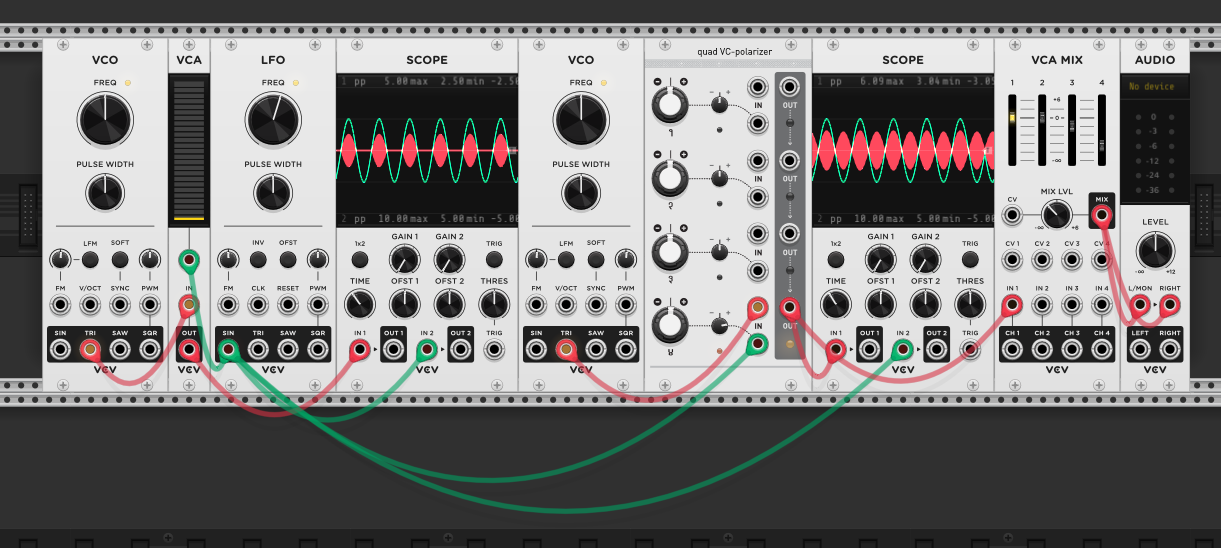
The difference from a VCA is visible on the scope. With the LFO modulating the polarizer’s CV input: when the LFO is positive, the triangle wave passes through normally. When the LFO crosses below zero, the signal doesn’t cut to silence like it would through a VCA — instead it passes through inverted. The signal never stops, it just changes polarity. Compare the two scopes side by side: the VCA version (left) has the carrier pinching to silence at the LFO zero crossing, while the polarizer version (right) keeps the carrier going continuously, flipping phase instead.
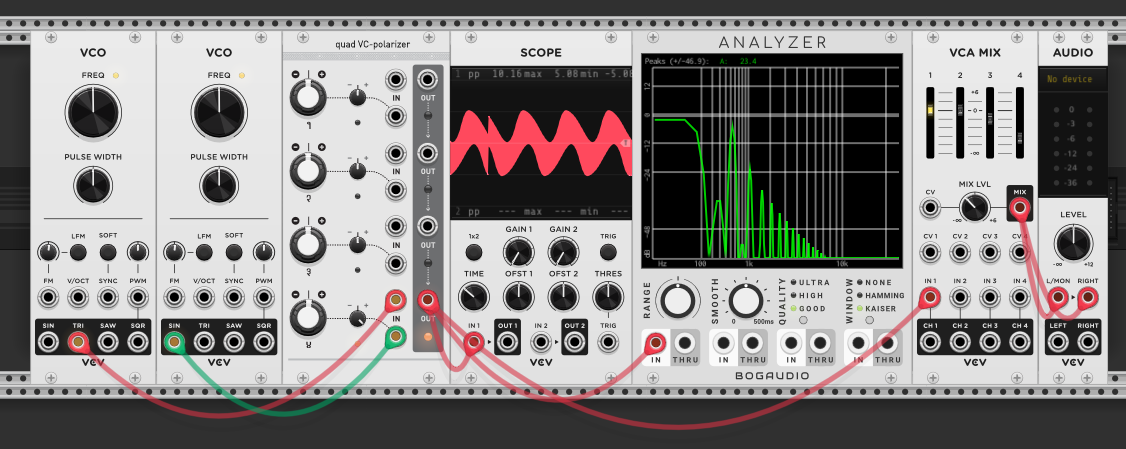
At audio rate, ring mod produces a different spectrum than AM. With AM, the carrier’s fundamental stays visible on the analyzer with sidebands flanking it. With ring mod, the fundamental disappears — only two peaks remain: one at the sum of the carrier and modulator frequencies, and one at the difference. No offset is needed on the polarizer since ring mod deliberately uses the full bipolar range. The absence of the fundamental is what gives ring mod its characteristically hollow, metallic, inharmonic sound — the original pitch is gone, replaced by two new frequencies that don’t relate to it in a simple harmonic way.
What it sounds like: ring mod at integer frequency ratios (1:1, 2:1, 3:1) produces sum and difference frequencies that fall on harmonically related pitches — the result sounds tonal but hollow, like a voice through a metal tube. At non-integer ratios (1.5:1, 2.7:1) the sum and difference frequencies land on inharmonic pitches — clangorous, bell-like, or alien. The further the ratio drifts from an integer, the more dissonant and metallic the sound becomes. At very close frequencies (nearly 1:1), the difference frequency drops low enough to hear as a slow beating — a wobbling amplitude effect similar to detuned unison.
Ring modulation is particularly effective on complex audio like voice recordings — modulating speech or vocals with an oscillator produces eerie, robotic, or alien-like textures as every frequency component in the voice generates its own sum and difference pair.
AM vs FM vs Ring Mod
All three create sidebands from two oscillators, but they differ in what survives:
- AM keeps the carrier’s fundamental and adds sum/difference sidebands around it. The original pitch is always audible. Good for adding brightness or nasal character while keeping the pitch clear.
- Ring mod removes the fundamental entirely — only sum and difference frequencies remain. The original pitch disappears, replaced by something inharmonic. Good for metallic, bell-like, or alien textures where you want to destroy the source pitch.
- FM creates a richer spectrum of sidebands (not just sum and difference, but multiples of them). The fundamental can shift or stay depending on FM type (exponential drifts, linear/through-zero stays). Good for complex timbres — everything from subtle brightness to dense, evolving textures. See session 16 for the three FM types.
When to use which: if you want the listener to hear a note with added timbral color, use FM or AM — both preserve a sense of pitch. FM gives a wider timbral range (from subtle brightness to dense, evolving textures) but is harder to control, especially exponential FM’s pitch drift. AM is simpler and more predictable — good for brightening a voice or adding shimmer without obscuring the note. If you want the listener to hear a texture rather than a pitch — metallic hits, alien sounds, clangorous bells — reach for ring mod.
Patching AM: Bell Tone Voice
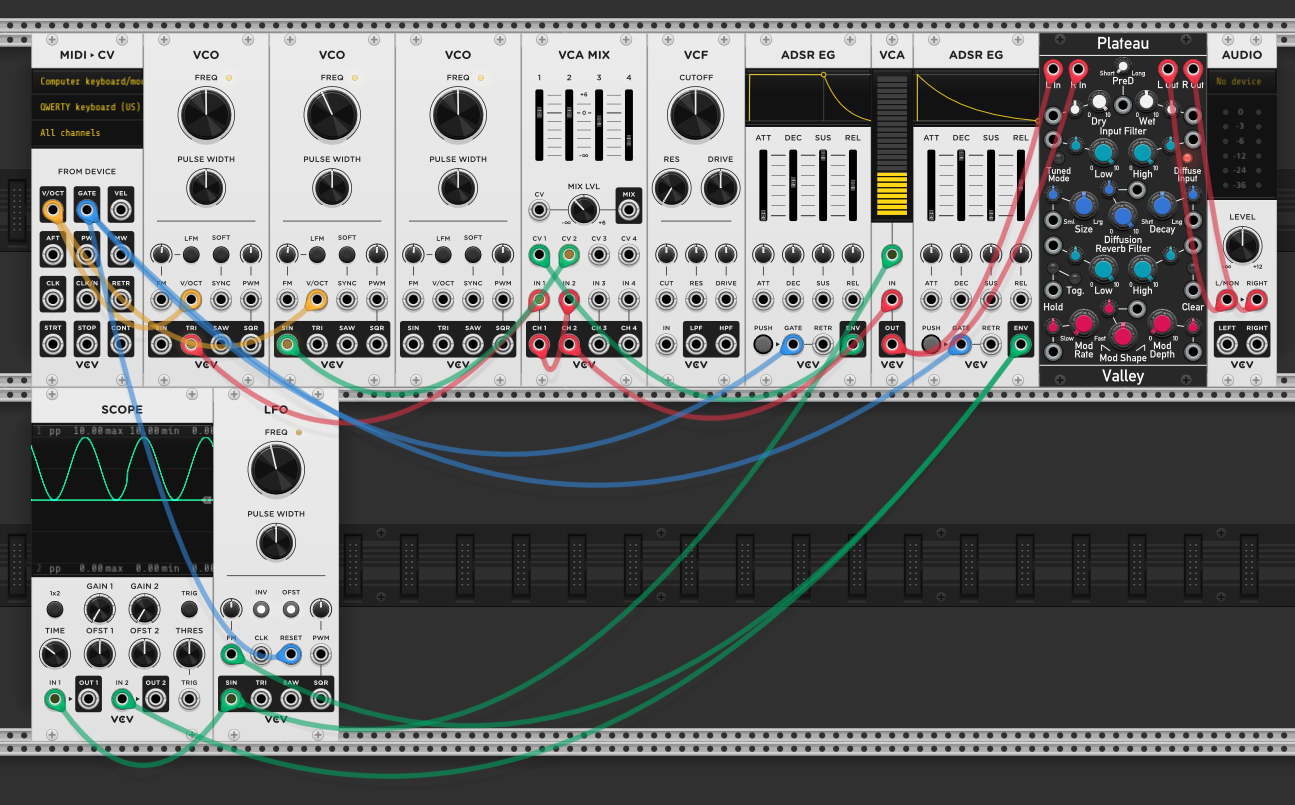
A practical AM patch that adds a ringing, bell-like timbre to each note. The signal chain: the first VCO’s triangle wave goes into a VCA whose amplitude is shaped by the first ADSR envelope — this is the carrier voice. The second VCO’s sine wave modulates this carrier at audio rate, creating AM sidebands that give the bell character. The AM’d signal then passes through a second VCA controlled by an LFO, which creates the ringing — a tremolo that sustains as long as the key is held. The second ADSR envelope modulates the LFO’s frequency, so the ringing starts fast and slows down as the note decays, mimicking how a struck bell’s shimmer settles over time. The whole thing goes through a VCF and Plateau reverb for filtering and space.