Expressive Voice
AC vs DC signals
AC (alternating current): voltage that alternates symmetrically between positive and negative — audio signals from a VCO are AC. The waveform swings equally above and below zero.
DC (direct current): voltage that stays steady or moves slowly — pitch CV, gate signals, LFO output. These signals have low or zero frequency.
AC-coupled modules have a built-in high-pass filter that strips out the DC component of a signal. Only the alternating part passes through. This is why you can’t send an LFO through most audio mixer channels and hear it at the output — the HPF removes the slow-moving voltage. As LFO frequency increases, more signal passes the HPF cutoff, so a fast LFO starts to behave like audio in an AC-coupled module.
DC offset: when a signal’s center point shifts away from zero, so there’s more weight on the positive or negative side. A pure AC signal centers on 0V; adding a DC offset pushes the whole waveform up or down. AC-coupled modules strip this offset out. DC-coupled modules preserve it — important for pitch CV, envelopes, and any slow modulation that needs to maintain its absolute voltage level. DC offset is also a transposition tool — adding +1V to a pitch signal transposes up one octave, -1V transposes down. This creates key changes or harmonies without reprogramming the sequencer.
Bipolar-to-unipolar conversion: to convert a bipolar LFO (-5V to +5V) to unipolar (0V to +10V), add half the total range as DC offset (+5V). This matters for parameters that only respond to positive voltages.
Why it matters for speakers: DC or very low-frequency signals can push a speaker cone to an extreme position and hold it there, which can damage the speaker. AC coupling before the output stage filters these out, protecting the hardware.
DC-coupled audio interfaces: to send CV signals (pitch, envelopes, slow modulation) from a computer to a hardware modular system, you need a DC-coupled audio interface. A standard AC-coupled interface has a built-in HPF that strips out the static/slow-moving components, so the CV arrives distorted or not at all. DC-coupled interfaces pass the full signal including the DC component.
Slew limiter
A slew limiter (also called a lag processor or lag generator) limits the rate of voltage change per second, converting rigid/instant signal transitions into smoother ones. It has two parameters:
- Rise (attack): the time it takes for the signal to ramp from zero to its maximum
- Fall (decay): the time it takes for the signal to fall from maximum back to zero
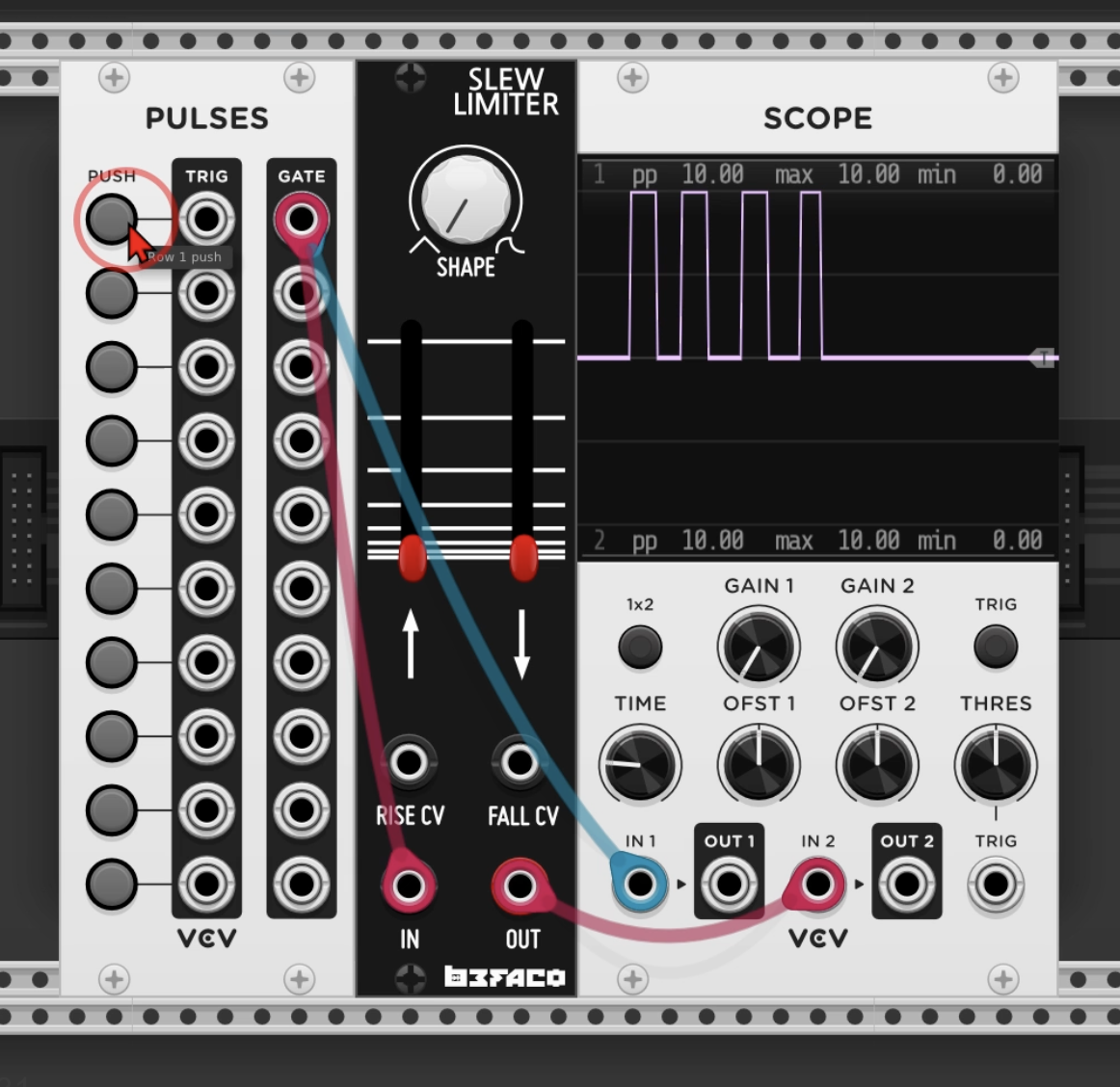
With both rise and fall at minimum, the slew limiter passes the signal unchanged — the scope shows the gate and slew output as identical square shapes.
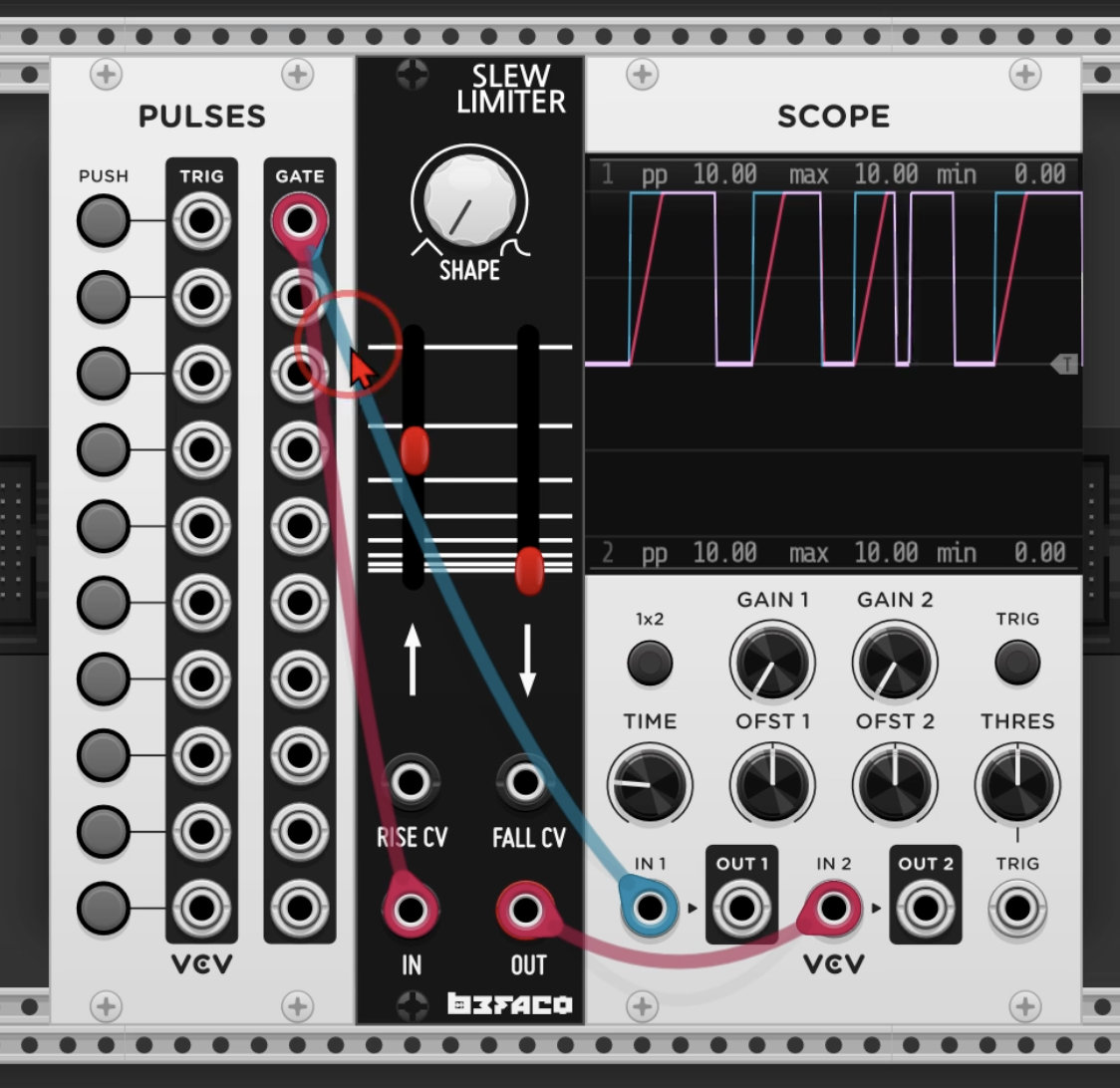
Increasing the rise slider: the gate still jumps to high instantly, but the slew output ramps up gradually. The sharper the original transition, the more visible the smoothing effect.
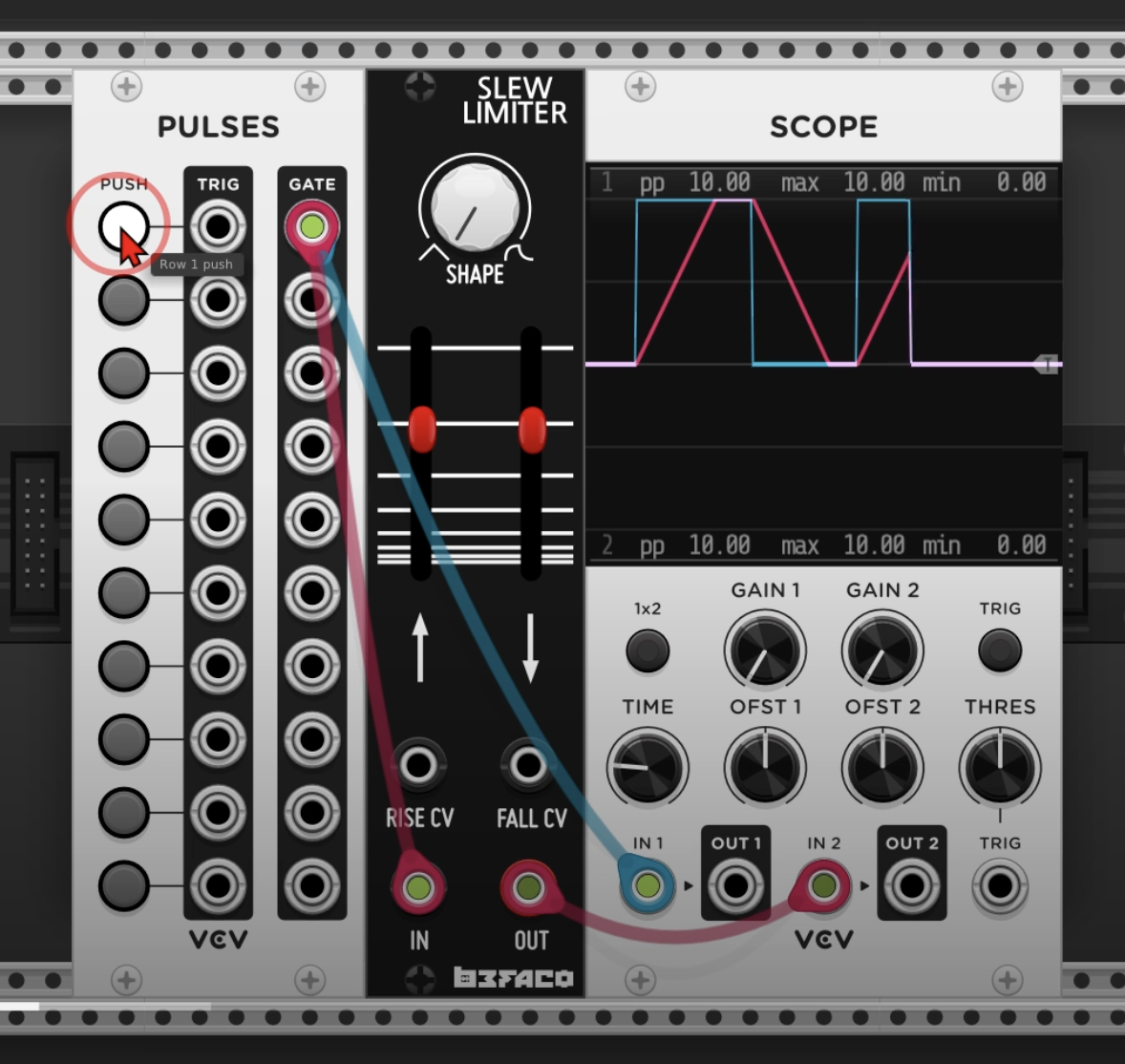
With both rise and fall increased, the output becomes triangular — slow ramp up, slow ramp down. The square gate is transformed into a smooth shape. The shape knob on the Slew Limiter controls the curve of the ramp — linear, exponential, or logarithmic.
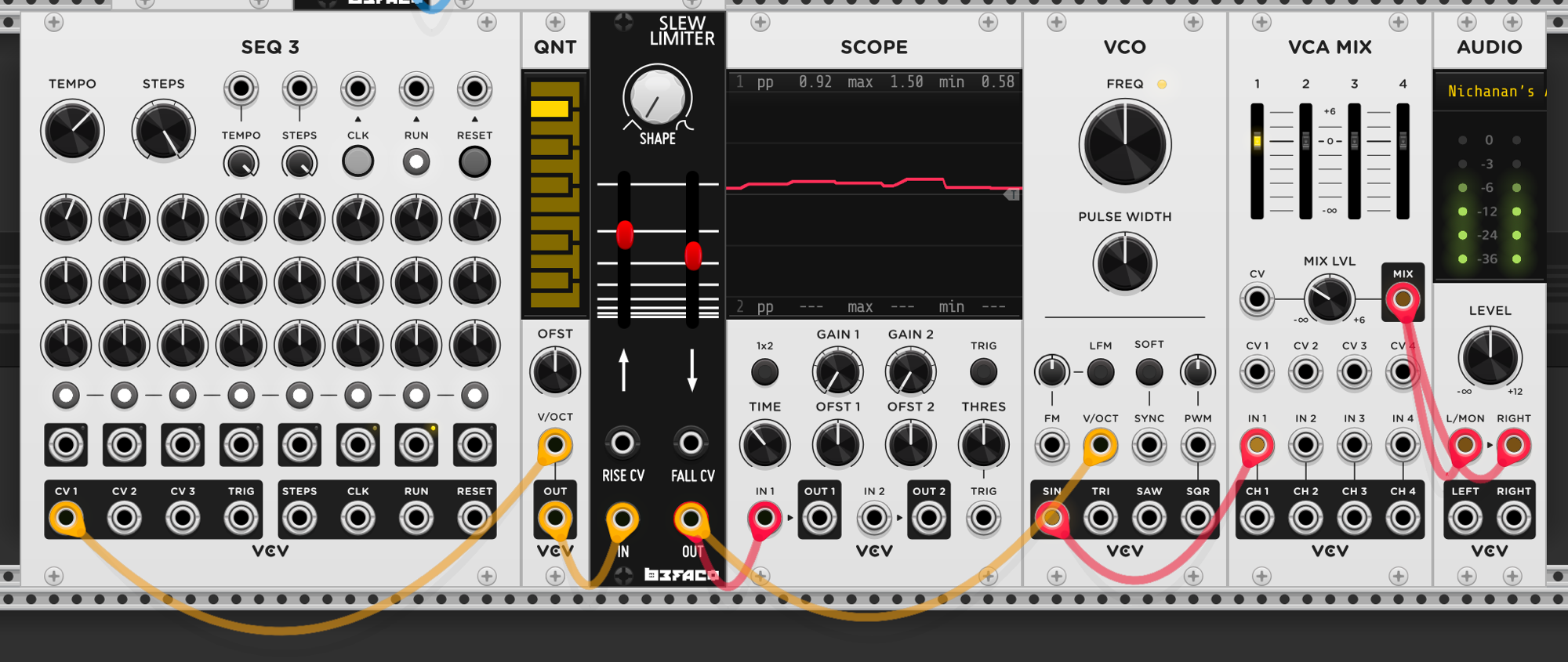
Portamento/glide in practice: the slew limiter sits between the QNT output and the VCO’s V/OCT input. The SEQ3 outputs quantized pitch CV — each step is a discrete voltage jump. Without the slew limiter, each note starts instantly and sounds separate from the next. With rise and fall increased, the pitch slides smoothly between notes — the scope shows the staircase CV softened into gentle ramps. Glide is the effect of pitch sliding smoothly from one note to the next instead of jumping instantly. The amount of rise/fall controls the glide speed: subtle values give a quick slide between close notes, higher values create long sweeping portamento.
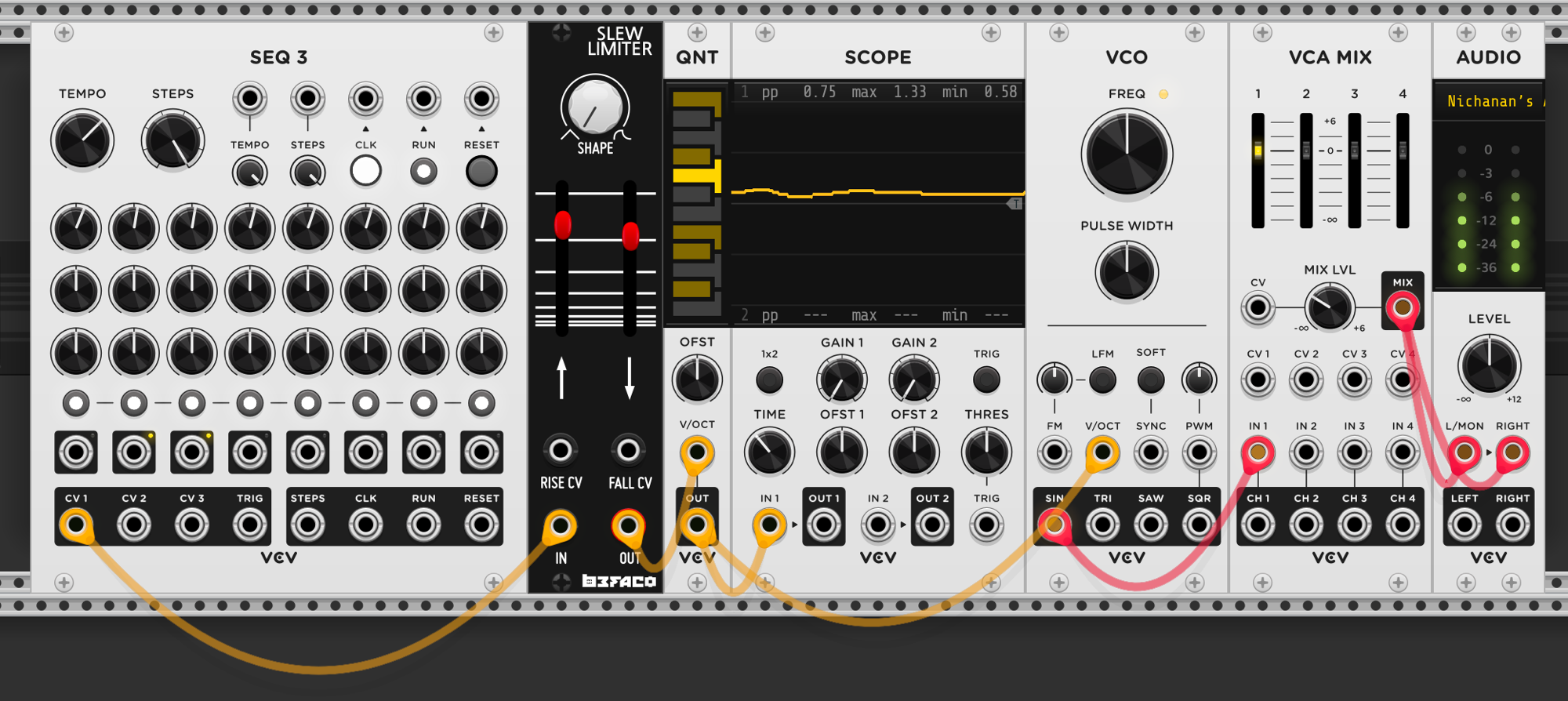
Glide vs glissando — the order of slew limiter and quantizer matters. With the slew limiter after the quantizer (QNT → Slew → VCO), the pitch slides continuously between notes — a smooth glide through all frequencies in between. With the slew limiter before the quantizer (SEQ3 → Slew → QNT → VCO), the slew output is re-quantized, so instead of a smooth slide you hear every chromatic note in between — a glissando, like running your finger up a piano keyboard. Same slew, completely different musical effect depending on where the quantizer sits in the chain.
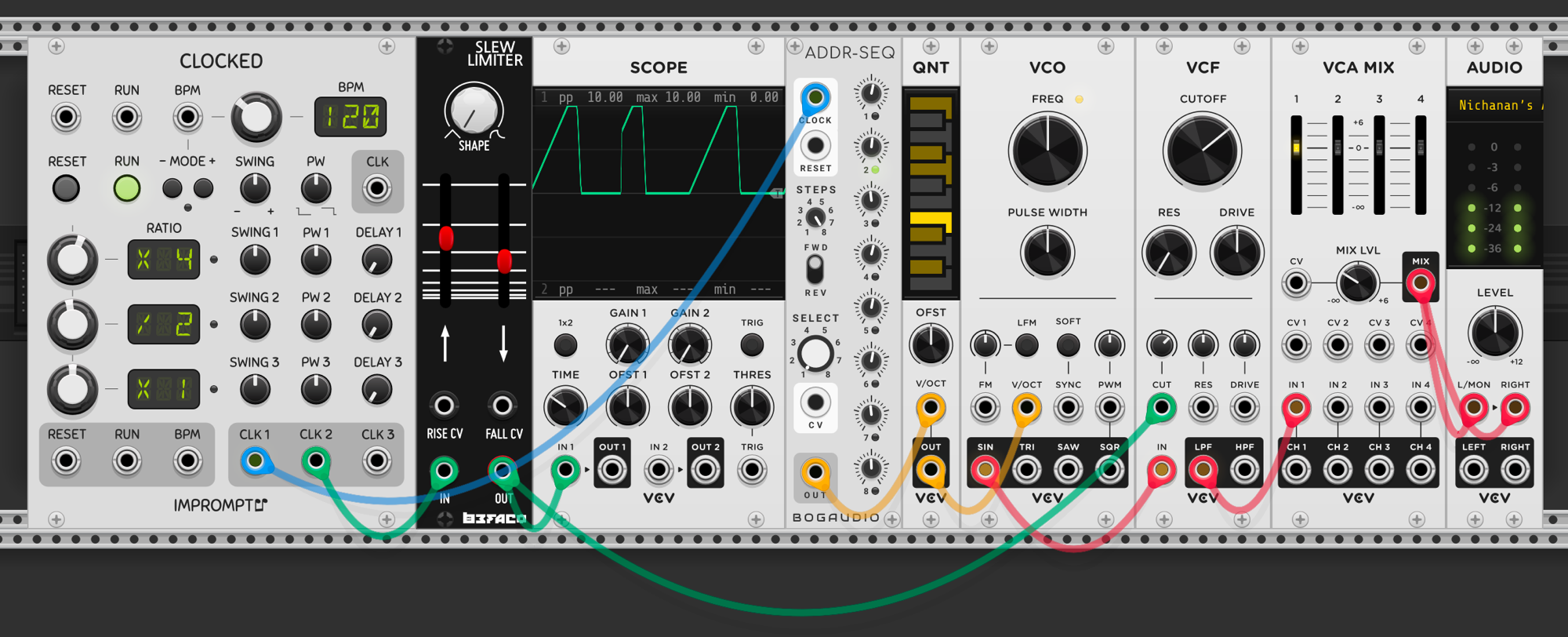
Clock-synced modulation: feeding a clock signal into a slew limiter turns the square clock pulses into smooth ramps that rise and fall in time with the beat. The scope shows the result — a waveform that looks like a smoothed clock, with the rise and fall times shaping how fast each ramp sweeps. This creates modulation that’s inherently synced to the tempo without needing a clocked LFO. Patching this to a filter cutoff or other parameter gives rhythmic modulation that breathes with the clock.
Velocity, glide, and vibrato
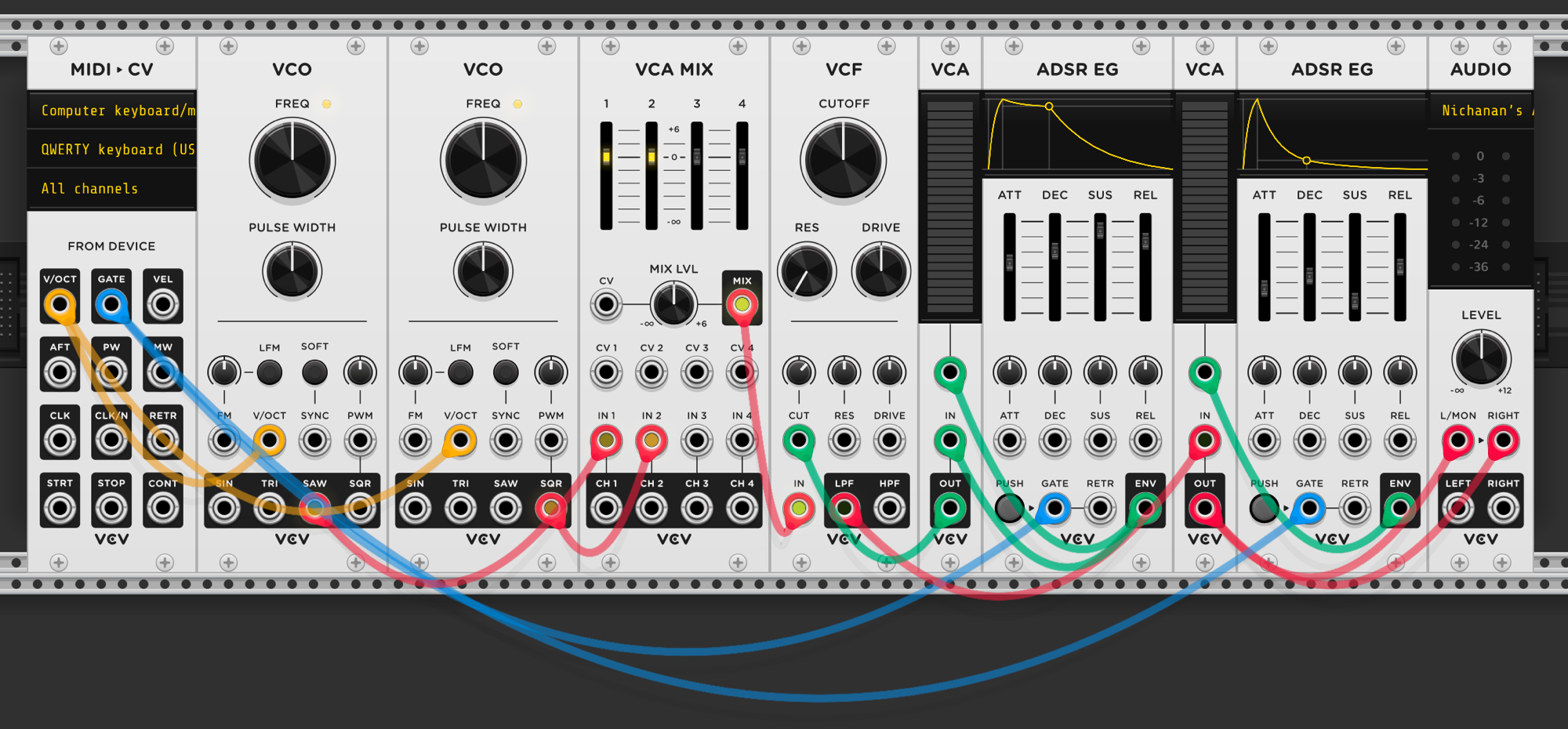
Starter patch for expressive playing: a MIDI-CV module provides V/OCT (pitch), GATE, and VEL (velocity) from a keyboard. Two VCOs receive the same pitch and mix through VCA MIX into a VCF. Two separate envelopes serve different roles — one ADSR modulates the VCF cutoff (how bright the note is), the other controls the amplitude VCA (whether you hear it at all). The gate signal triggers both envelopes. This is the base voice to add expression to.
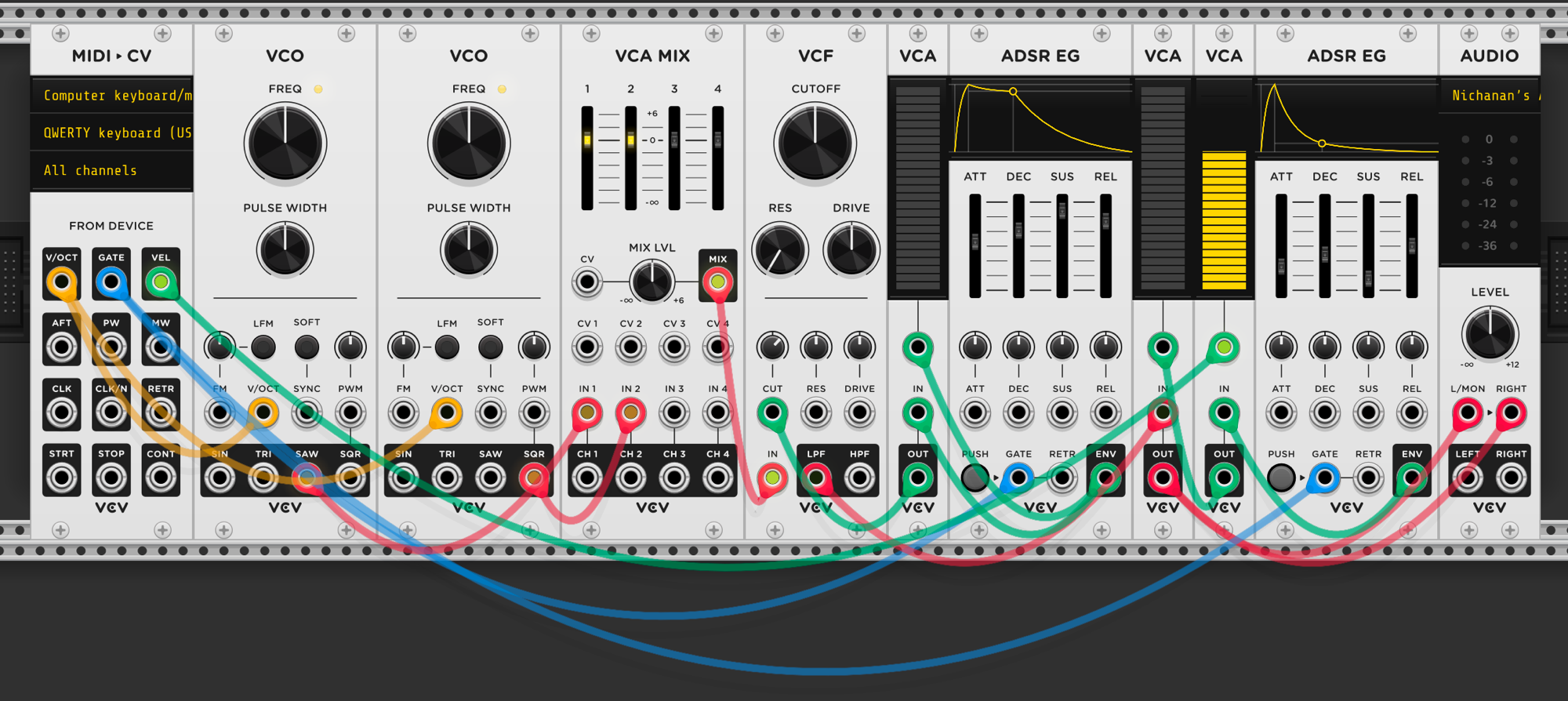
Velocity sensitivity: a third VCA is added to the signal chain, controlled by the MIDI-CV module’s VEL output. Velocity measures how fast/hard a key is pressed — it outputs a higher voltage for harder strikes and a lower voltage for softer ones. This VCA sits before the two envelope-controlled VCAs, so the velocity scales the overall level of the note before the envelopes shape it. Play softly and the note is quieter; play hard and it’s louder. The envelopes still control the shape of the sound (attack, decay, sustain, release), but velocity controls how much signal enters that shaping stage. This is one of the most direct ways to make a synth voice respond to playing dynamics. Per-step velocity can also come from the sequencer itself — using a CV row to control the envelope’s VCA amplitude gives each step its own dynamics without MIDI.
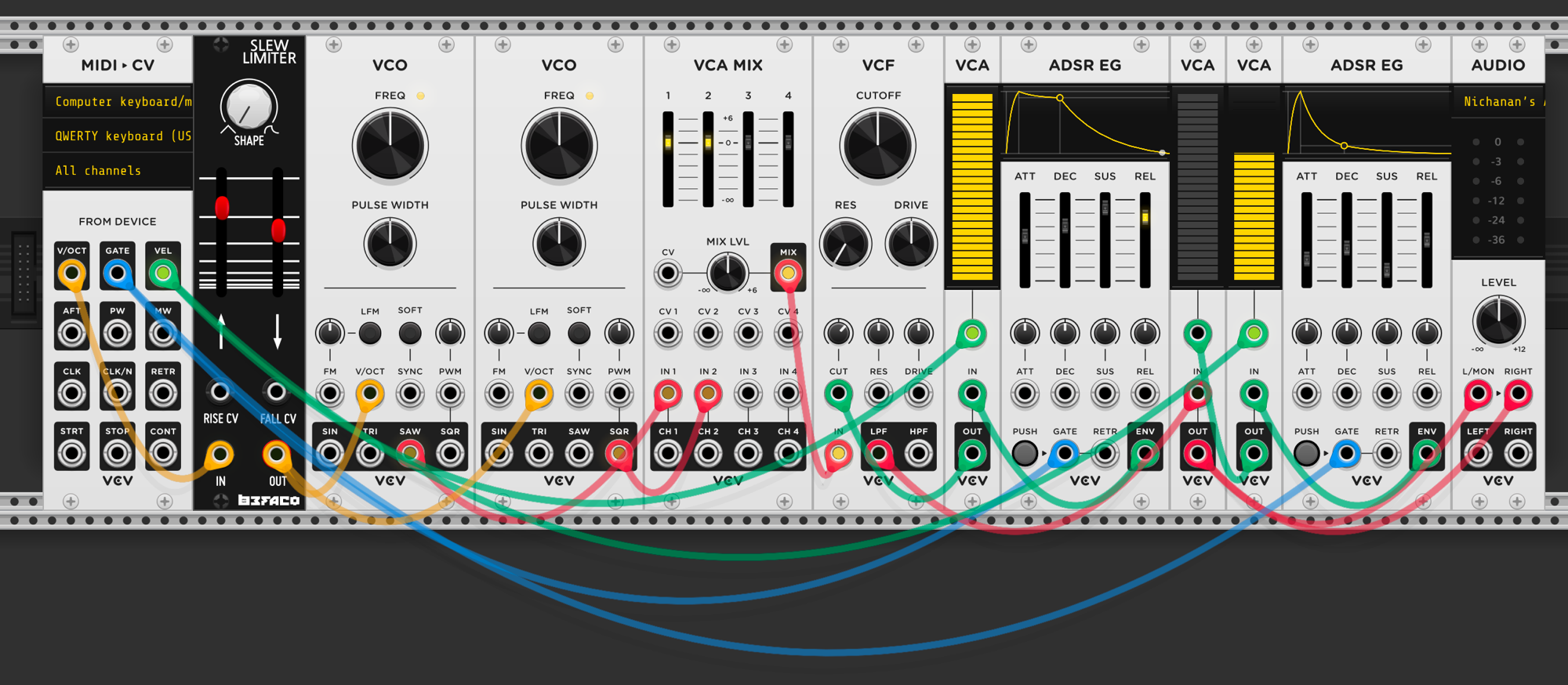
Adding glide: a Slew Limiter sits between the MIDI-CV’s V/OCT output and the two VCOs. Instead of the pitch CV jumping instantly from note to note, the slew limiter smooths the transitions — each new note slides from the previous pitch rather than clicking discretely into place. The rise and fall sliders control how long the slide takes. With subtle settings, the glide is a quick scoop between notes that adds a vocal, legato quality. With higher settings, the pitch sweeps slowly and dramatically between notes. This is the same portamento technique covered in the slew limiter section above, now applied to a played keyboard voice rather than a sequencer.
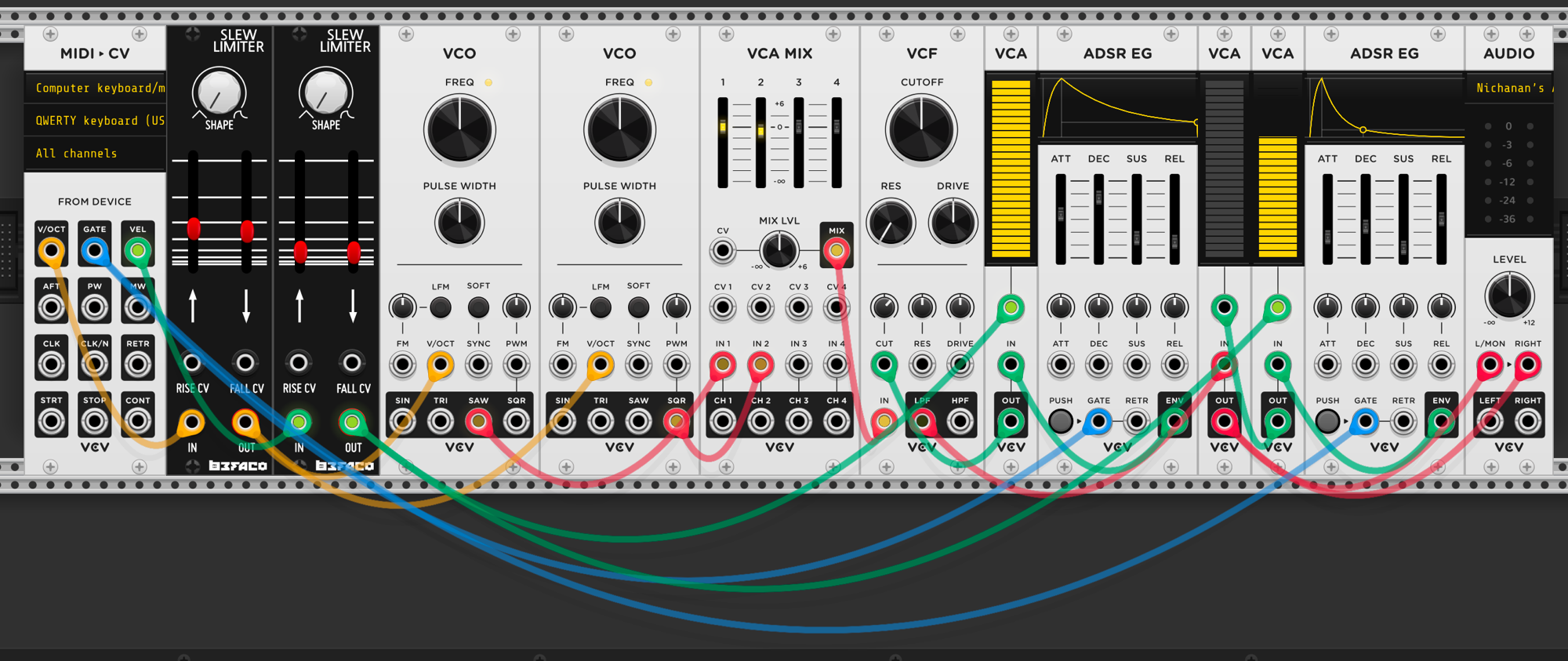
Smoothing velocity: a second Slew Limiter is added, this time on the velocity signal path. Without it, the velocity voltage jumps instantly between values as each key is struck — if one note is played softly and the next hard, the amplitude snaps abruptly from quiet to loud, producing a click at the transition. Adding a small amount of slew to the velocity smooths those jumps, so the amplitude transitions gently between notes instead of stepping harshly. The same principle as pitch glide, applied to dynamics: the slew limiter turns rigid voltage steps into fluid curves.
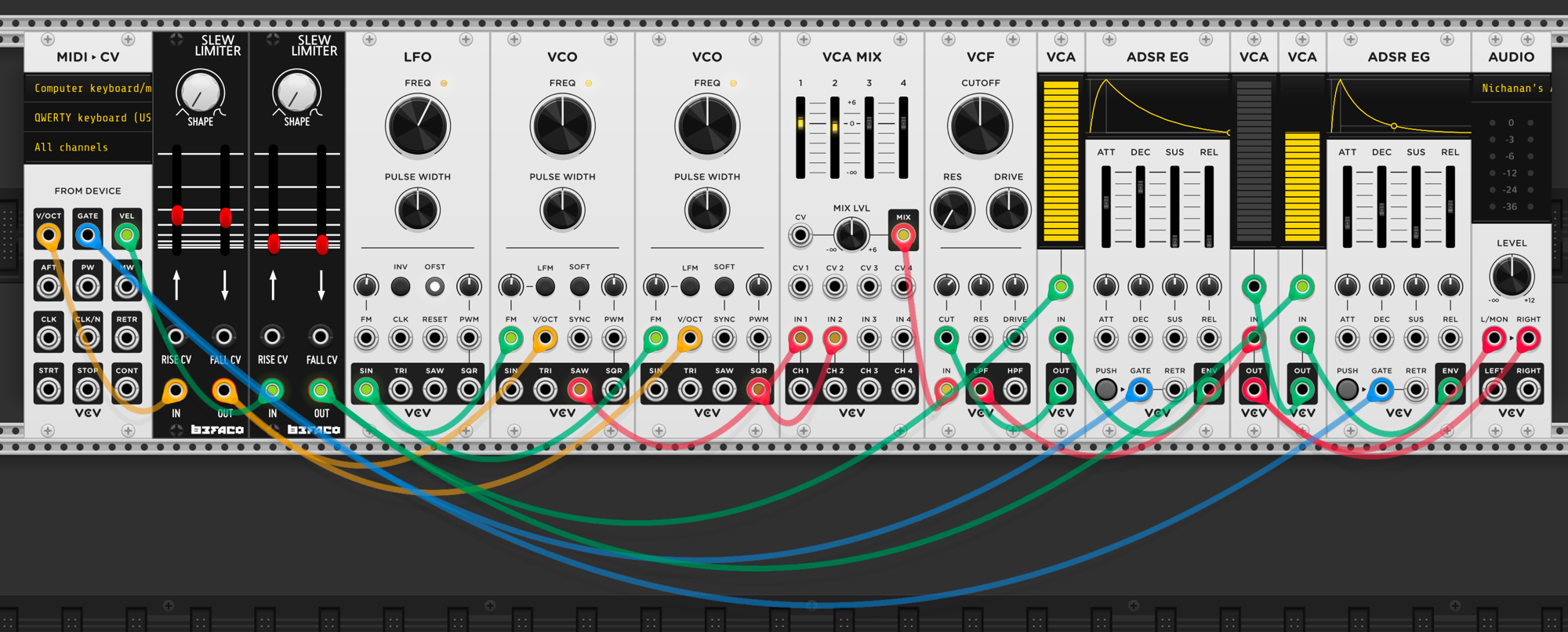
Vibrato: an LFO is added, its sine wave patched to the FM input of both VCOs. The LFO continuously wobbles the pitch up and down at a rate set by its frequency knob. This is vibrato — a small, periodic pitch variation that adds warmth and life to sustained notes. The sine wave shape keeps the wobble smooth and symmetrical. The FM input’s attenuator on each VCO controls the vibrato depth — how far the pitch bends in each direction. A subtle setting mimics the natural vibrato of a singing voice or bowed string; too much and the pitch swings wildly out of tune.
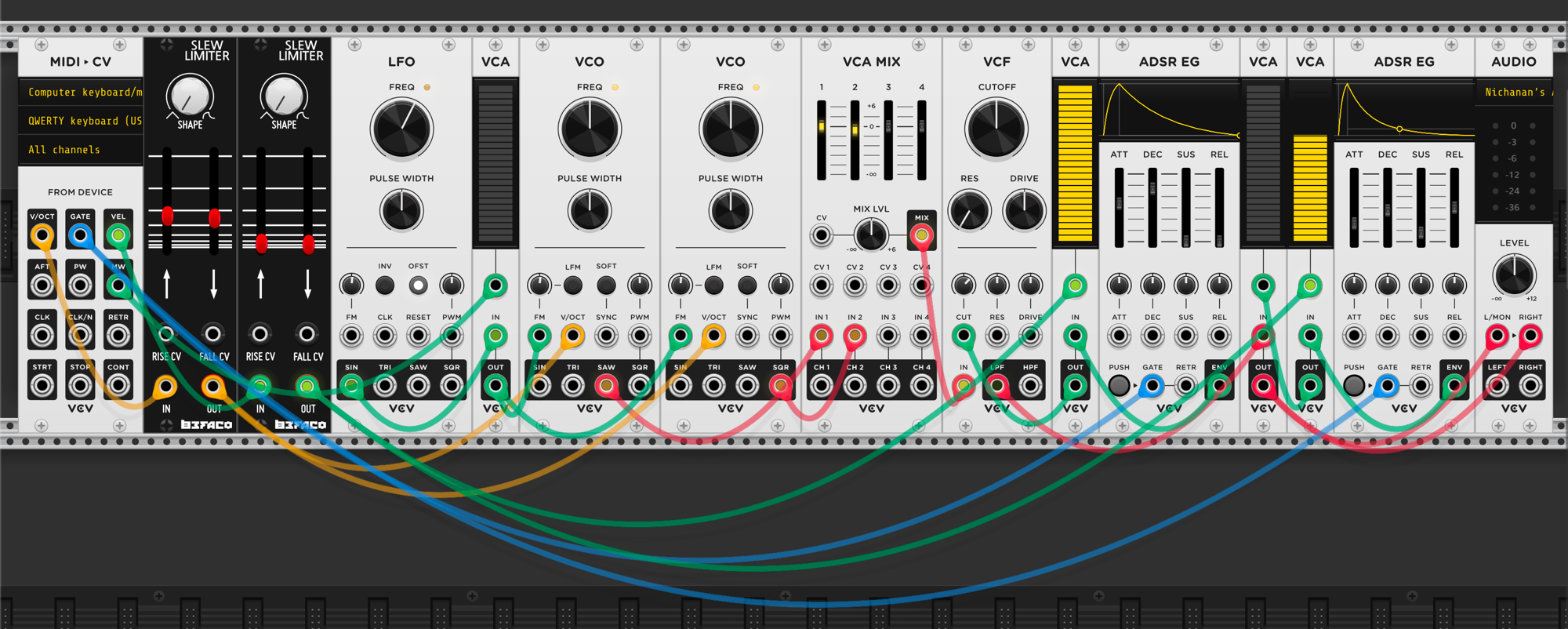
Mod wheel control: a VCA is inserted between the LFO and the VCOs’ FM inputs. The LFO sine goes into the VCA’s audio input, and the VCA’s output feeds both VCOs’ FM. The MIDI-CV module’s MW (mod wheel) output controls the VCA’s amplitude. With the mod wheel down, the VCA is closed — no LFO signal reaches the VCOs, so there’s no vibrato. Pushing the mod wheel up opens the VCA, letting the LFO through and introducing vibrato. The further the wheel is pushed, the deeper the vibrato. This gives real-time performance control: vibrato can swell in on sustained notes and disappear on staccato passages, just like a vocalist or string player applying vibrato intentionally rather than constantly.