The Shared Modulator
Intention
My patches lock into a strong loop, but the voices still read as separate parts playing in time rather than one instrument. This session goes after that problem — glue — with a single principle: voices gel in proportion to what they share. They already share a clock, so they agree on rhythm; the move here is to give them a shared modulator — one slow source of movement fanned across several voices at once — so they also agree on breath. And by inverting that source into some voices while leaving it upright in others, one “lung” can make one voice open as another closes, turning a single modulator into interplay rather than everything pumping in lockstep.
This extends the session 29 hypnotic-techno rack — kick, hat and a rolling arp over one clock. The rack already contains the exact mechanism the session is about: one slow, clock-synced LFO breathing the arp’s level. But that breath feeds only the arp while the kick and hat sit static beside it — so the whole move is to recognise that a single lung can feed many, multing that one LFO out to the other voices so they breathe from it too, each taking the same contour at its own depth and polarity.
Starting patch
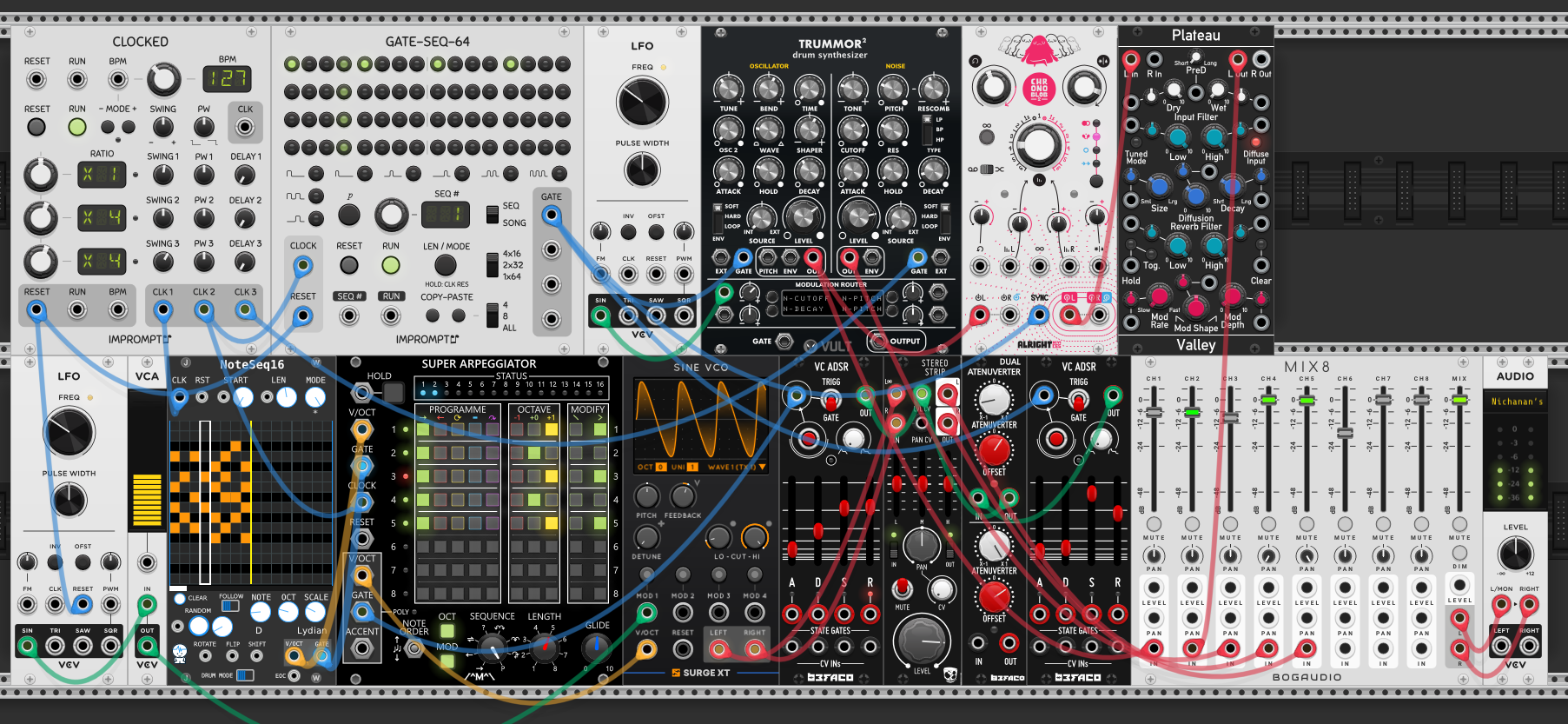
The starting point is a fork of the session 29 loop — three voices over one Clocked master:
- the kick — Trummor²’s oscillator section, run through a
Chronoblobdelay into aPlateaureverb for a tail - the hat — Trummor²’s noise section
- the rolling arp —
NoteSeq16→Super Arpeggiator→ SurgeSine VCO, its level shaped by aVCAandStereo Strip
All three are gate-sequenced from the GATE-SEQ-64 and locked to the one clock, so they agree on rhythm. What they don’t share is movement: the kick and hat fire and decay identically every bar, dead static between hits. The one exception — and the seed for the whole session — is a slow LFO (0.1× the clock, synced to it) already modulating the arp’s VCA, so the arp swells in and out of the mix over a long, bar-spanning cycle. One voice breathes; the other two don’t, and the loop reads as a breathing arp with two static parts bolted to it rather than as one instrument.
The shared modulator
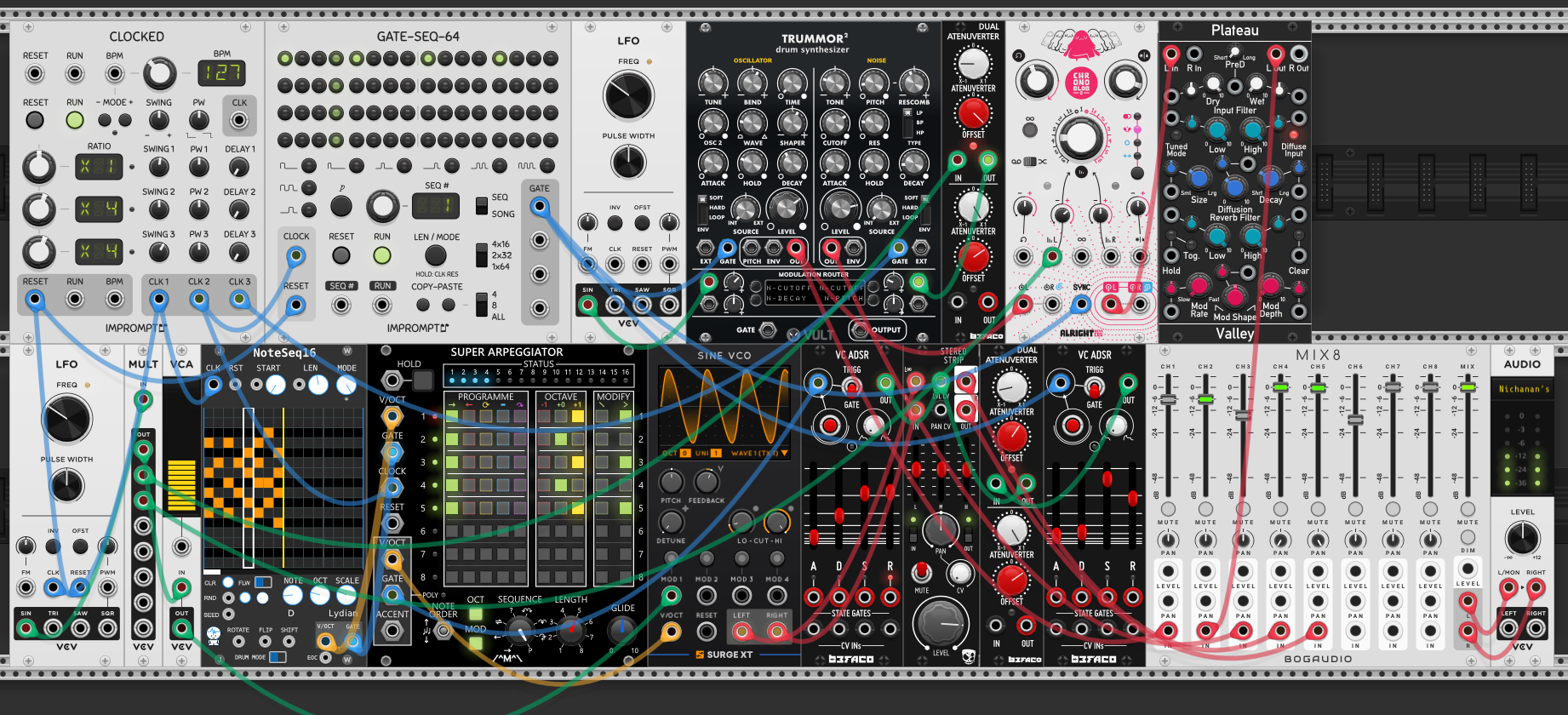
The change is small and entirely about sharing: the slow LFO now runs into a MULT, and its single contour fans out to three places across the patch.
- The main voice (unchanged) — one copy keeps swelling the arp’s level through its
VCA, the breath that was already there. - The kick’s delay time — a copy goes to the
Chronoblob’s left delay-time CV, very gently. Because modulating a delay’s time drags the read point through the buffer, the kick’s echoes slowly stretch and compress in pitch — a faint tape-warble on the kick’s tail that rises and falls with the same cycle. Kept tiny: enough to feel, not enough to register as an effect. - The hat’s cutoff, inverted — the last copy runs through a
Dual Atenuverterset to invert it before it reaches the Trummor noise cutoff. So as the LFO rises and the arp swells up, the hat darkens; as the arp recedes, the hat opens and brightens. The hat answers the arp rather than moving with it.
That mix of polarities is the whole lesson. The arp’s volume and the kick’s warble move with the breath (upright); the hat moves against it (inverted). It’s one source, but it doesn’t read as a single uniform pump — the upright destinations swell together while the inverted hat fills the troughs, so the patch breathes and trades places within the breath. Depth per destination (each attenuator’s amount) sets how much of the cycle each voice shows: the arp obvious, the kick’s warble almost subliminal, the hat somewhere in between.
The A/B that proves it. Pull the MULT’s feeds and the loop snaps back to three parts playing in time. Restore them and the kick’s tail, the arp’s level and the hat’s brightness all start tracing one hidden slow contour — and the three voices fuse into a single organism moving on one breath. The glue isn’t a new sound; it’s the shared movement.
A fourth voice on the same lung
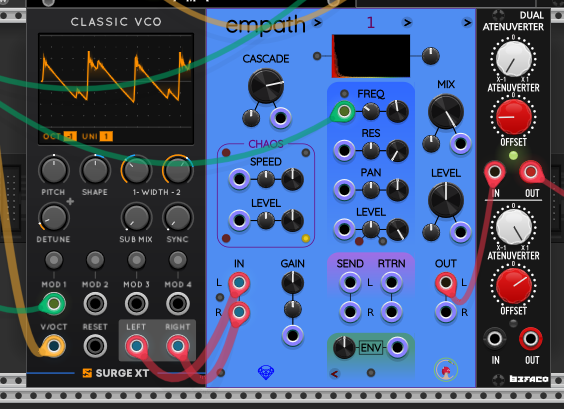
The real test of the principle is whether a brand-new voice can be folded in without sounding bolted on — and the way to guarantee that is to wire the sharing in as you build it, not patch a finished voice and then try to make it fit. This fourth voice shares not one thing with the patch but two.
First, its pitch. A Classic VCO (Surge XT) takes its V/OCT from the same Super Arpeggiator that drives the rolling arp, so it plays the exact same notes — a sustained saw layer that tracks the arp’s line, the same pitches held and filtered rather than plucked. It’s in harmonic lockstep before any modulation is even patched.
Second, the breath. Another copy off the MULT runs through a Dual Atenuverter channel set to invert it, into the Empath (Sapphire) filter’s FREQ — so this voice’s cutoff opens as the shared LFO falls. When the arp swells up, the layer darkens and sinks back; when the arp recedes into its trough, the filter blooms open and the chord rises to fill the space. It’s the inverted-hat move again, but on a sustained voice big enough to really feel the call-and-response: the patch never goes empty, because this layer swells into exactly the gap the arp leaves. From the Empath it passes through the Dual Atenuverter’s other channel, which sets its level into the mixer.
Sharing both the pitch and the modulation is what makes it land the instant it’s unmuted — same notes, opposite breath. A voice that shares nothing has to be mixed in gingerly so it doesn’t sound like a separate record playing over the top; this one is tied into two of the patch’s hidden structures at once, so it reads as part of the organism immediately. Four destinations now hang off the one slow LFO — arp level, kick delay-time, hat cutoff, pad cutoff — and the loop still reads as a single breathing thing rather than four parts, which is the whole payoff: glue scales with sharing, not with restraint.
The full patch
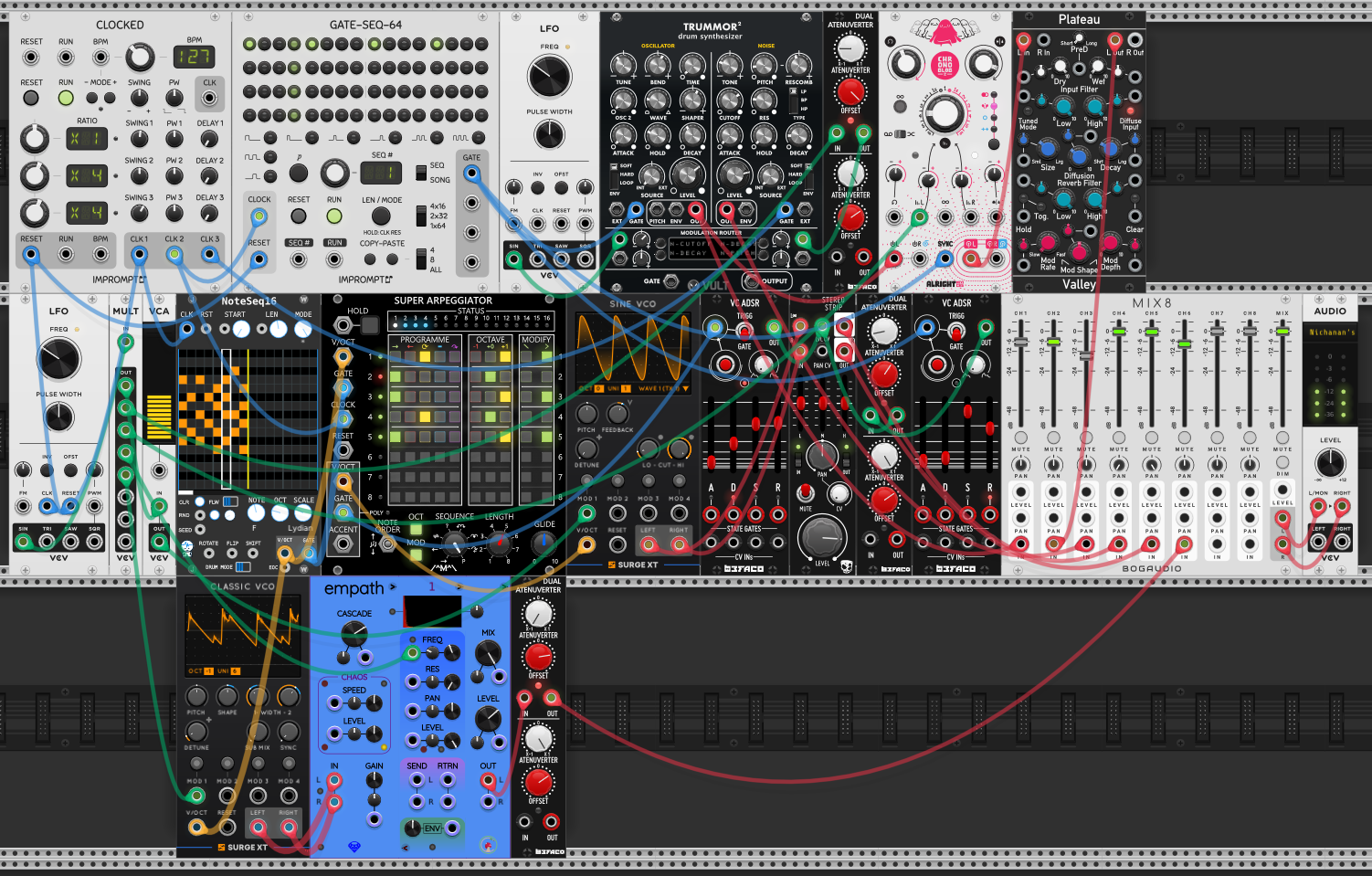
Assembled, it’s four voices over one clock — Trummor²’s kick and hat, the rolling arp, and the Empath-filtered saw layer — but what makes it cohere is the topology hiding behind them: a single slow LFO through one MULT, its contour reaching the arp’s level, the kick’s delay time, the hat’s cutoff and the chord’s cutoff, two of them running with the breath and two against it. Nothing about the individual voices changed from the session 29 starting point — same sequences, same drum sounds, same mix — yet the loop stops sounding like a stack of parallel parts. One lung, four breaths.
Reflection
What stuck is how much togetherness comes from one shared source. Before, the voices each sat at their own fixed spot and just coexisted — flat, parallel, quietly competing for the same space. Feeding them all from the same slow modulation changed that completely: because they rise and fall on one contour, the composition feels like it breathes together instead of several things playing at once and crowding the same place in a flat way. The inversions are what keep that breath from being a uniform pump — when some voices swell while others duck on the same cycle, the patch is always full but never static, because something is always moving into the space something else just left. Glue, it turns out, isn’t about blending the sounds themselves; it’s about giving them one hidden motion to share.