Dark Techno — Deep Rolling
Intention
A darker, heavier techno patch in the spirit of Marcel Dettmann and Ben Klock — deep, rolling, and hypnotic. Where session 25 was bright and busy (seven voices, an acid hook, a melodic chord stab, everything at equal level), this one is about pressure, space, and restraint. Fewer elements, more room between them, and a low end that feels physical rather than tuneful.
The defining traits I’m chasing:
- A rumble kick at the center. Not just a clean four-on-the-floor thud, but a kick whose tail bleeds into a long reverb that ducks under the next kick — the cavernous sub-bass rumble that underpins the whole deep-rolling aesthetic.
- A rolling, swung groove. Not industrial or hardcore — the momentum is hypnotic, built from offbeat hats, syncopated 16th percussion, and swing, so the loop feels like it’s perpetually rolling forward rather than stomping.
- A deep, dark stab on the offbeat — warm and muffled, drenched in reverb, pushing the roll along. Texture and hypnosis, not a melodic hook.
- Warmth and space, restrained. Dark reverb everywhere, gentle saturation rather than grit, and fewer elements with more room between them.
- An actual mix with hierarchy — the kick huge and forward, everything else buried in the dark around it. The unfinished thread from session 25.
Starting patch
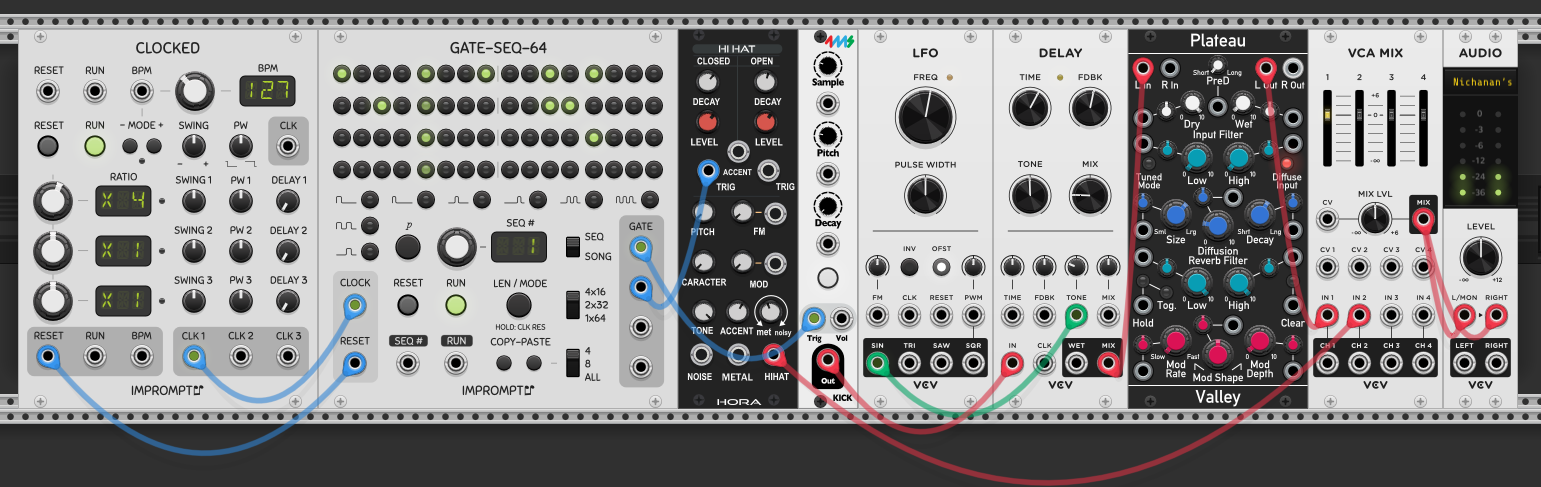
I kept the part of the session 25 patch I trusted — the rhythmic skeleton — and threw the rest away. CLOCKED at 127 BPM drives GATE-SEQ-64, which fires the kick on every quarter note and a hi-hat pattern against it. The kick’s pitch-drop and decay were already dialed to the tempo I wanted, so the foundation didn’t need rebuilding. Everything sums through a DELAY and a Plateau reverb into VCA MIX → the master and out. The acid line, sub, chord stab, snare, and noise sweep are all gone — this track gets built from a near-empty rack so the darkness has room to breathe.
Rumble kick — the bassline hiding in the reverb
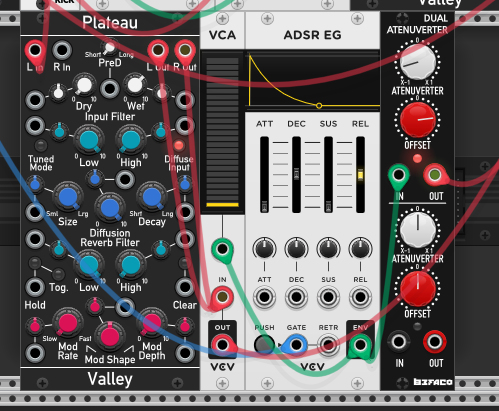
This is the whole deep-rolling sound in one trick: the kick is the bassline. A dry four-on-the-floor kick on its own is just a thump with silence between hits. But feed that kick into a long, dark reverb and the tail becomes a continuous cloud of low-frequency energy — and if I make that cloud pump in time with the beat, it turns into a sub-bass rumble that swells in every gap and gets slammed back on each downbeat. One module, the kick, ends up doing the job of a kick and a bass voice. No second oscillator, no bass sequence.
A dedicated dark reverb for the tail. The kick goes into a second Plateau, separate from the one on the master — the a-voice-per-reverb rule again, so I can push this one to extremes without washing out everything else. Decay long and Size large so the tail sustains all the way across the gap between kicks; the High shelves pulled down (both Input Filter and Reverb Filter) so the cloud is dark and sub-heavy instead of a bright hiss; Mod Depth near zero so the low end doesn’t wobble in pitch. What comes out is a deep, dark, sustained boom with no transient of its own — exactly the raw material for a rumble.
Ducking the tail with the kick. Left alone, that reverb cloud would just be constant mud sitting under the track. The motion comes from sidechaining it — the same kick-pushes-the-signal-down idea from session 15, but here it’s multiplicative on a VCA instead of additive. The reverb tail returns on its own mixer channel, and that channel’s level is driven by a control voltage that sits open between kicks and slams shut on each kick. So the dry kick punches through clean, the rumble ducks out of its way, then swells back up in the gap before the next hit. The pump is the groove.
Building the duck voltage — invert and raise. The kick gate fires a Befaco ADSR, which gives a 0→up envelope on every kick — but that’s backwards for ducking (it would swell the rumble up on the kick, not down). So the envelope passes through a Befaco atenuverter, set to negative gain (flip it upside down) with the offset turned up (lift the whole thing to a high baseline). The result is a voltage that rests high and dips toward zero on each kick: CV = baseline − envelope. That goes straight into the rumble channel’s CV input — and since every mixer channel is already a VCA, no extra VCA module is needed; the channel ducks itself.
The settings that make or break it:
- ADSR
SUSmust be 0. This is the one that bit me — with any sustain, the envelope rises and then holds high for the length of the kick gate, so the rumble stays ducked and never swells back. Sustain at zero turns the envelope into a pure attack-decay blip: duck down, recover, done. ATT near zero so the duck snaps shut the instant the kick hits, and DEC is the pump-time knob — short for a fast snappy swell, long for a slow breathing rumble. - The atenuverter’s two knobs are the two musical controls. OFFSET sets how open the channel sits between kicks — the rumble’s ceiling/loudness. Gain (invert depth) sets how deep each kick carves the dip — the pump intensity. Turn the offset up to the rumble level I want, then push the gain negative until each kick takes a satisfying bite out of it.
Keeping the dry punch. The kick output is multed: one cable into Plateau #2 for the rumble, a second cable straight to its own master channel. The rumble channel carries only the wet tail; the dry kick lives on top of it. Lose that split and the kick disappears into reverb soup — the rumble has to sit underneath a clean transient, not replace it.
Rolling hats — swing and ghosts
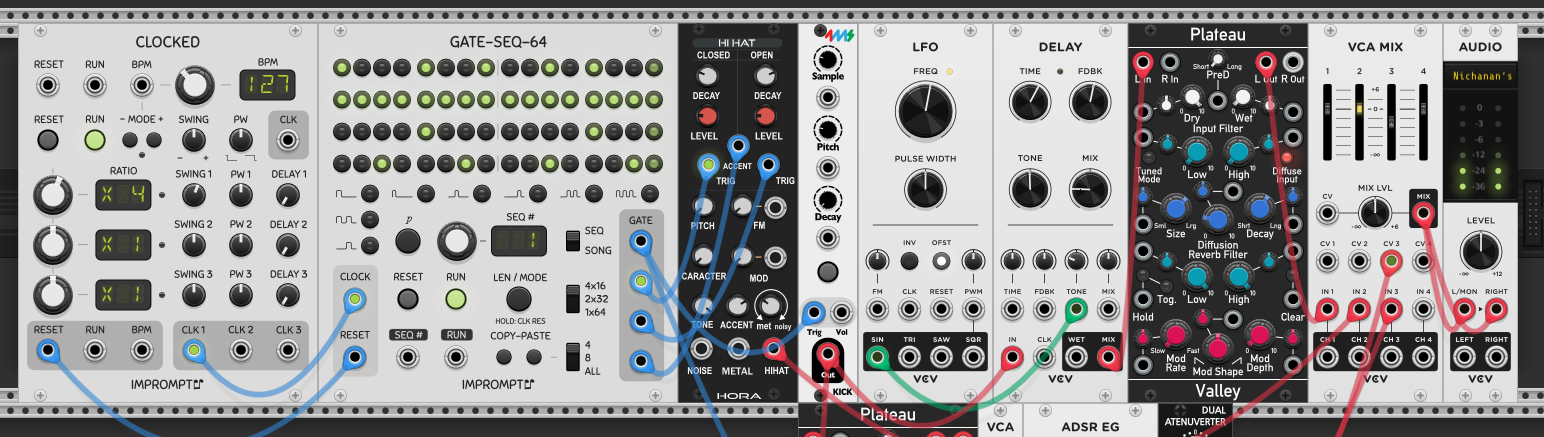
What makes a beat roll instead of march isn’t a busier pattern — it’s swing and dynamics on a simple stream. Three rows on GATE-SEQ-64, all feeding the one Hora hi-hat, turn a static metronome into something that feels played by hand.
A steady 16th closed-hat stream. The base is just closed hats on (nearly) every 16th — deliberately plain. The motion doesn’t come from the rhythm; it comes from what the next two rows do to this stream.
An offbeat open hat. A second row triggers the open hat on the ”&” of each beat — the upbeats sitting between the four kicks. The kick pushes down on the beat, the open hat answers up on the offbeat, and that call-and-response is the forward pull. A slightly longer open-hat decay lets it ring into the gap so the offbeat lifts.
Accents make it breathe. A third row marks which hats hit harder, patched into the Hora’s dedicated ACCENT input. With the hat’s base LEVEL set low, the un-accented 16ths drop to quiet ghosts and only the marked steps pop — the per-step accent idea from session 25, used here not to drive a bassline but to give the hats human-feeling dynamics. The gap between ghost and accent is the groove.
Swing is the big lever. One knob on CLOCKED — SWING on the ratio output clocking the sequencer — delays every other 16th slightly, and that shuffle is most of the rolling feel. Subtle is the whole game: around 55–58% reads as a pocket; push it far and it lurches.
Kept dark, not industrial. To stay on the deep-rolling side rather than hardcore, the Hora’s METAL is pulled down and TONE darkened, so the hats are a soft tss rather than a bright clang — texture under the groove, not an attention-grabbing clank.
The payoff is exactly the goal: instead of a static march, the hats sound like someone drumming — ghosted 16ths shimmering underneath, the offbeat open hat lifting each upbeat, accents and swing keeping it loose. The dynamism comes entirely from two cheap moves — accent dynamics and a swing knob — over a dead-simple pattern.
Deep stab — the dark chord on the offbeat
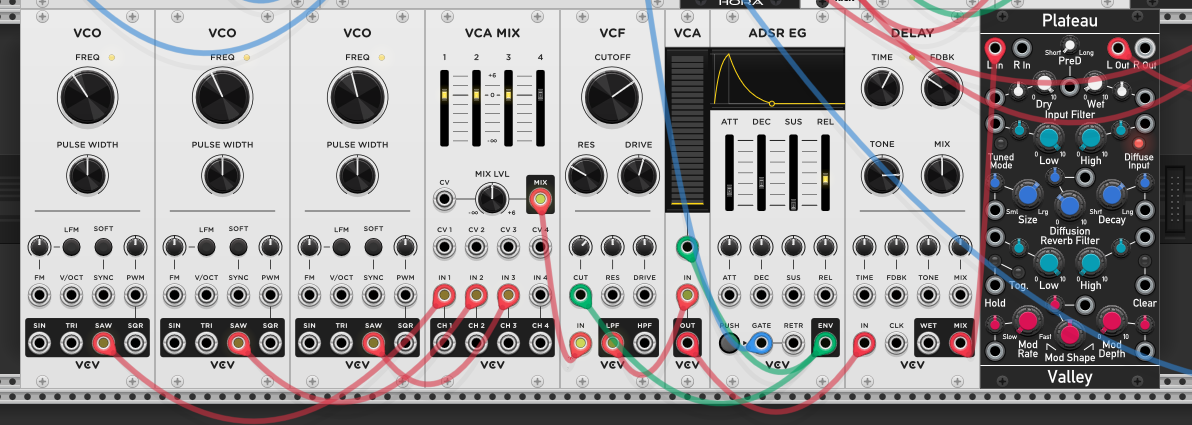
The hook of the style: a dark minor chord that hits on the offbeats, muffled and warm, with a long rolling tail. The same subtractive chord recipe as the session 25 stab — three oscillators, a filter, an envelope — but everything tuned deep instead of bright.
The chord. Three VCV VCOs on saw waves, tuned by FREQ-knob readout to a C-minor triad — C3 (130.81 Hz), E♭3 (155.56 Hz), G3 (196 Hz) — summed in three VCA-MIX channels. Saw, not sine, for the same reason as always: the filter needs harmonics to act on. With one oscillator per chord tone, the lush “detune” beating you’d get from unison pairs isn’t really available, so I kept them close to in tune; the warmth comes from the filter and the space, not from spread.
The muffle is the depth. The summed chord runs through the VCF low-pass with the cutoff low — this is the single biggest “deep” move. Low cutoff makes the chord sound like it’s heard through a wall: all warm body, no bright fizz, felt more than heard. A little DRIVE on the filter adds gentle saturation — warmth and weight rather than grit. Pushing cutoff up thins the muffle toward an open, buzzy chord; pulling it down buries it into a dark thud, so it’s the dial between “stab” and “rumble-pad.”
One envelope, two jobs — gate and brightness. A single ADSR, gated by the 4th sequencer row (hits on steps 3 and 10 — the ”&” of beat 1 and a syncopated 16th near beat 3, so two sparse, asymmetric pushes per bar). Its ENV is multed to two places: the VCA CV (so the chord only sounds on those steps) and the VCF cutoff (so the filter opens a crack on each hit and closes again). That cutoff movement is what gives each stab a soft push — open-bright-close — instead of a dead muffled blip. Short-ish decay keeps each hit a stab, not a pad.
The rolling tail. The stab feeds the VCV DELAY then a dark Plateau — the dub-techno bloom. The delay is set for a tempo-synced echo, but with a catch I had to learn the hard way (below): the VCV delay can’t be clocked, so its TIME knob is set by hand to the millisecond value of a beat division. By this point I’d eased the whole track down to 125 BPM for a deeper, more patient roll, which also makes the math clean — a beat is 480 ms, so a straight 8th is 240 ms and the dotted-8th dub bounce is 360 ms. Set the TIME by tooltip to one of those, with moderate FDBK so three or four echoes ricochet through the gaps, each quieter than the last, and MIX kept so the tail hangs off the dry hit rather than drowning it.
Two mistakes that taught the voice. First, it came out as “dull static in the background” — a continuous drone, not stabs. The cause was the VCA’s own level propping it open, so the chord passed through nonstop and the envelope couldn’t carve gaps; dropping the VCA’s manual level to zero (and the row down to two hits) snapped the drone into discrete whumps in the offbeats. Second, trying to tempo-sync the delay, I patched a /8 clock into the delay’s TIME CV input — but a clock is a pulse train, and into a time input it just jerks the delay time between two values, warbling the pitch (the session 23 wobble) instead of syncing. The VCV delay has no clock-sync input at all; tempo-locking it means doing the BPM-to-milliseconds math and setting the knob by hand. (That /8 output isn’t wasted — a slow LFO, not a clock, into TIME CV is exactly how you’d get tape-style pitch drift on the tail later.)
Mixing for hierarchy — the pyramid
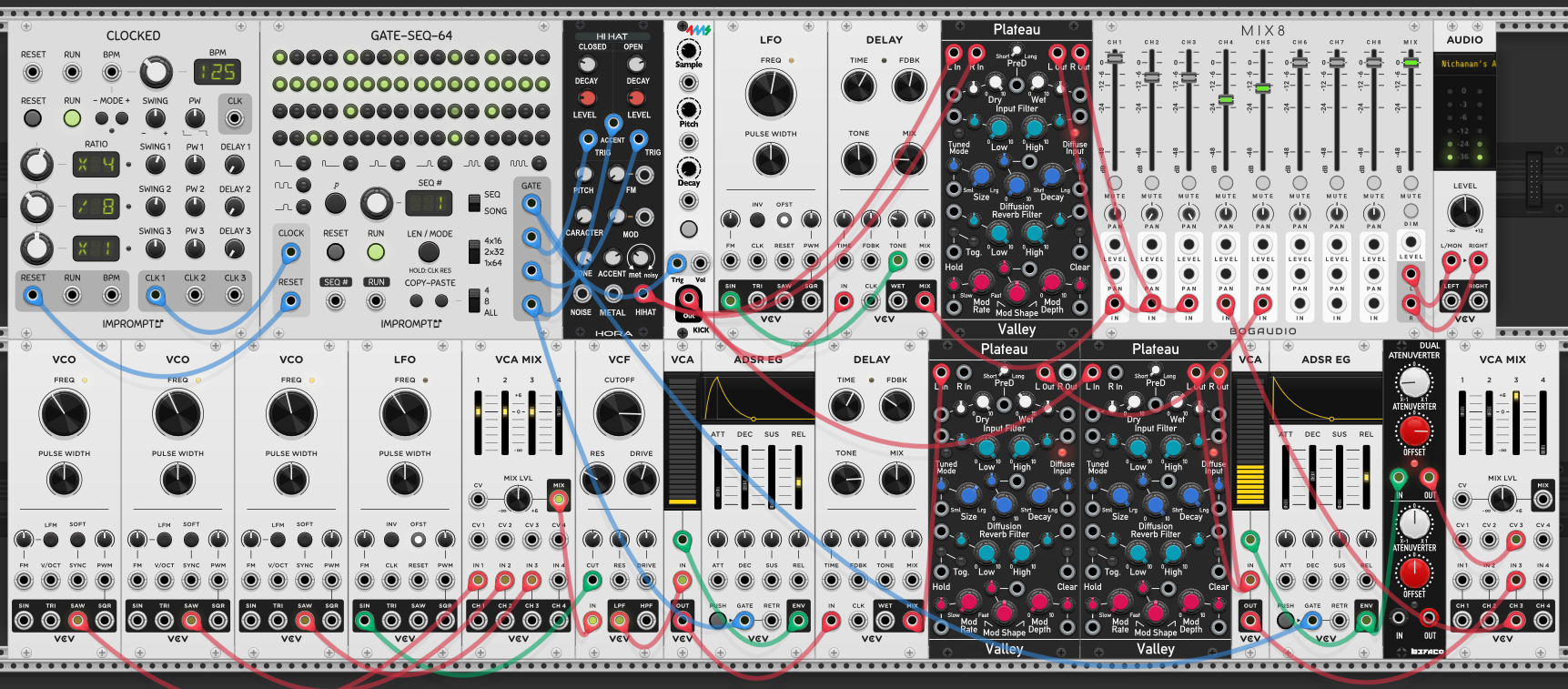
This is the part session 25 never got to — last time seven voices all sat at one level and the mix went flat and busy. The fix isn’t a tool, it’s a way of thinking: a mix is a pyramid in three dimensions — loudness (who’s on top), depth (who’s close, who’s far), and width (what’s centered, what’s spread). Every voice gets a deliberate place in all three.
Build from the kick, not from everything at once. Pulled every fader down, brought the dry kick up alone on its own MIX8 channel — no reverb, just the raw transient — to a healthy level with headroom on the master meter. That’s the loudness reference; every other voice comes up relative to it. Then down the ladder: the rumble up until it’s felt under the kick but never overtakes it, the hats to sit crisp above the low end, the stab last and quietest, brooding behind everything.
Depth = level + wetness + darkness. The single most useful idea of the session. To push a voice toward the back of the room, make it quieter, wetter, and darker; to pull it forward, make it louder, drier, and brighter. So the kick is loud / bone-dry / full-range → right in your face, while the stab is quiet / drenched / muffled → at the back. I’d already built the stab dark and wet, so it wanted to sit back; the mix just had to let it, by keeping its fader low.
Reverb size is a distance cue. Not every reverb should be the same. The hats get a small, short reverb so they feel close — a tight halo, just air and width. The kick rumble and the stab get big, long, dark reverbs so they feel far — a cavern behind the beat. Small = near, large = far; using reverb size to stack voices front-to-back is what gives the mix its sense of a real, deep room.
Mono lows, wide highs. The low end — kick and rumble — stays dead center and mono, because panned bass weakens the low end and falls apart on a big system. The width lives up top. For the hats, the lesson was that multing one mono signal to two channels panned hard L/R does not make it wide — identical signal in both speakers just collapses to phantom center. Real width needs the two sides to differ, so the hats run into their own reverb and the stereo L/R returns spread to two channels panned hard left and right: the dry tick stays anchored in the middle while the reverb tail blooms wide. That contrast — a tight mono point in the low end, an airy spread up high — is what makes the whole thing sound big.
The result is the pyramid I was after: kick punching front-and-center, rumble felt underneath, hats crisp and wide up top, stab brooding in the back. Same four voices as before the mix, but now they occupy different places instead of fighting for one.
Sound characteristics
The kick is the bassline. The whole low end comes from one kick fed into a long dark reverb whose tail is ducked by the kick itself — a sub-bass rumble that swells in every gap and gets slammed back on the downbeat. No separate bass voice; the pump is the groove’s foundation.
A rolling, swung groove. Hats that breathe rather than march — ghosted 16ths, an offbeat open hat lifting each upbeat, accent dynamics, and swing on the clock turning a metronome into something hand-played.
A deep, dark chord on the offbeat. A muffled C-minor stab hitting sparsely in the gaps between kicks, a cutoff envelope giving each hit a soft push, blooming into a tempo-synced delay and a long dark reverb — the rolling dub tail that is the Klock signature.
Restraint over density. Four voices, not seven. The power is in the space between them and in repetition, not in piling on layers.
A deliberate mix. Every voice placed in three dimensions — loudness, depth, and width — with depth built from level/wetness/darkness and reverb size used as a near/far distance cue. Mono centered lows, wide airy highs.
Reflection
This was the session where building from a reference feeling finally felt fluent. “Deep rolling Ben Klock” is a vague sensation, but the translation into signal flow came quickly — the kick is the bass (rumble), the roll is swing-plus-accents not a busier pattern, the hook is a dark muffled offbeat stab with a dub tail. The early miss — reaching for “industrial, metallic” percussion before being corrected — was the useful one: it showed how much a genre label hides, and that “dark techno” splits into very different sub-aesthetics (the hard/industrial one vs. the deep/rolling one) that demand different palettes. Naming the right reference narrowed the build far more than naming the genre did.
The real growth, though, was finally doing the thing I’d flagged twice: mixing for hierarchy. Session 25’s honest weakness was seven voices at equal level, flat in the depth dimension. This time I built fewer voices and placed each one deliberately — and the lesson that stuck is that depth is a craftable dimension, not an accident. Quiet + wet + dark sends a voice to the back; loud + dry + bright pulls it forward; reverb size sets distance. The track sounds like it has a front and a back and a real room, which the session 25 patch never did. The phantom-center trap — discovering that panning a duplicated mono signal hard L/R does nothing — was the small mistake that taught the bigger principle: stereo width is about difference, not position.
What’s still open: the loop is locked but static over time — the dynamism/generativity thread is still unspent. A slow LFO opening the stab filter over many bars, the tape-warble on the delay, or some controlled randomness in the hat accents would let this breathe over minutes instead of repeating identically. That’s the next session’s work — keep this mix, and make it evolve.