Hypnotic Techno — Rolling Arp Bass
Intention
A hypnotic techno patch where the arpeggio is the bassline. Instead of a held or one-note sub, the low end is a fast arpeggio rolling up and down a scale — the kind of relentless sixteenth-note figure that drives a track forward by never sitting still, yet stays locked enough to feel hypnotic rather than busy. Under it, a rumbling kick holds the floor. The goal is for the kick and the rolling arp to interlock into a single pulse: the kick is the weight, the arp is the motion, and together they should loop for ten minutes without getting old.
The arp itself is built from the modules introduced last session — NoteSeq16 into the Super Arpeggiator — but pointed at a new job: not a melodic flourish on top, but the engine at the bottom.
Starting patch
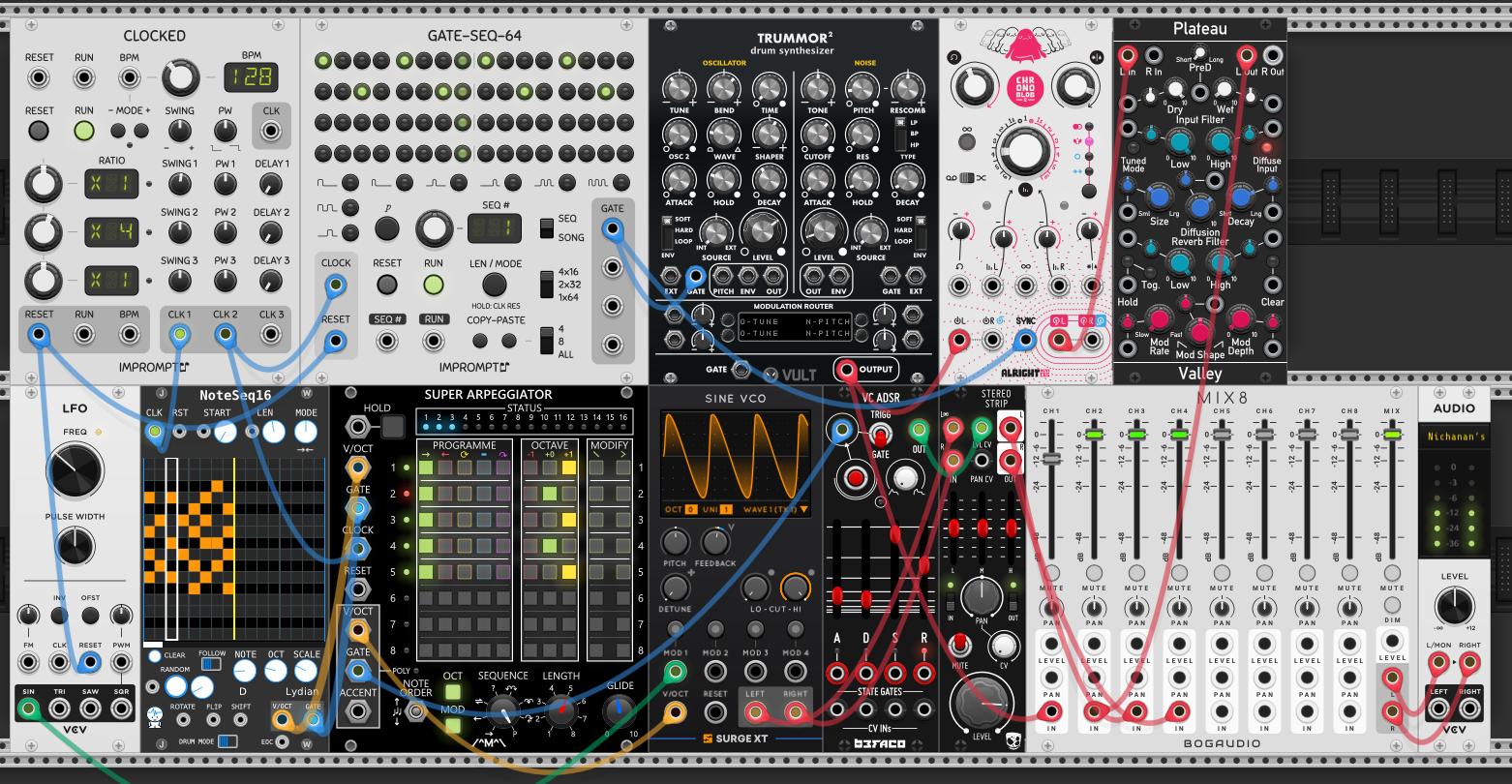
Two voices are already wired, sharing one clock so they lock from the start.
The clock backbone. CLOCKED (Impromptu) is the master at 128 BPM, and its RATIO outputs hand out divisions and multiplications of that tempo — the same division/multiplication split that made the arp work last session. One output clocks the drum sequencer, another drives the arpeggiator’s step clock, so the kick and the bass are children of the same pulse rather than two things I have to keep in sync by hand.
The rumbling kick. The percussion voice is a GATE-SEQ-64 (Impromptu) firing a TRUMMOR² (Vult), a complete drum-synthesis engine in one module — the kick-from-an-oscillator-plus-envelope idea built into dedicated hardware. Its OSCILLATOR section is the body: TUNE sets the fundamental pitch and BEND sweeps the pitch down at the start of the hit (the click-into-boom transient that gives a kick its punch), while the amp envelope’s DECAY sets how long the boom rings — short for a tight thud, longer for the rumble I’m after. A NOISE section with its own filter adds the attack click on top. The gate sequencer decides the pattern; right now it’s the four-on-the-floor foundation.
Rumble from the tail. The kick runs into a CHRONOBLOB (clock-synced delay) and a PLATEAU (Dattorro reverb), and that’s where the “rumbling” comes from — a long reverb tail on the kick that blurs into a continuous sub-bass cloud under the beat, the deep-rolling move from session 26. The Decay sets how long that cloud sustains and the Reverb Filter (low/high dampening) keeps it dark so it sits beneath everything rather than washing over it.
The arp bass. The bottom row is last session’s arpeggiator chain: an LFO and NoteSeq16 (set to a D Lydian scale) feed the SUPER ARPEGGIATOR, whose monophonic output drives the SINE VCO through the VC ADSR and a stereo strip into the MIX8. This is the voice I want to turn into the rolling bass — clocked fast off the master so it rolls in sixteenths, pitched down into bass register, and shaped tight so each note reads as a pluck in the low end rather than a sustained tone.
Both voices sum through the MIX8 to AUDIO. Right now they’re sitting side by side but not yet interlocked — the work of the session is making the rolling arp and the kick share a groove: getting the arp into bass register, tightening its envelope so it rolls instead of drones, and setting the kick and arp levels so the weight and the motion lock into one hypnotic pulse.
Locking the bass to the kick: the sidechain duck
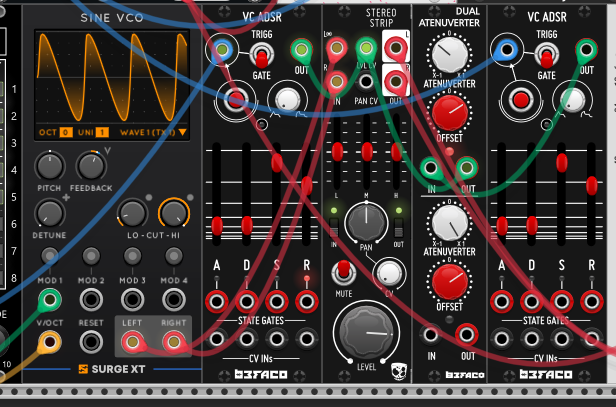
First I made the arp behave like a bass. I dropped the SINE VCO down a couple of octaves into the low register, and pulled the VC ADSR to a short decay with little sustain so each arp step snaps in and out as a pluck instead of sustaining into a drone. That’s the move that turns the melodic figure from last session into a rolling bassline — fast notes, each one a short thump rather than a held tone.
But pitched down into bass register, the arp and the rumbling kick are now both living in the low end at once — and that’s a collision waiting to happen. The kick’s body and its long reverb-rumble cloud occupy the same frequencies as the rolling bass notes, so they sum into boom and mask each other into mud. The fix is to carve the low end: make the two take turns down there instead of fighting for the same space. I did it in time, with a sidechain duck — pull the bass’s level down a notch each time the kick hits, then let it swell back in the gap between kicks.
A duck envelope off the kick’s own gate. Session 15 ducked using an envelope follower reading the kick’s audio; here I used a cleaner, tighter source — a second VC ADSR triggered by the same gate that fires the kick. Because both the kick and the duck come off one trigger, the dip lands exactly on the beat with no lag, which is what keeps it feeling locked rather than sloppy. Its Decay sets how long the gap stays open — short for a sharp punch, longer for a slow breathing pump.
Inverting it with the Dual Atenuverter. A raw envelope rises when the kick hits, which would boost the bass, not duck it — so it has to be flipped. The DUAL ATENUVERTER (Befaco) does it in one channel: its ATENUVERTER knob scales the input from ×1 to ×−1, and its OFFSET knob adds up to ±10 V of DC, so the channel computes (envelope × scale) + offset — exactly the sidechain math. I set the ATENUVERTER into the negative half (that knob is the duck depth), and the OFFSET holds the bass at its resting level so the dip falls down from full rather than the bass only opening on the kick.
Into the level as a second modulation. That inverted-and-offset signal goes to the stereo strip’s level alongside the arp’s per-note envelope, so the bass amplitude is now shaped by two things at once: each note still plucks (the note envelope), and the whole voice dips on every kick (the duck). The result is the pumping interlock the patch is built on — the kick punches through a gap it opens for itself, and the bass rolls up to fill the space between hits. Weight on the beat, motion in the gaps, breathing together as one pulse instead of two voices crowding the bottom.
Rolling hats from Trummor’s noise section
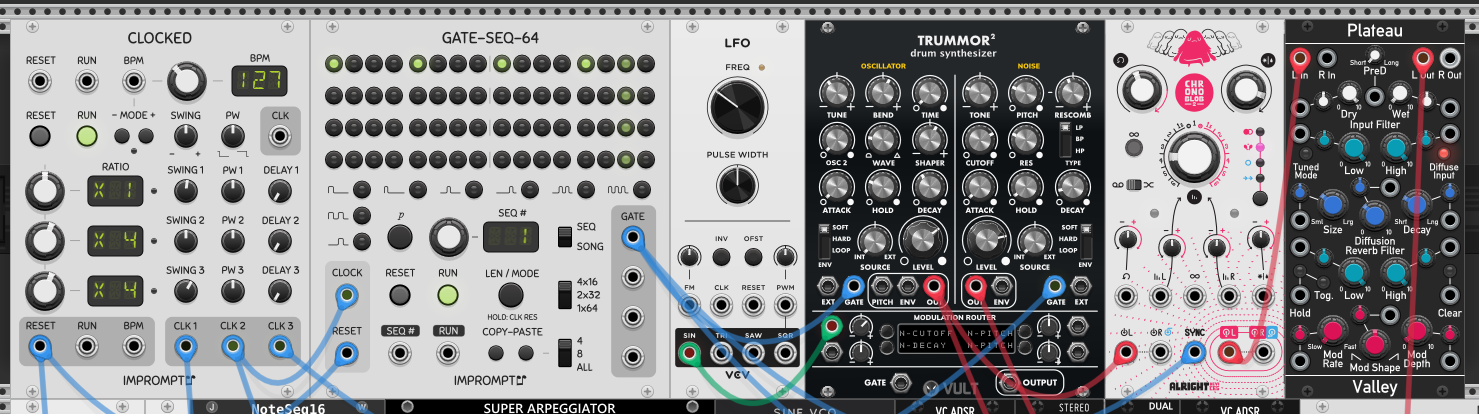
For the high-frequency plane that turns the pulse into a groove, I built the hats out of Trummor’s other half. Its NOISE section is its own filtered-noise-plus-envelope hi-hat — noise through a filter (TYPE set to band-pass/high-pass, CUTOFF up high for a bright metallic tick, RES adding edge) shaped by a short envelope whose DECAY is the difference between a closed “tick” and an open “tss.” So one Trummor gives me two drum voices: the oscillator is the kick, the noise is the hat.
Two voices, two outputs, two spaces. The move that made it work was splitting Trummor’s separate OUT jacks. The oscillator (kick) goes to the mixer plus a send to the CHRONOBLOB delay and PLATEAU reverb on its own channel — that’s where the deep rumble cloud lives. The noise (hat) goes to its own dry channel, so it stays crisp and present on top instead of being swallowed by the kick’s long, dark reverb tail. Kick in a big space, hat in a tight one: the two drums sit in different rooms, keeping the low end deep and the highs articulate rather than smeared together.
Its own clock, with swing. The hat is gated by a separate x4 output of CLOCKED — four pulses per beat, so it rolls in sixteenths under the four-on-the-floor kick. That output has SWING dialled in, so the offbeat sixteenths land late and the roll shuffles instead of ticking dead-straight. That shuffle is most of the “rolling” feel — the difference between a metronome and a groove — and because it’s a separate clock output from the kick’s, I can shuffle the hats without touching the kick’s straight pulse.
LFO sweeping the cutoff for movement. An LFO modulates the noise filter’s cutoff through Trummor’s MODULATION ROUTER (the N-CUTOFF destination), so the hat’s brightness rises and falls over the LFO’s cycle rather than every hit sounding identical — the roll opens up and closes down on its own slow breath. A slow LFO is a long timbral drift across many bars; faster, it’s a per-phrase shimmer. Either way that movement is what keeps a repetitive sixteenth roll alive over a ten-minute loop.
Now the patch has three interlocking planes: the kick’s weight on the floor, the arp bass rolling and ducking through the low end, and the hats shuffling up top.
The full patch
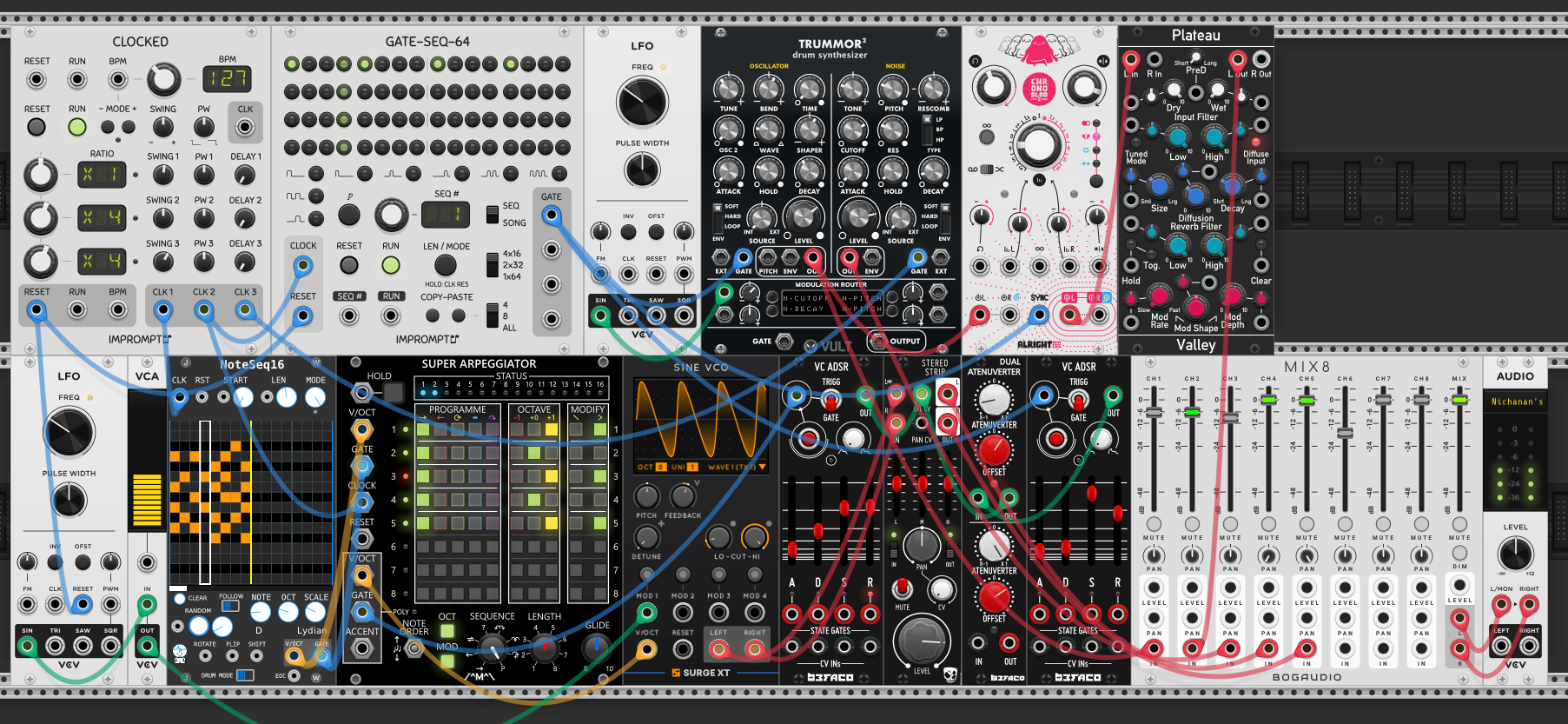
Three voices, one clock, summed through the MIX8. CLOCKED at 128 BPM is the spine: its straight output gates the kick on every beat, a swung x4 rolls the hats in sixteenths, and a multiplication clocks the arpeggiator so the bass rolls in time with everything else. The TRUMMOR² carries two of the three voices — the oscillator kick into the CHRONOBLOB + PLATEAU for its rumble cloud, the noise hat out dry on its own channel — and the SINE VCO arp bass comes through the stereo strip and the Dual Atenuverter duck. Each lands on its own MIX8 channel: kick (plus a wet reverb-return channel for the rumble), hat, and ducking bass, balanced so the kick sits deepest, the bass rolls just above it, and the hats shuffle on top. Out to AUDIO.
Sound characteristics
- A single rolling pulse, not three parts. The defining feature is that the kick, bass, and hats don’t read as separate layers — the sidechain duck ties the bass to the kick so they breathe as one, and the swung hats lock to the same grid. It’s the hypnotic-techno goal: a loop you stop hearing as “kick + bass + hats” and start hearing as one continuous machine.
- Weight that pumps. The kick’s rumble (its reverb tail blooming under each hit) gives the low end physical depth, and the bass ducking out of its way on every beat creates the pump — the bass swelling back up between kicks is the “breath” of the track.
- Forward motion from the hats. The swung sixteenth roll is what drives it forward; the LFO sweeping the noise cutoff keeps that roll shimmering and drifting so it never sits still over a long loop.
- A faintly bright, floating bass. Because the arp runs a D Lydian scale, the rolling bassline carries Lydian’s raised fourth — a slightly bright, unresolved colour under all that dark weight, which keeps the low end from feeling purely heavy.
Reflection
The thing that turned this from “two sounds playing at once” into a track was the sidechain duck — and it’s worth noting how little of that is about the notes. The bass pitches and the kick pattern were already fine; what made them lock was a timing-and-dynamics relationship (duck on the beat, swell in the gap) laid on top of them. The same was true of the hats: the swing did more for the groove than any choice of timbre. Most of “hypnotic” turned out to live in when and how loud, not in what — the carving of the low end in time, and the shuffle, far more than the pitches or the patch’s raw sound.
The other satisfying part was that last session’s theory paid off directly. The arpeggiator I learned as a melodic toy became the engine at the bottom of the track just by pitching it down and tightening it — and one drum module (Trummor) turned into two voices the moment I stopped thinking of its noise section as part of the kick and gated it on its own clock. Both were less about adding modules than about re-pointing what was already there.
I kept this one deliberately minimal — kick, rolling arp bass, swung hats, nothing more — so the arpeggio-as-bassline could be the whole focus without anything else competing for attention. This is meant as a foundation, not a finished track: in future patches I want to build on this arpeggio-and-percussion base, adding dynamism to the bass voice itself (movement in its timbre and pattern, not just the duck) and layering more voices on top. For now the restraint is the point — a small patch where the one new idea has room to be heard before I start stacking.