Krell Patch
Generative Clock with Rampage and S&H
Building on the generative clocks from session 12 and the function generator concepts from session 3, this patch uses Rampage’s looping function as a self-evolving clock source, combining it with the S&H + noise technique from session 7.
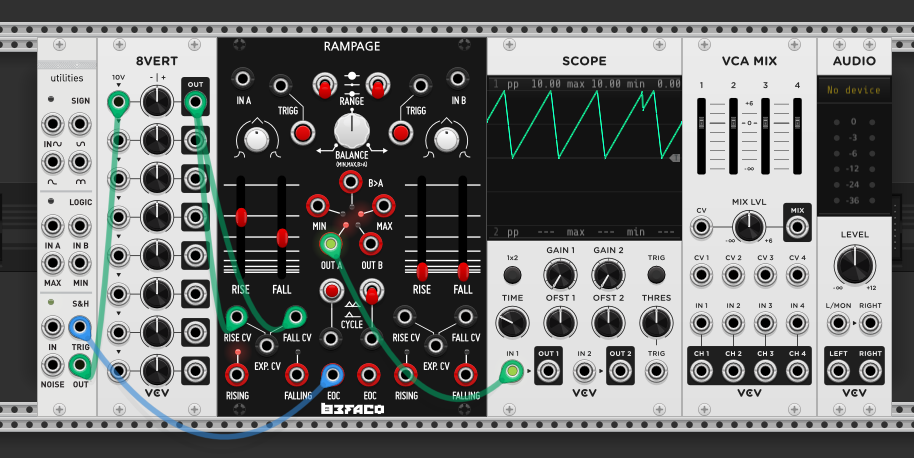
Rampage is set to cycle mode so it continuously loops its rise/fall shape. Its EOC (end of cycle) output triggers the S&H module, which samples noise on each trigger. The S&H output feeds back into Rampage’s fall CV — so each time Rampage completes a cycle, it triggers a new random voltage that changes the fall time of the next cycle. The result is a function that is always changing: sometimes the fall is long (slow clock), sometimes short (fast clock), and the pattern never repeats. The scope shows the irregular, shifting ramp shape.
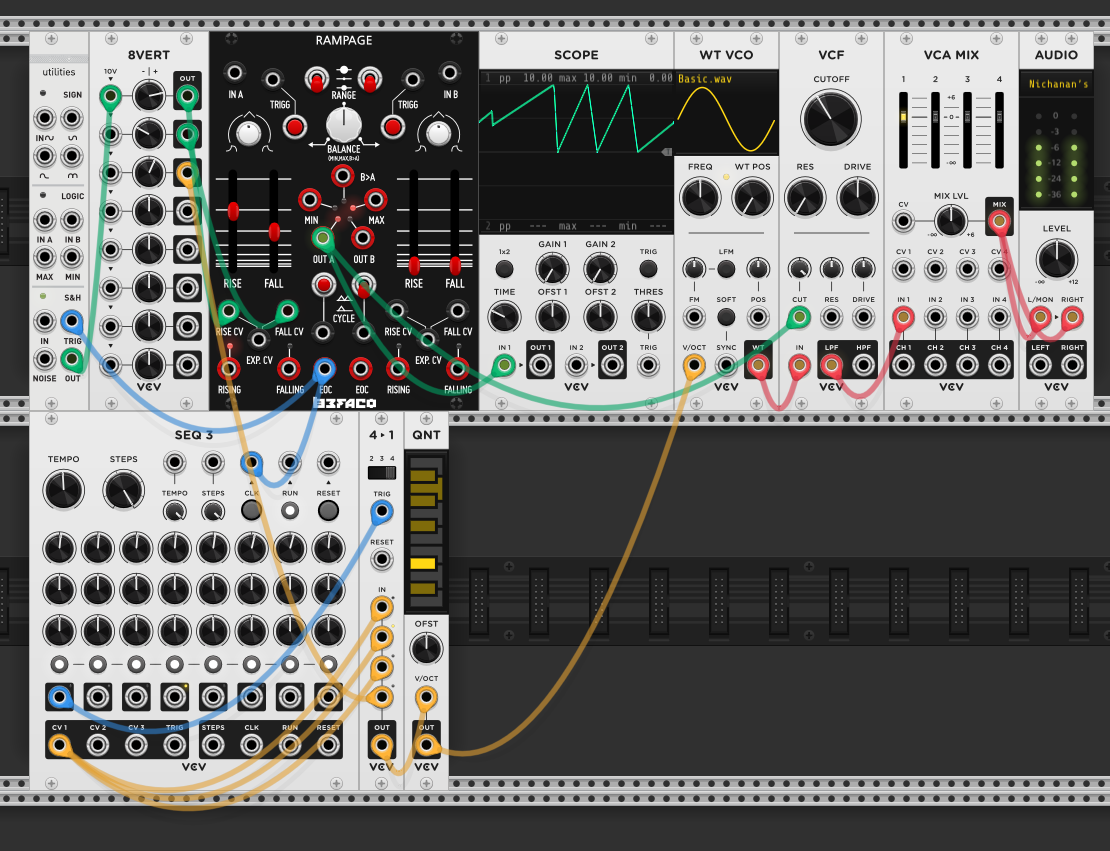
Adding pitch: a 4→1 sequential switch cycles through four pitch sources on each trigger from the sequencer’s first row. The first three inputs come from SEQ3’s CV1 rows — composed, deliberate pitch sequences. The fourth input comes from the S&H, so every fourth step pulls a random pitch instead. The switch output goes through a quantizer into the VCO. This gives a melody that’s mostly composed but periodically injects a random note — controlled unpredictability.
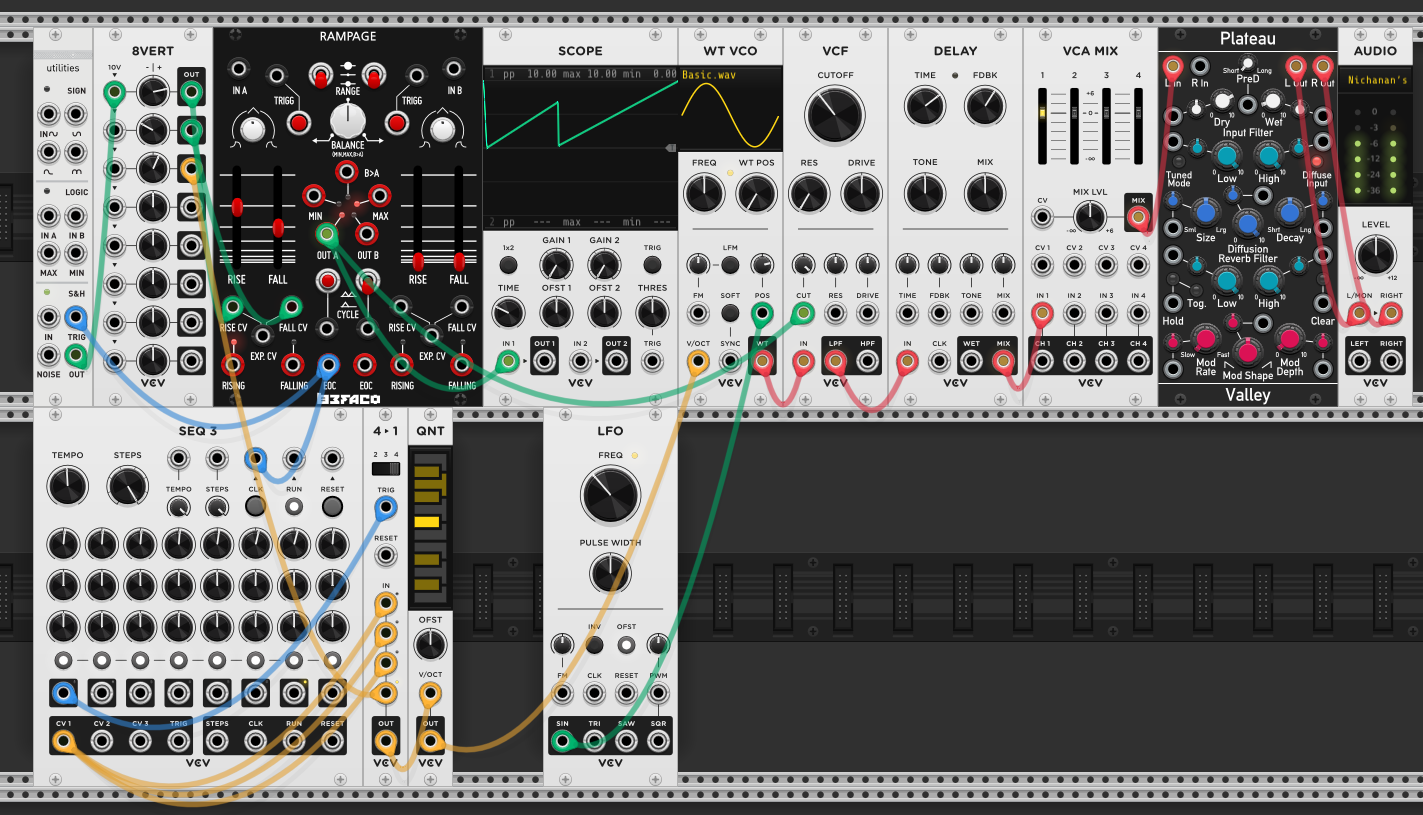
An LFO modulating the wavetable VCO’s position (WT POS) continuously shifts the waveform shape, so the timbre evolves on its own without any manual input. Adding delay and Plateau reverb to the signal chain gives the voice spatial depth — the delay repeats spread notes out in time and the reverb blurs them together. The voice now sounds varied and alive with nothing being manually altered: the Rampage/S&H controls the timing, the sequential switch controls the pitch, and the LFO controls the timbre.
Krell Patch
The Krell patch, developed by Todd Barton (inspired by the film Forbidden Planet), is a self-playing patch where a function generator triggers itself — each note decides the timing and pitch of the next. No clock, no sequencer, no human input after the initial trigger. What makes it a Krell patch specifically: the function generator’s EOC feeds back to its own trigger input, creating a self-sustaining loop. The rise and fall times are modulated by random or evolving voltages, so the rhythm is never regular. Pitch, timbre, and dynamics are all derived from the function generator’s output or from secondary modulation sources it triggers. The result is a patch that sounds composed but never repeats — an endlessly unfolding melody with no external timing reference.
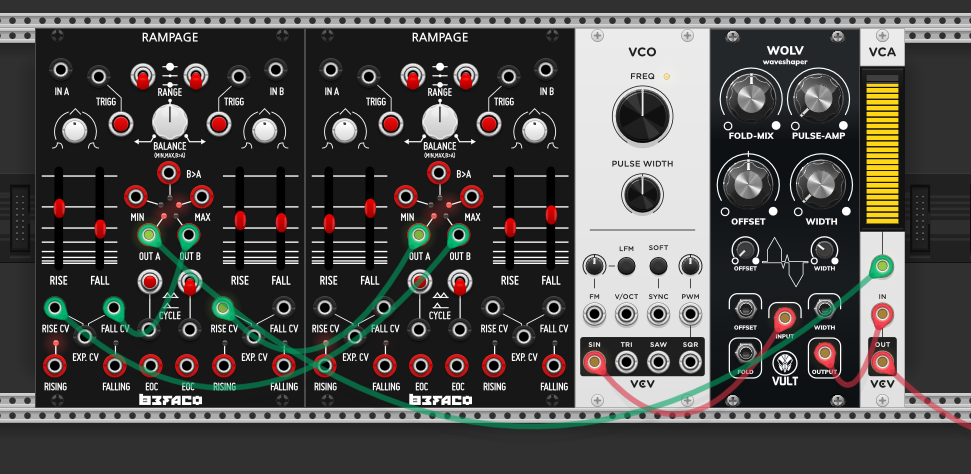
Here a second Rampage acts as a modulation source for the main Rampage. The first Rampage cycles freely, and its output modulates the second Rampage’s rise and fall times — so the main function generator’s shape is being continuously reshaped by another looping function. The second Rampage’s output drives the VCO’s pitch and goes through a WOLV waveshaper into a VCA, giving the west coast signal path: simple oscillator → wavefolder → amplitude control.
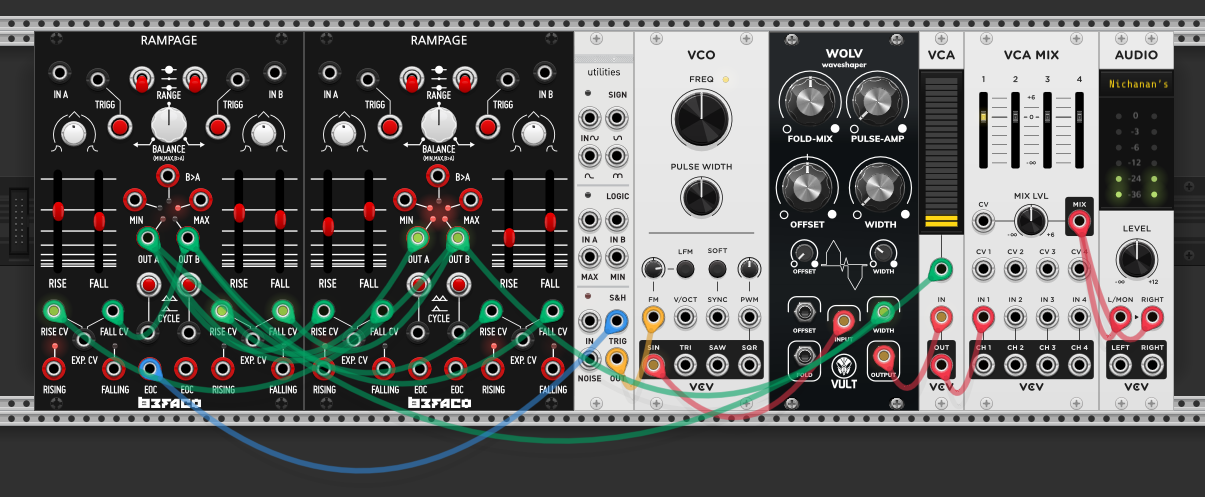
The two function generators can also cross-modulate — the second Rampage’s outputs feed back into the first Rampage’s rise and fall CV inputs, so each function generator is reshaping the other’s timing. This creates deeply intertwined, unpredictable rhythmic patterns where neither function generator’s behavior is independent. The second Rampage’s output also modulates the WOLV waveshaper’s width, so the harmonic content shifts continuously with the same signal that’s driving the timing — tying timbre and rhythm together.
An alternative Krell variation uses two S&H modules triggered by the function generator’s EOC — one randomizes the rise time, the other randomizes the fall time independently. This gives more timbral variety than cross-modulation, since the attack and decay of each note are uncorrelated.
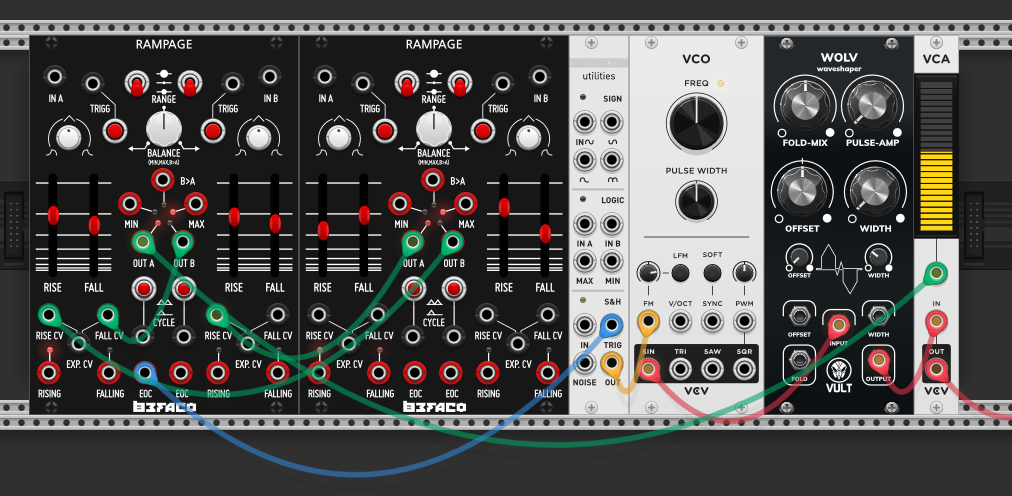
Adding an S&H triggered by the second Rampage’s EOC brings pitch variation into the Krell patch. The S&H samples noise on each cycle completion, and its output modulates the VCO’s FM input — so each note gets a different amount of frequency modulation, adding timbral variation alongside the pitch changes already coming from the Rampage output into V/OCT. The S&H gives stepped, per-note changes while the Rampage gives continuous sweeps — two different flavors of unpredictability layered together.
What it sounds like: a Krell patch has a distinctive quality — melodic phrases that emerge and dissolve without any repeating pattern. Notes cluster together when the function generator’s cycle speeds up, then stretch apart when it slows down, creating natural-sounding phrasing without a grid. The continuous pitch sweeps from the Rampage (as opposed to stepped sequencer pitches) give a gliding, portamento-like quality between notes. With the wavefolder and FM modulation, the timbre shifts from pure to complex unpredictably — some notes ring cleanly, others bite with harmonics. The overall effect sits between music and ambient texture: recognizably melodic but never looping.
Tuning a Krell patch: the balance between chaos and musicality comes down to constraining the right parameters. Quantizing the pitch keeps notes in key even when the source is random. Limiting the range of the S&H output (via an attenuverter) keeps the melody within a singable interval rather than leaping across octaves. The rise/fall knob positions on the Rampage set the range of possible tempos — even with random modulation, the base settings determine whether the patch tends toward slow ambient drones or rapid bursts. The key insight: a good Krell patch isn’t fully random — it’s random within boundaries that keep it musical.