East Coast vs West Coast
East Coast
East coast synthesis is based on subtractive synthesis — start with a bright, harmonically rich waveform like a sawtooth and subtract harmonics using a filter and other modules. This is the approach from session 1: VCO (saw/square) → VCF → VCA, shaped by envelopes. The raw oscillator provides all the harmonics upfront, and the signal chain sculpts the sound by removing what you don’t want.
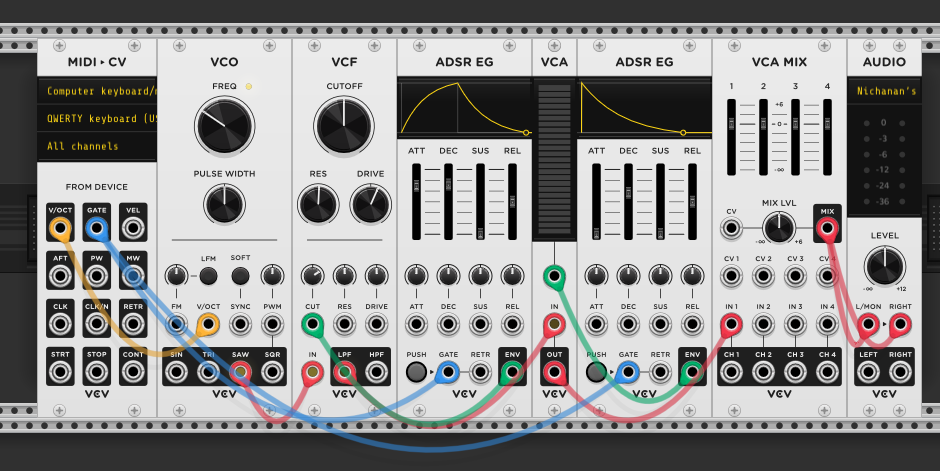
The order of VCF and VCA matters — with VCF before VCA (the standard east coast chain), the filter always processes the full-amplitude signal. With VCA before VCF, a nonlinear filter responds differently to louder vs softer signals, adding dynamic timbral coloration that changes with note velocity or envelope shape.
Mixing a noise generator with the oscillator before the filter adds texture and character to the subtractive voice — useful for breathy pads, gritty basses, or organic percussive sounds.
West Coast
West coast synthesis takes the opposite approach — start with a simple, harmonically sparse waveform like a sine or triangle, and add harmonics to it. This is not additive synthesis (which combines multiple oscillators at specific harmonic frequencies) — instead, west coast uses nonlinear processing to generate new harmonics from a single simple source. The key west coast modules:
- Wavefolder / waveshaper — takes the simple waveform and shapes it into something more complex by folding or distorting it, adding harmonics. See session 6 for how fold amount controls timbral density.
- Low pass gate — combines a VCA and a low-pass filter in one module, so volume and brightness are coupled together. When a note decays, it gets both quieter and darker simultaneously — no separate filter envelope needed. See session 14 for LPG and vactrol behavior.
- Function generator — similar to an envelope but trigger-only, no gate dependency. A trigger fires it and it completes its rise/fall shape independently. This makes it more suited to percussive, self-completing events than the sustain-dependent ADSR used in east coast patches.
West coast patches also tend to use sequencers rather than keyboards as the primary pitch and trigger source — the focus is on generative, self-playing systems rather than real-time performance.
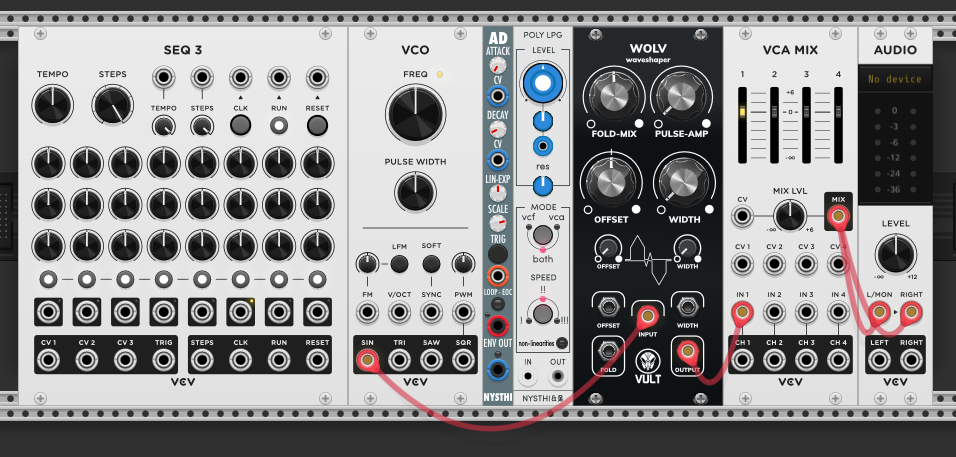
Here the VCO sine goes through the WOLV waveshaper to add harmonics. Unlike the east coast approach where the filter removes harmonics from a bright source, the waveshaper adds harmonics to the simple sine — adjusting the width and pulse-amp knobs on the WOLV increases the timbral complexity. See session 6 for how these controls shape the waveform.
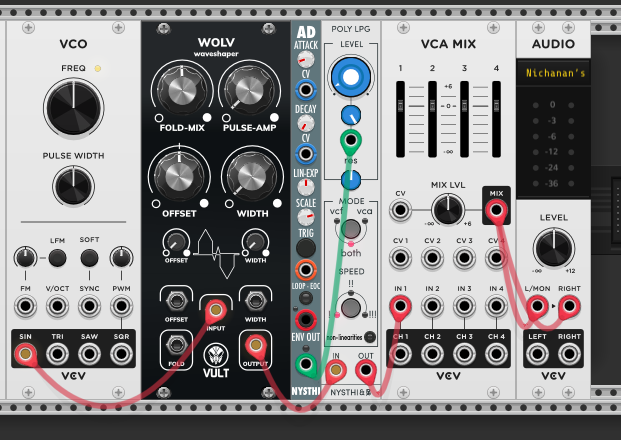
The waveshaped signal then goes to the Poly LPG, which doubles as a level control — it can pass signal on its own without an envelope. To use it with the AD envelope (function generator), take the LPG’s level knob all the way down and send the AD envelope output into the LPG’s CV input. Now the function generator controls when and how the sound opens — a trigger fires the AD, which briefly opens the LPG, and the sound completes its attack/decay shape without needing a held gate.
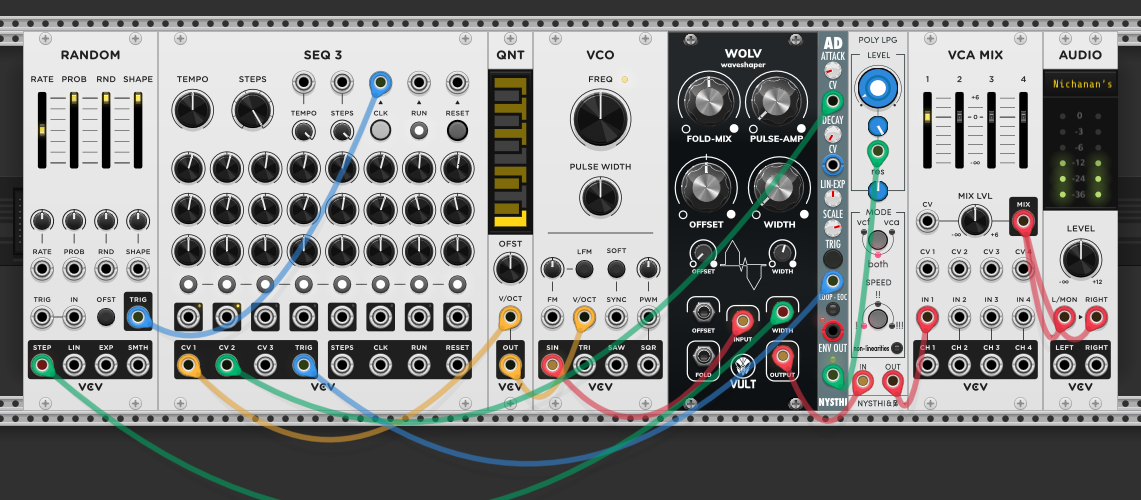
Adding a random module whose step output modulates the waveshaper’s width gives each note a different timbral character — some notes fold more, some less, so the harmonic content varies per step. This is a west coast approach to variation: instead of filtering a static bright source differently per note (east coast), you’re generating different amounts of harmonics per note from a simple source.
Filters and LFOs as Voices
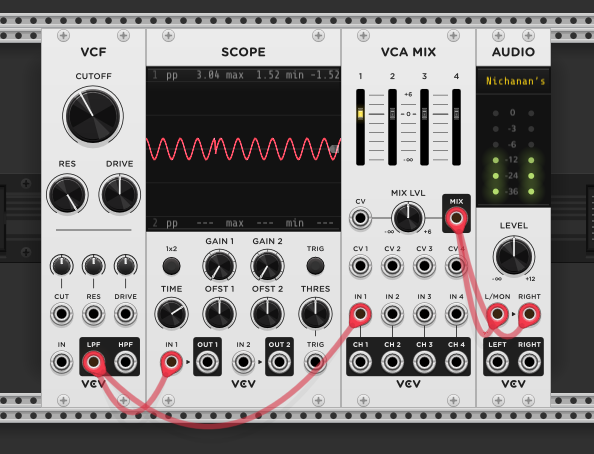
A filter’s resonance boosts frequencies at the cutoff point. With some filters, pushing the resonance high enough causes the filter to self-oscillate — it generates a sine wave on its own with no input signal. This was used for percussion in session 14, but it can also be a pitched voice. The cutoff frequency controls the pitch of the self-oscillation, and some filters track 1V/OCT on their cutoff CV input, meaning they can be played chromatically with a sequencer or keyboard like a regular oscillator.
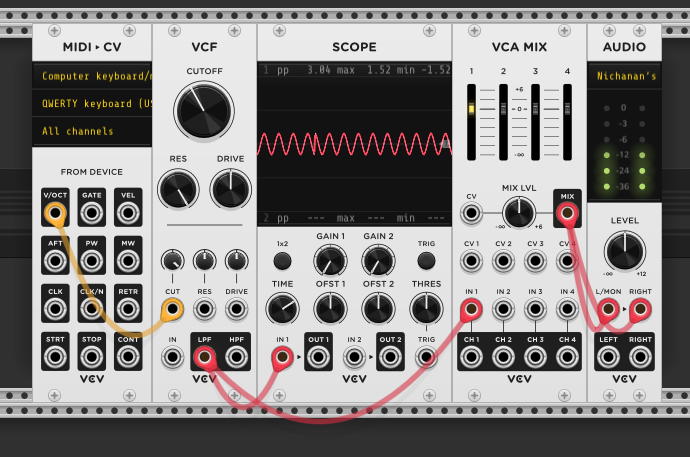
Here the MIDI-CV module’s V/OCT output goes straight into the VCF’s cutoff CV input — no oscillator in the patch at all. The keyboard plays the filter like an instrument, with each key setting the cutoff frequency and therefore the pitch of the self-oscillating sine.
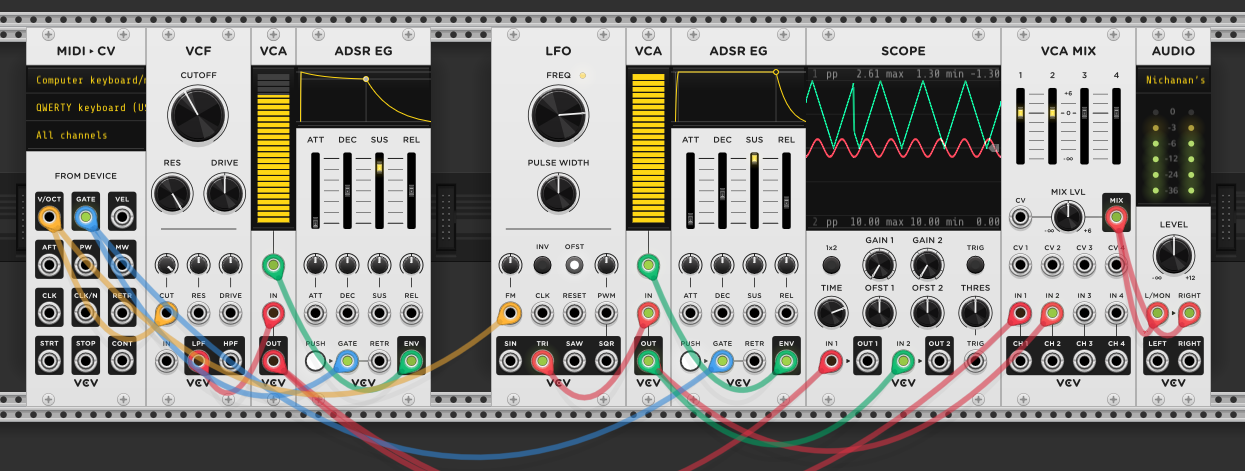
An LFO can also become a voice by turning its frequency up into the audio range. An LFO is just a slow oscillator — there’s no fundamental difference between an LFO and a VCO other than the frequency range and sometimes V/OCT tracking. Here the LFO runs as a second voice alongside the self-oscillating filter, each with its own ADSR and VCA, both mixed together.
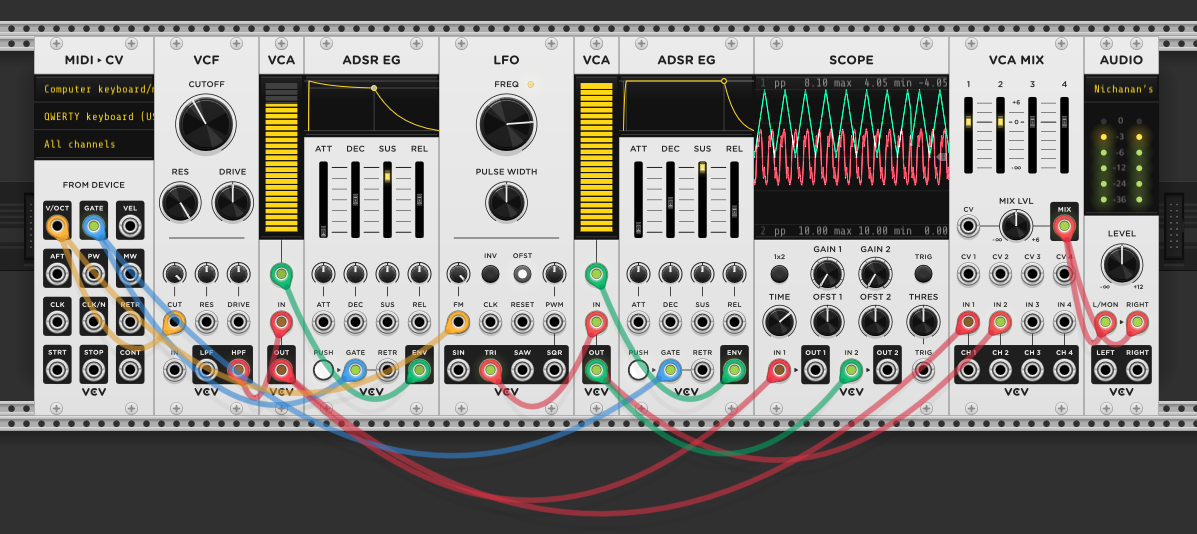
Switching the filter to its HPF (high-pass) output changes the character of the self-oscillation. The high-pass produces a different waveform than the low-pass, giving an organ-like tone at higher frequencies or a bass-like sound at lower frequencies — a different voice from the same filter module just by using a different output.
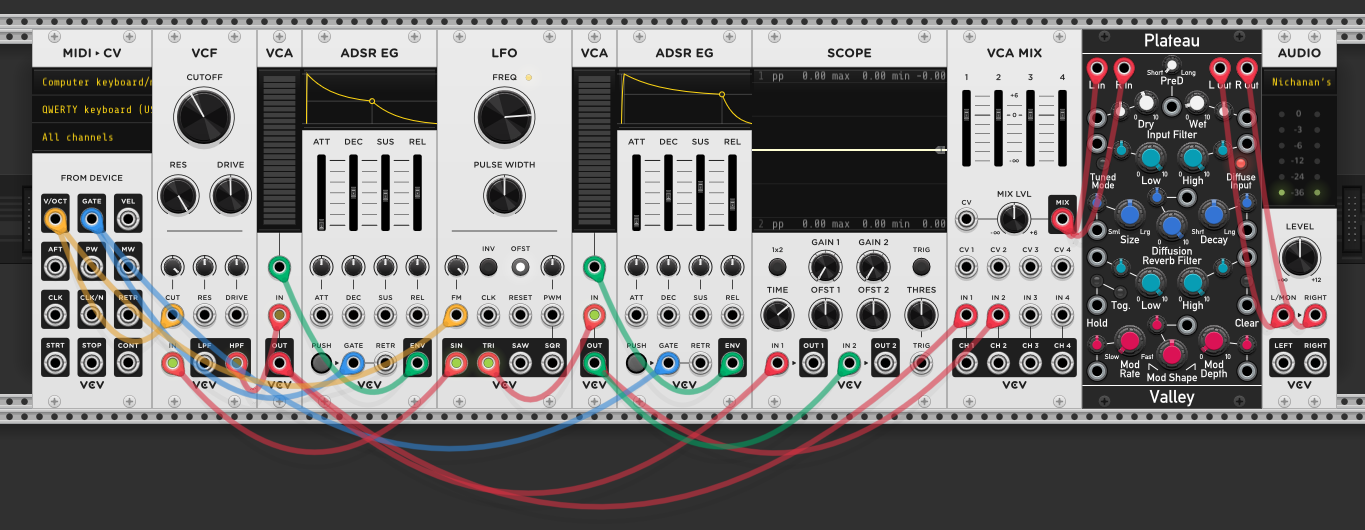
Passing the audio-rate LFO into the self-oscillating filter’s input combines both voices — the LFO signal interacts with the filter’s resonance for a richer, more complex tone. The key takeaway: you don’t need a traditional oscillator to create voices. Filters and LFOs can both produce pitched audio on their own. This is especially useful in hardware where modules are expensive — getting extra voices from modules you already have means more sounds from fewer HP.
East Coast vs West Coast Summary
The two approaches differ in philosophy, not just signal flow:
| East Coast | West Coast | |
|---|---|---|
| Source | Harmonically rich (saw, square, pulse) | Harmonically simple (sine, triangle) |
| Timbre control | Subtractive — VCF removes harmonics | Additive/nonlinear — wavefolder, FM add harmonics |
| Amplitude | VCA + ADSR (separate filter and amp envelopes) | LPG — volume and brightness coupled, natural decay |
| Envelope | ADSR — gate-dependent, sustain stage | Function generator — trigger-and-forget, rise/fall only |
| Input | Keyboard-oriented, real-time performance | Sequencer-oriented, generative/self-playing |
| Sound character | Precise, controllable, familiar (analog synth sound) | Organic, plucky, percussive (vactrol decay, natural damping) |
In practice, the distinction is a spectrum — most patches blend both approaches. The east coast chain gives precise, repeatable control over the sound. The west coast chain produces sounds that feel more organic and unpredictable because the LPG’s vactrol response and the wavefolder’s nonlinearity introduce natural variation that’s hard to replicate with a VCF + VCA chain. The LPG’s coupled brightness/volume decay — where the sound gets darker as it gets quieter — is the signature west coast quality, mimicking how acoustic instruments naturally behave.
A complex oscillator bundles two oscillators with pre-routed internal modulation — typically FM, AM, ring mod, sync, and waveshaping in one module. Rather than patching discrete VCOs and wavefolders together (as in this session), a complex oscillator provides the same interactions — FM, AM and ring mod, sync, and waveshaping — with dedicated knobs for each. Common in west coast systems where timbral complexity comes from oscillator interaction rather than filtering.