Sequential Switches
What sequential switches do
Sequential switches are like sequencers, but instead of generating a fixed sequence of values, they let you choose what signals get sequenced or where signals get sent. A sequencer steps through its own internal values — a sequential switch steps through external connections.
Two configurations:
- One input → multiple outputs: a single source is routed to destinations one at a time, cycling through them on each trigger. The signal appears at output 1, then output 2, then output 3, and so on.
- Multiple inputs → one output: several sources take turns feeding a single destination. Input 1 passes through, then input 2, then input 3 — the output hears each source in sequence.
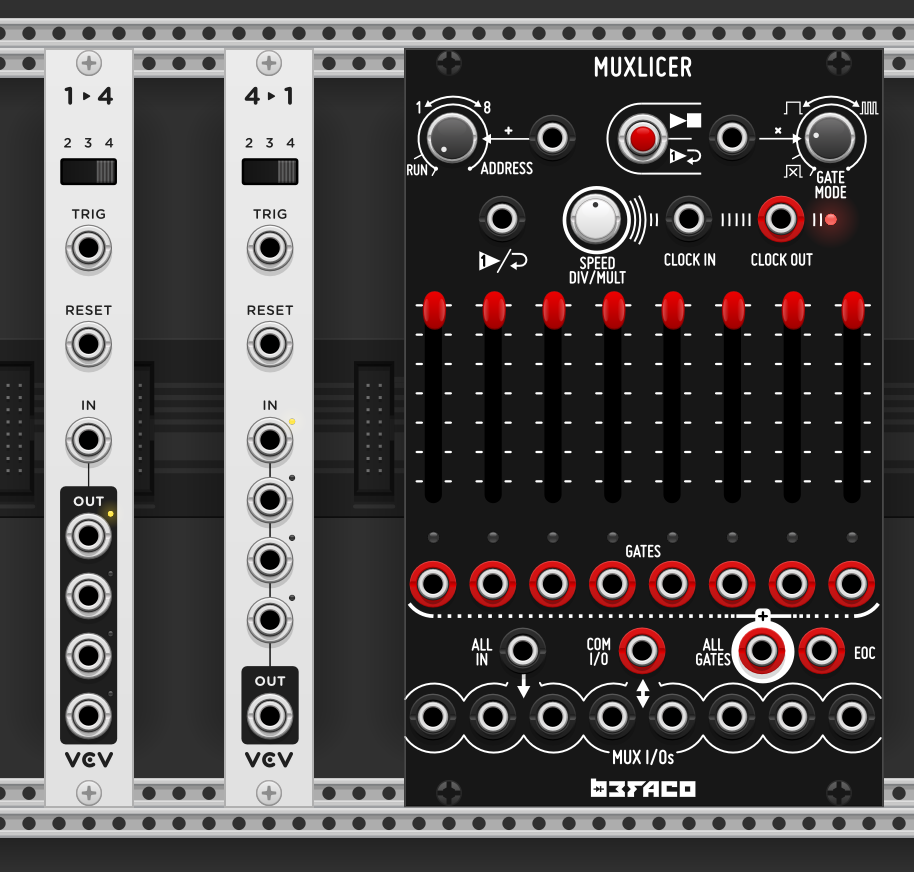
Hardware flexibility — the Muxlicer
In VCV, these are separate modules. In hardware, a single module can often do both. The Muxlicer (Befaco) is a good example: it has 8 channels and works as either 1-to-8 or 8-to-1 depending on how you patch it. The direction isn’t a setting — it’s determined by whether you connect a signal to the single I/O jack as input or tap it as output.
Sequencing modulation sources — 4→1 LFO switching
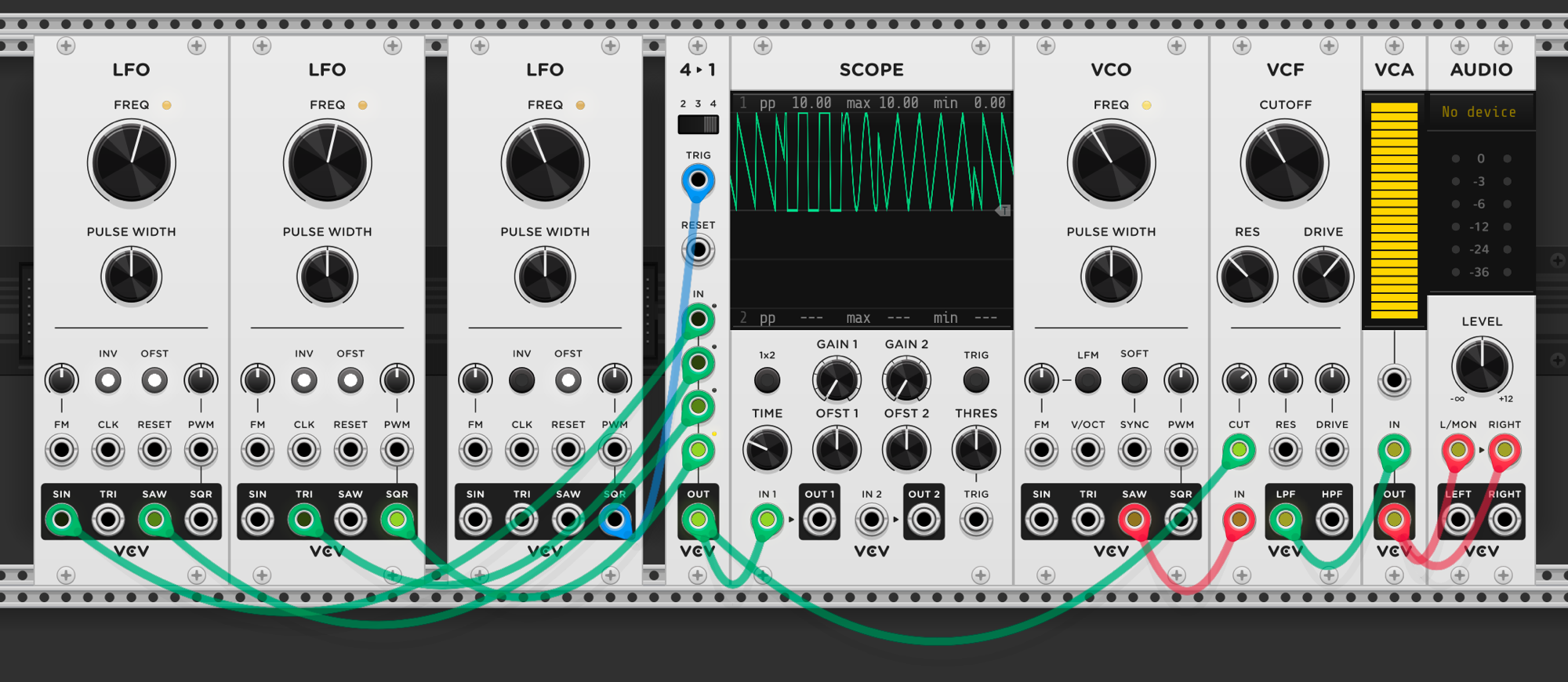
Three LFOs with different waveshapes feed the inputs of a 4→1 sequential switch (green cables). The switch steps through them, sending one LFO at a time to the VCF’s cutoff modulation input. The voice chain is straightforward: VCO (sawtooth) → VCF → VCA → Audio (red cables).
The scope shows the result — the modulation waveform keeps changing character as the switch cycles between LFO shapes. Instead of one continuous modulation, the filter hears a sine, then a triangle, then a saw, then a square, each shaping the cutoff differently before the next takes over. The timbral movement becomes more complex than any single LFO could produce.
Chaining rows into a long sequence
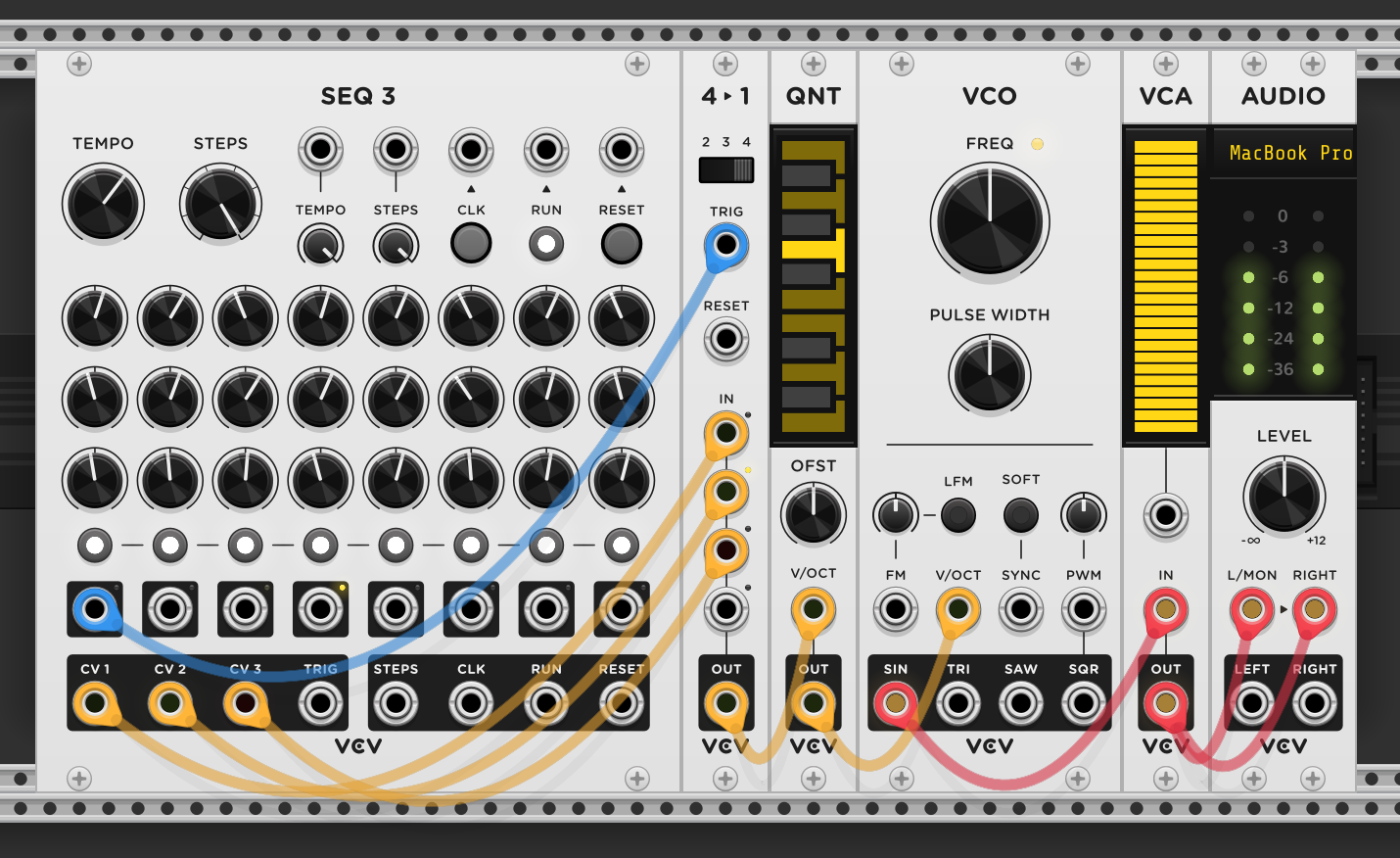
SEQ 3 has three rows of 8 knobs, each with its own CV output. All three row outputs (yellow cables) feed the inputs of a 4→1 sequential switch. The switch plays row 1, then row 2, then row 3 — turning three 8-step sequences into one 24-step sequence.
The clocking trick: the first step of row 1 has its trigger output (blue cable) patched to the switch’s TRIG input. Every time the sequencer completes a full cycle and returns to step 1, that trigger fires and advances the switch to the next row. The sequencer clocks itself through the rows. The switch output goes through a quantizer into VCO → VCA → Audio (red cables) for the voice.
Sequencing destinations — cycling through effects
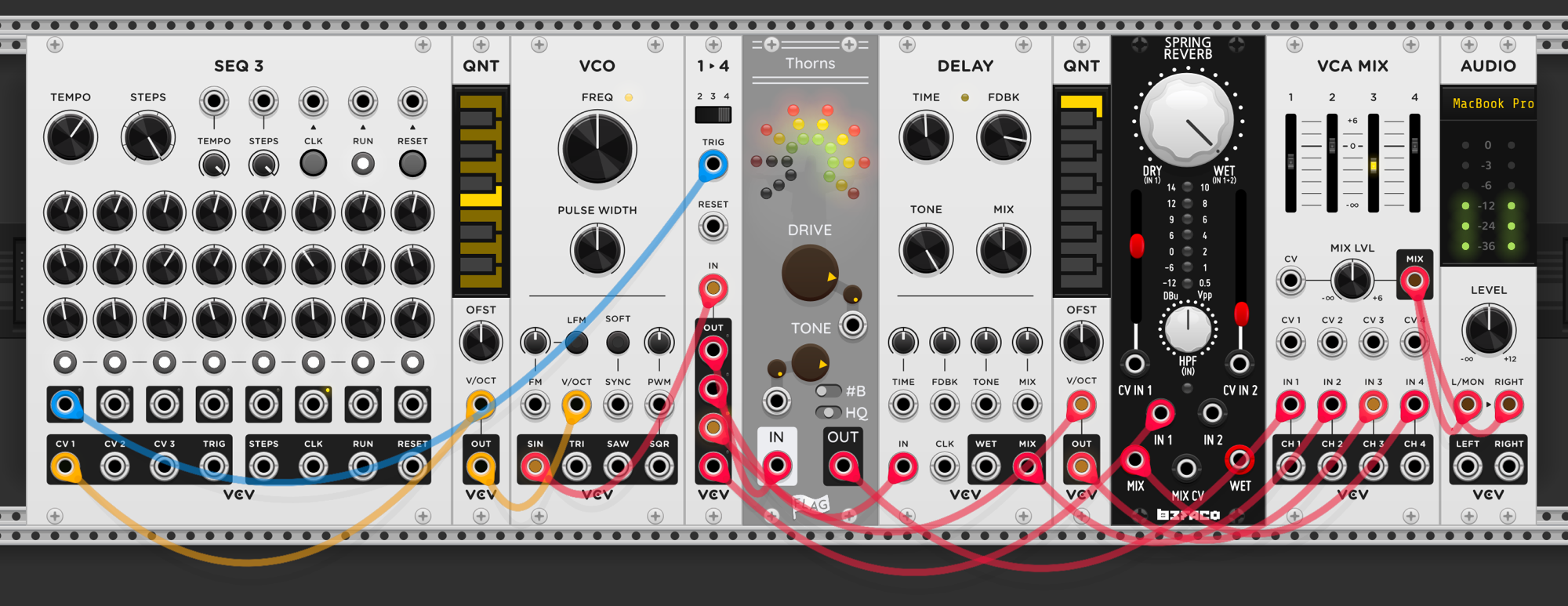
The previous patches used the 4→1 switch to sequence sources. This one flips it — the 1→4 switch sequences destinations. SEQ 3’s first row provides pitch (yellow cable) through a quantizer to the VCO. The VCO’s output (red cable) feeds the 1→4 switch’s single input.
The four switch outputs each go to a different effect: Thorns (distortion), Delay, Quantizer, and Spring Reverb. As the switch steps, the same audio signal gets routed to a different effect on each step — distorted on one beat, delayed on the next, quantized on the third, reverbed on the fourth. All four effect outputs are mixed back together through VCA MIX to audio (red cables), so you hear the sequence passing through a rotating chain of processing.
Two voices from one sequencer — reordered rows
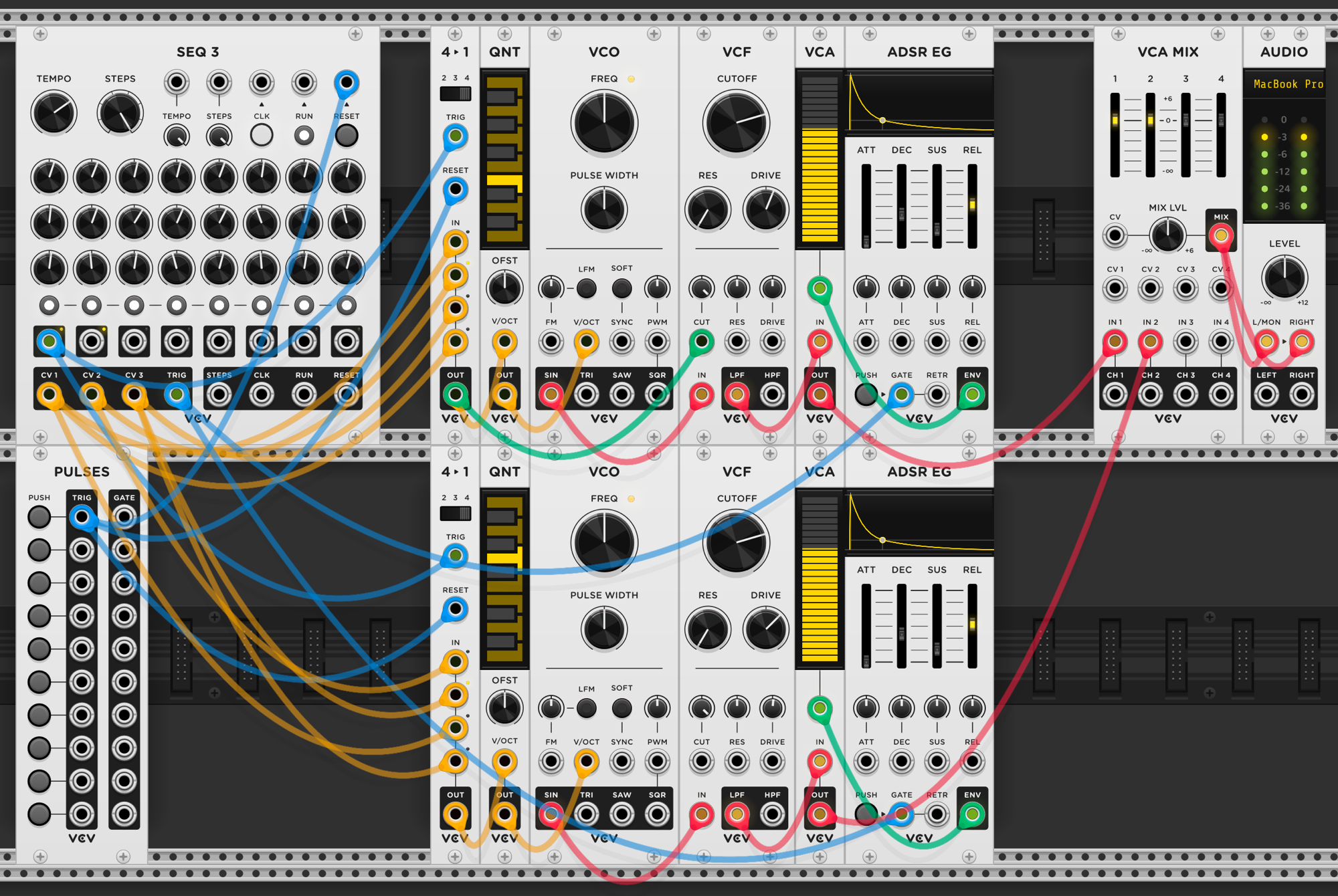
The same SEQ 3 feeds two separate 4→1 sequential switches, but the three CV rows (yellow cables) are patched to the switch inputs in a different order. Both switches step at the same rate, so they play in sync — but because the rows appear in a different sequence, each voice gets a different melody. One might play row 1 → 2 → 3, the other row 2 → 3 → 1.
Each switch output goes through its own complete voice chain: quantizer → VCO → VCF → VCA with ADSR envelope. Both voices are summed through VCA MIX to audio (red cables). The Pulses module (blue cables) resets both sequential switches so the two voices always start from the same point — without this, they could drift out of alignment after a reset or tempo change.
Splitting a sequence to four destinations
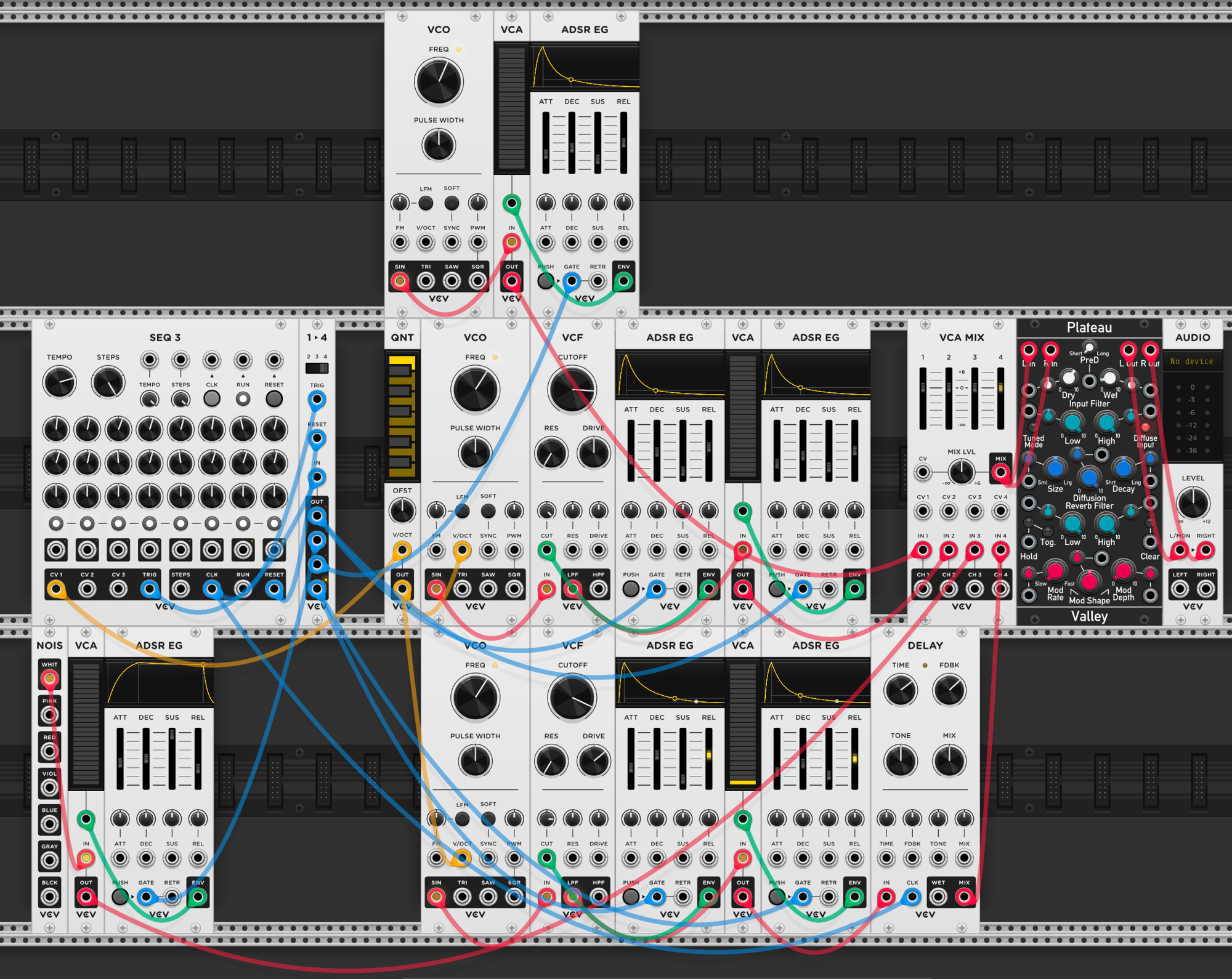
Instead of playing every step through the same voice, the 1→4 switch distributes the sequence — each step goes to a different destination. SEQ 3’s first row CV output feeds the switch, and the four outputs go to:
- Noise percussion: noise module through VCA with a short ADSR. The pitch CV from the sequencer doesn’t matter here — the noise source ignores it. What shapes the sound is the gate triggering the envelope.
- Three melodic voices: each with its own VCO → VCF → VCA chain and distinct ADSR envelope shapes
Each voice has different processing — one gets delay, the final mix passes through Plateau reverb. The result is a single 8-step sequence that sounds far richer than it is: step 1 might be a percussive click, step 2 a filtered pad, step 3 a delayed pluck, step 4 a reverbed tone, then the cycle repeats. One sequencer, four timbres.