Wavefolder
Wavefolding a sine
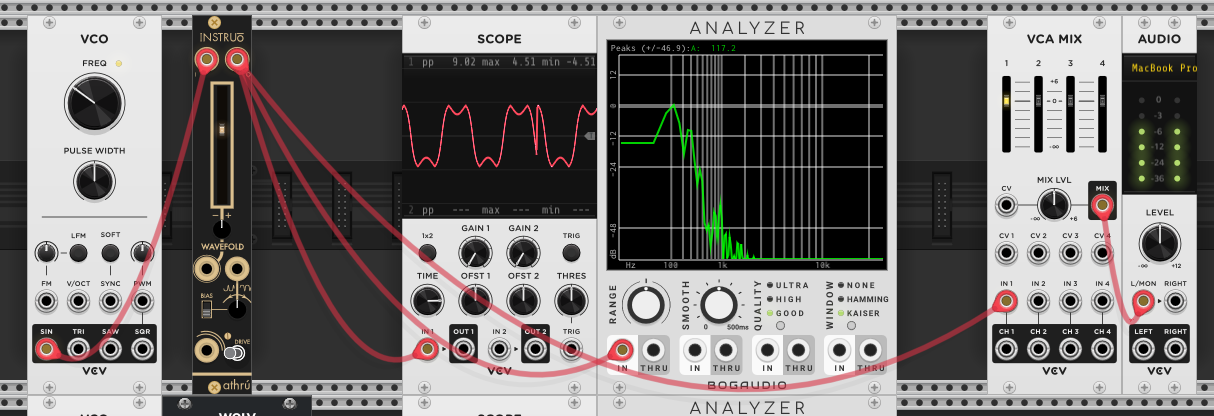
A VCO sine output patched into an Instruo wavefolder. The WAVEFOLD fader controls how much the waveform folds — as it increases, the sine’s peaks exceed the fold threshold and get pushed back down, folding in on themselves. The scope shows it clearly: what was a smooth sine now has extra peaks and valleys where the waveform reversed direction.
The analyzer confirms what the ear hears: the folded sine has new harmonics that the original didn’t have. A pure sine has only its fundamental — wavefolding adds overtones by creating sharp changes in the waveform shape.
Wavefolding is not the same as distortion or clipping. Clipping flattens the peaks — the signal hits a ceiling and stays there. Wavefolding reflects the peaks back down, creating new curves rather than flat tops. This is why folded waveforms sound richer and more complex rather than just harsh.
As the input level or fold amount increases, the signal folds multiple times — each fold adds another reflection, progressively more harmonics, and a more complex waveform. A single fold adds a few overtones; multiple folds create dense, metallic, even vowel-like timbres.
This is the opposite approach to subtractive synthesis. Subtractive starts with a harmonically rich waveform (sawtooth, square) and removes harmonics with a filter. Wavefolding starts with a simple waveform (sine) and adds harmonics by folding its shape. Two opposite paths to timbre — one carves away, the other builds up.
Vult WOLV waveshaper
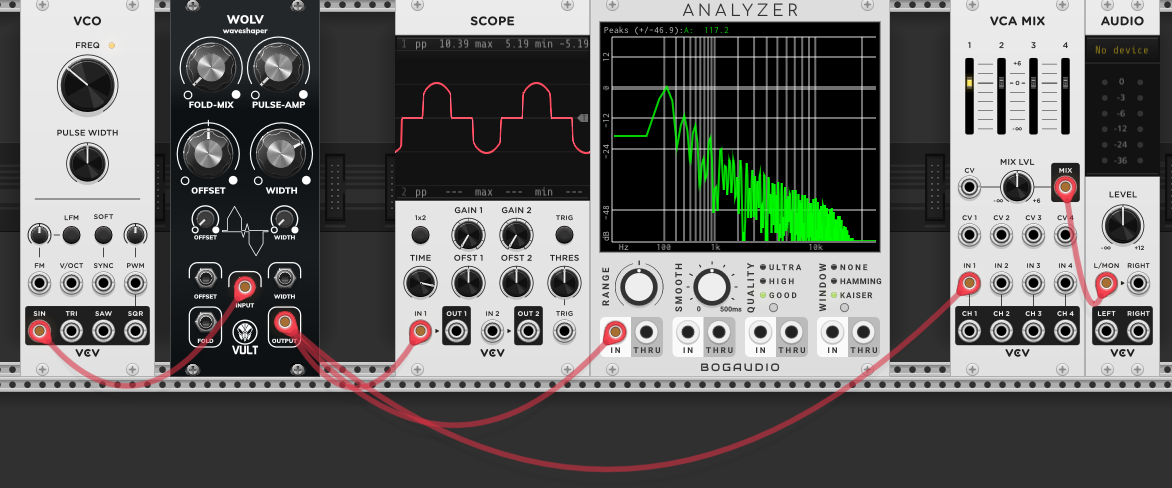
A different module, the Vult WOLV waveshaper, taking the same sine input. The WIDTH and FOLD-MIX knobs control the shape of the output waveform. The scope shows a dramatically different result from the Instruo — the sine has been squared off with rounded bumps, almost pulse-like. The analyzer shows a dense spread of harmonics extending well into the high frequencies.
Both modules start from the same principle — reshape a simple waveform to add overtones — but each has its own character. The Instruo folds the peaks symmetrically, the WOLV offers more control over the shape with its width and offset parameters. The OFFSET knob shifts the waveform up or down relative to the fold threshold, introducing asymmetry between the positive and negative halves — this creates different overtones than symmetric folding, adding odd or even harmonics depending on the bias. Different waveshapers are like different filters: same concept, different sonic personality.
LFO modulating the waveshaper
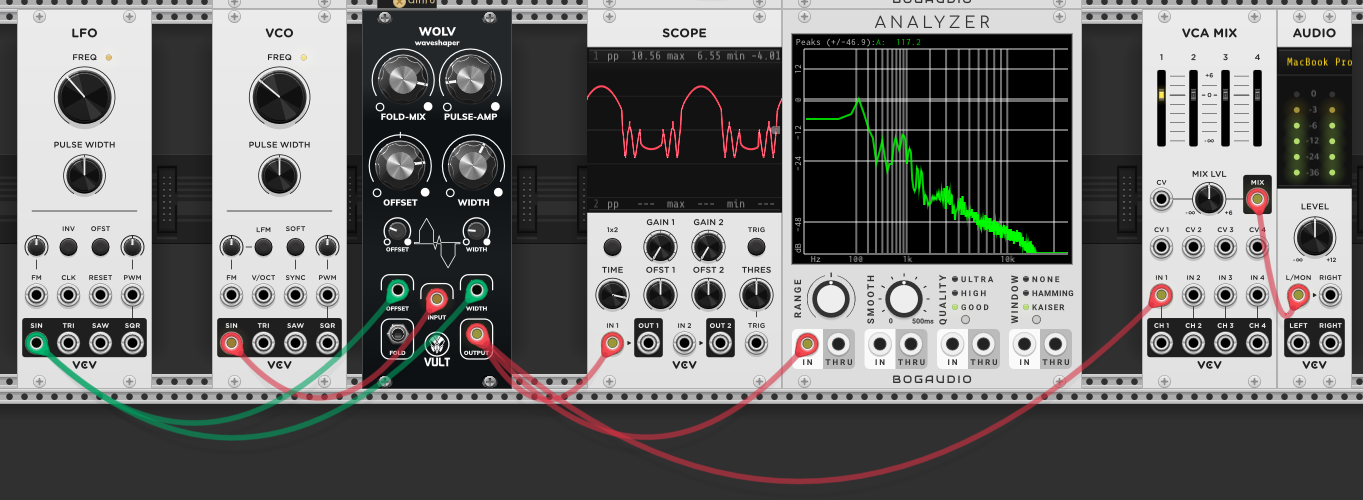
An LFO is added, with its outputs patched to the WOLV’s offset and width CV inputs (green cables). The LFO continuously sweeps both parameters, so the waveform shape and harmonic content are always changing — the scope shows the waveform morphing in real time, and the analyzer spectrum is smeared because it never settles.
This is the same idea as the LFO sync sweep from Session 4: a free-running modulation source continuously varying the timbre. The difference is the mechanism — Session 4 swept the secondary oscillator’s frequency to change which harmonics the sync created, here the LFO changes how aggressively the waveform folds. Different timbral tool, same modulation principle.
Waveshaper controlling filter cutoff
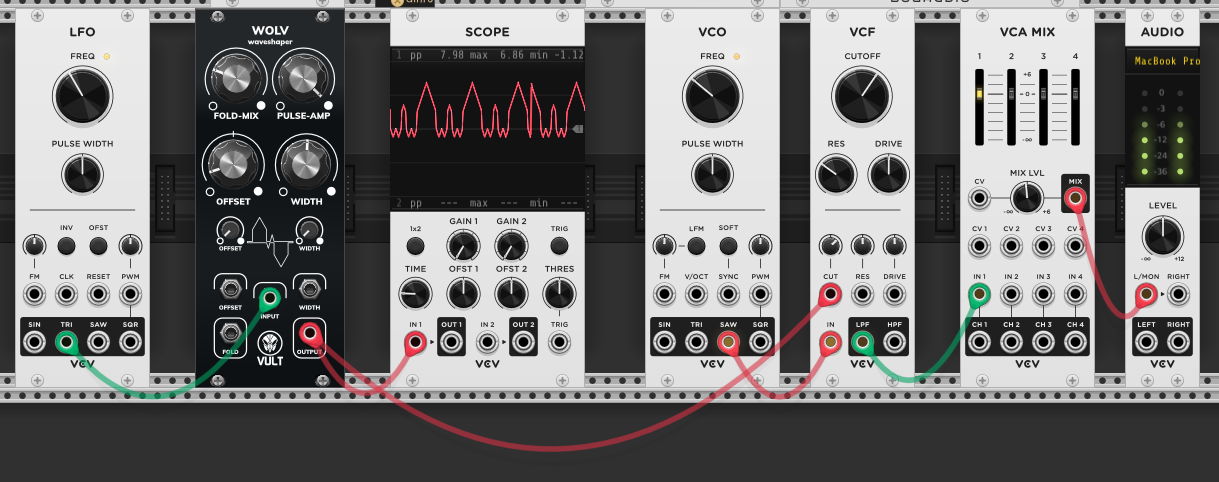
The waveshaper isn’t limited to shaping audio — it can shape any signal, including modulation. Here the LFO goes through the WOLV, and the shaped output controls the VCF’s cutoff point. A separate VCO provides audio through the filter’s low-pass output to the mixer.
The LFO alone would sweep the cutoff in a smooth sine or triangle shape. Running it through the waveshaper first reshapes that modulation curve — the cutoff now moves in a more complex, non-linear pattern. The scope shows the shaped LFO waveform that’s driving the filter. This is a way to get more interesting filter movement without needing a more complex modulation source — take a simple LFO and reshape it.
This works because the WOLV is DC-coupled — it processes control voltage the same way it processes audio. Many wavefolders are DC-coupled, meaning they can reshape LFOs, envelopes, or any other modulation signal into unique curves, not just audio waveforms. The same applies to audio — wavefolders can process drum loops, field recordings, or vocals for unexpected harmonic textures, not just simple oscillator waveforms.