Basic Techno
Intention
A driving techno patch built on a steady, predictable foundation — four-on-the-floor kick and a hi-hat keeping time, no randomness or generative drift. Unlike the generative thriller score, this one is meant to lock in. The groove should be hypnotic and repetitive, the kind of pulse you could loop for ten minutes. From that rhythmic bedrock we layer in a bass voice that locks to the kick, then atmospheric voices — pads, stabs, noise sweeps — to give the loop depth and movement without breaking the pulse.
Starting patch
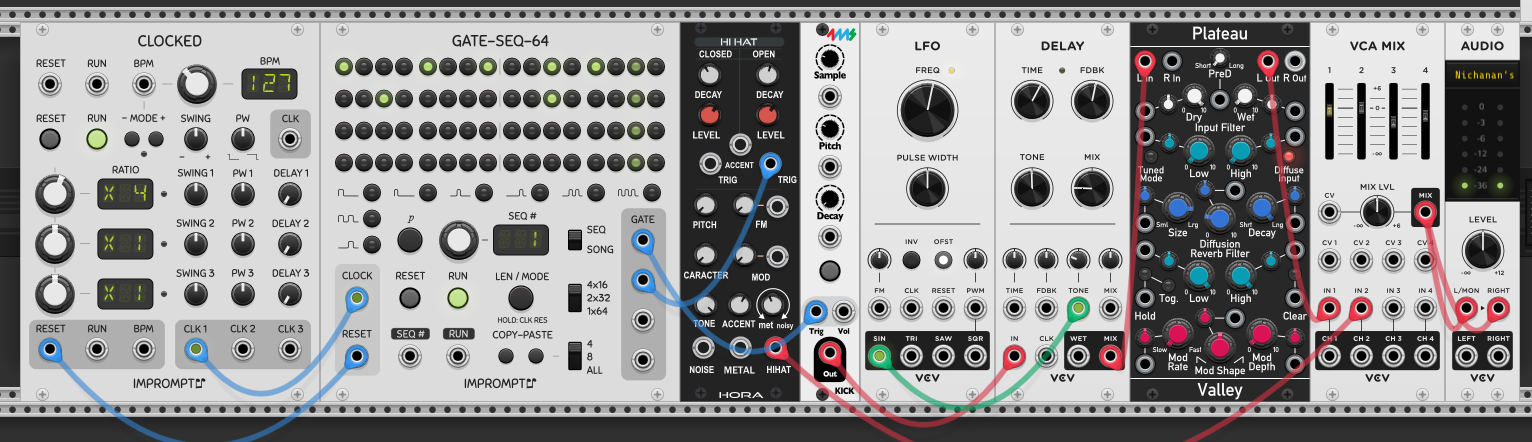
Clock: Impromptu CLOCKED runs the whole patch at 127 BPM, with ratio outputs and per-output clock delays. Its CLK and RESET outputs (blue) drive the gate sequencer and the drum triggers.
Drums: Impromptu GATE-SEQ-64 holds the programmed patterns — a kick on every quarter note and a hi-hat pattern offset against it. The kick comes from a dedicated kick drum module (Sample / Pitch / Decay), the hi-hat from a dedicated hi-hat module with closed/open trigger inputs and noise/metal character controls.
Effects and mix: an LFO is available for modulation (green), a VCV DELAY and a Valley Plateau reverb provide space (red audio in/out, with wet/mix sends). Everything sums into VCA MIX → AUDIO out.
The foundation runs predictably — kick and hi-hat, fixed patterns. The task: add a bass voice that locks to the kick, then atmospheric voices for depth.
Bass voice — sub
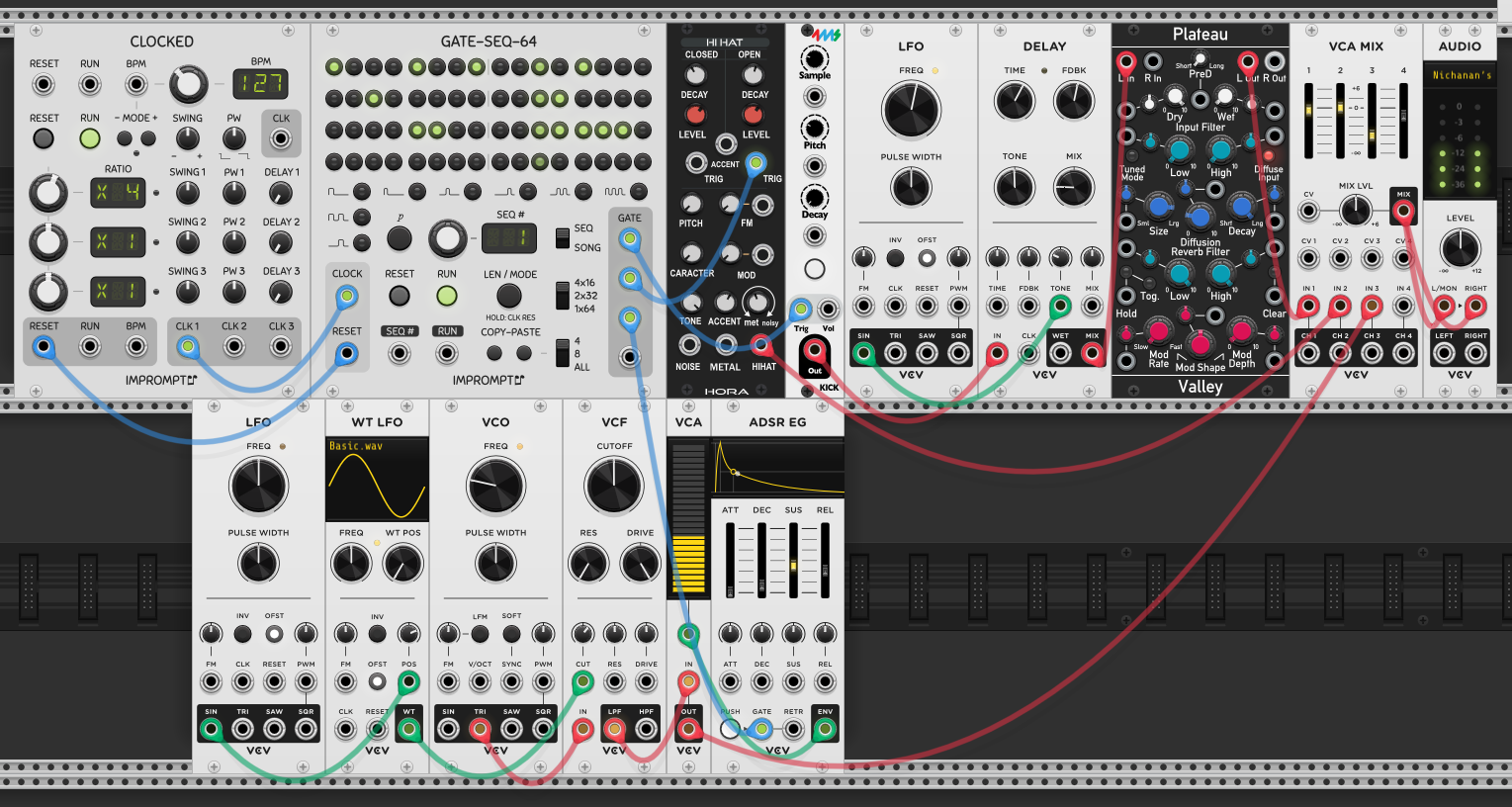
A basic subtractive voice for the bass: VCO (sine) → VCF (low-pass) → VCA. The gate sequencer’s GATE output (blue) drives an ADSR EG, whose envelope (green) opens the VCA — so the bass only sounds on the programmed steps. The VCO is tuned low (around 50–65 Hz) for pure sub weight.
A first lesson in the limits of a sine: a filter can only reveal harmonics that exist, and a sine has none. Sweeping the cutoff with the WT LFO did almost nothing audible — there’s nothing above the fundamental for the filter to open onto. A pure sub therefore feels static. Movement has to come from the dimensions a sine does respond to — pitch, loudness, note length, glide — or from adding harmonics so the filter has something to act on.
Adding movement — pitch and accent
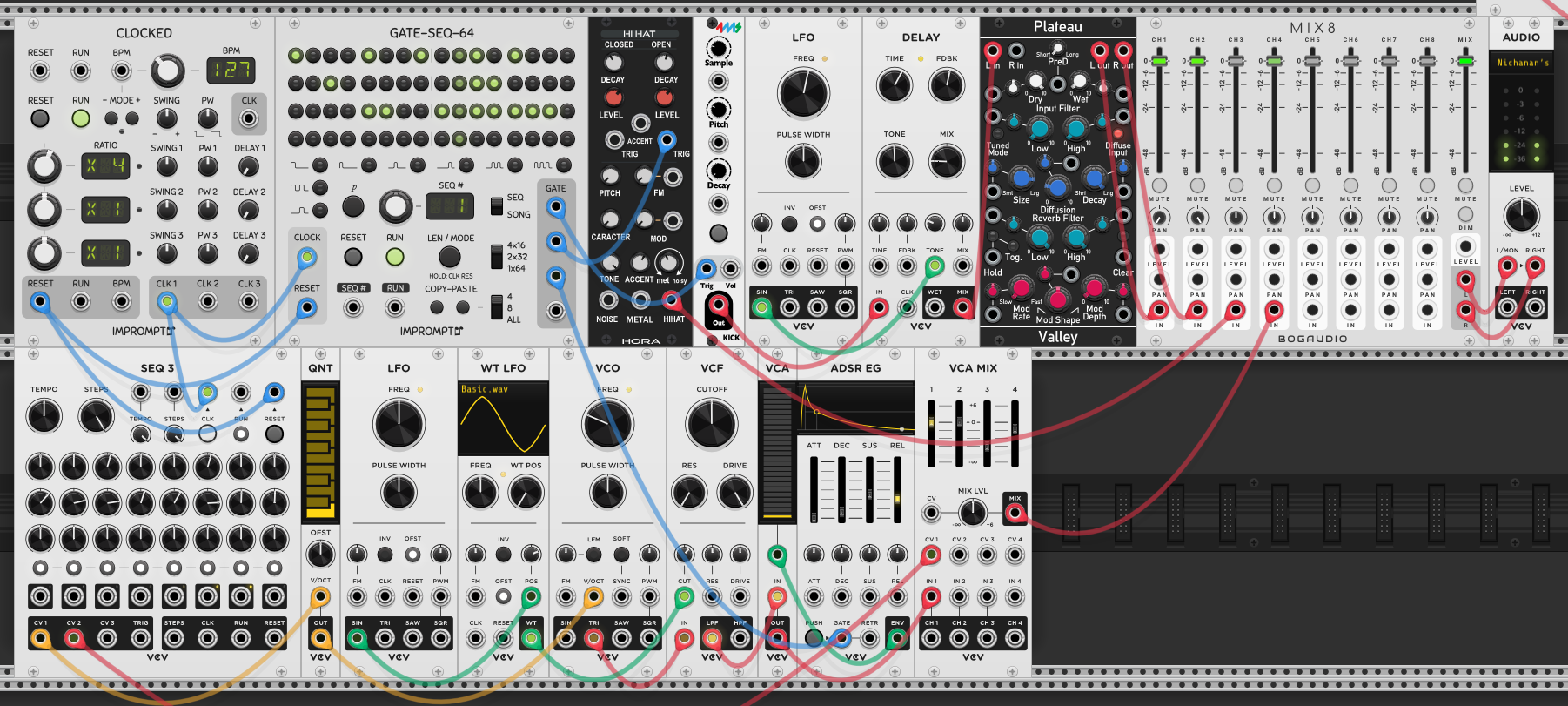
The two changes that make a repetitive bassline feel alive: give it notes (pitch movement) and give it accents (per-step loudness). Both need a source of per-step voltages — and the gate sequencer only makes gates — so the new module is a SEQ-3, a 3-row × 8-step CV sequencer. One row becomes pitch, another becomes accent.
Keeping two sequencers in sync. The bass gate still comes from GATE-SEQ-64 (it already held the rhythm), while pitch and accent come from SEQ-3. For these to line up, SEQ-3’s CLK and RESET both come from CLOCKED — the same clock and reset as everything else. Reset is the critical one: it forces both sequencers back to step 1 together, so step N of SEQ-3 always lands on step N of the gate sequencer. Match the step counts and the pitch/accent voltages stay glued to the gated notes. Without a shared reset, the two sequencers slowly drift and the bass slides off the grid.
Pitch — SEQ-3 Row 1 → QNT → VCO V/OCT. The first CV row is a staircase of pitch voltages. It passes through a quantizer so every value snaps to a scale degree (no out-of-key notes possible), then into the VCO’s V/OCT. Only 2–3 distinct pitches are needed — a root with the occasional octave or fifth reads as a deliberate bassline; lots of movement reads as random. The fixed-knob drone becomes a line.
Accent — multiply, don’t add. The accent is a second CV lane (Row 2) setting how loud each step is. The instinct is to add the accent voltage onto the envelope and feed the VCA — but that leaks: the accent CV is held for the whole step while the envelope only opens during the note, so the held voltage props the VCA open between notes and the sub drones through. The fix is to multiply instead — put the accent on a second VCA in series after the envelope VCA. The envelope VCA slams the gaps to silence, so there’s nothing for the accent VCA to leak; it just scales the notes that do play. Signal: note × envelope × accent.
The mixer is a bank of VCAs. No dedicated second VCA was needed — the bass runs through its own VCA-MIX channel before the master, and every mixer channel is a VCA with a CV input. So SEQ-3 Row 2 → the bass channel’s CV turns that channel into the accent VCA for free. One gotcha: a patched channel CV makes level = fader × CV, so a step left at 0 V goes silent — the accent lane needs a baseline voltage on every active step (≈ 6 V), lifted on the accented ones (≈ 9–10 V). The accent is only as strong as the gap between baseline and accent steps.
The result: some notes hit harder than others, in a pattern locked to the groove. Combined with the 2–3 note pitch sequence, the static sub is now a moving, breathing bassline — without a single random source. All of the movement is composed, which suits techno: the point is a hypnotic, repeating figure with internal dynamics, not unpredictability.
Stab voice — minor triad chord
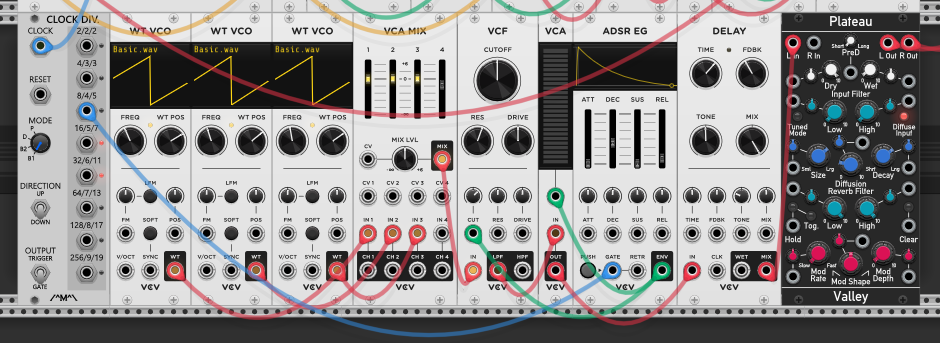
A techno chord stab: three notes hit briefly and sparsely, drenched in reverb. Four ingredients, and the contrast between them is the effect — a chord, a snappy envelope, a sparse trigger, and a long wet tail.
A chord needs more than one oscillator. Three WT VCOs, tuned to a C-minor triad — root C4 (261.63 Hz), minor third E♭4 (311.13 Hz), fifth G4 (392 Hz). Each oscillator is one note; tuning the intervals deliberately (root, +3 semitones, +7 semitones) is what fuses three pitches into one harmony rather than a cluster. With V/OCT left empty, each VCO’s FREQ knob is its absolute pitch — VCV shows the frequency in the knob tooltip while dragging, so you tune by readout, not by ear. Saw wavetables, not sine: same lesson as the sub — the filter needs harmonics to bite into.
The envelope is the stab. The three VCOs sum in a VCA-MIX, pass through a VCF, and into a VCA shaped by an ADSR with fast attack, short decay, zero sustain. That brevity is the entire difference between a “stab” and a “pad.” A little filter resonance and an envelope on the cutoff add a percussive “pew” — the same open-bright-close-dark snap as FM percussion.
Sparse triggering with a clock divider. Rather than a sequencer row, a clock divider takes the master clock and fires the ADSR every Nth pulse (the 8/4/5 tap). The chord punctuates the groove every couple of bars instead of cluttering every beat. Resetting the divider from CLOCKED keeps it bar-aligned.
Its own space. The stab routes through a dedicated delay and a second Plateau reverb before the master — much wetter than the bass, so the short chord blooms into a long tail. Giving each voice its own reverb (as in session 24) keeps the low end tight while the stab fills the room — one shared reverb on everything turns the mix to soup.
Atmosphere — noise sweep
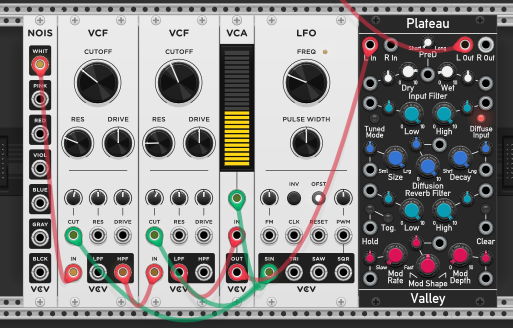
The last layer is pure texture: no pitch, no rhythm, just slow movement under everything else. Noise contains every frequency at once — a filter carves a moving window out of it, and the ear reads that motion as wind, surf, or a rising whoosh.
Band-pass from two filters. A band-pass passes only a window in the middle, cutting both lows and highs — but the VCF here only has low-pass and high-pass outputs, no dedicated band-pass. A band-pass is just a high-pass and a low-pass in series: noise → VCF (HPF out, cuts the lows) → VCF (LPF out, cuts the highs). What survives is the band between them. (For a quicker version, a single resonant low-pass swept by the LFO also works — a high resonance peak acts like a movable band on its own.)
The window has to stay open. The band only exists where the two filters overlap — the low-pass cutoff must sit above the high-pass cutoff. If the low-pass ever drops below the high-pass, the window slams shut and the sound vanishes. The most common reason a chained band-pass goes silent.
The sweep is a slow LFO on both cutoffs. One LFO, multed to both filters’ cutoff inputs, slides the whole window together. Rate is everything — a full cycle every 10–20 seconds (sub-Hz). Slow enough, it reads as wind; any faster and it’s a wah pedal. Sweeping the window up brightens it to a hiss (wind picking up); down darkens it to a rumble (distant surf).
Resonance and color shape the character. A little resonance on each filter makes the band whistle as it moves (sci-fi riser); zero resonance gives soft, broad wind. Noise color sets the base timbre — pink for natural wind, white for bright hiss, red/brown for deep rumble.
Reverb makes it atmosphere. Through its own (third) Plateau with a long decay, the swept noise smears into ambient wash and sits low in the mix — felt more than heard. This is what turns “filtered noise” into the feeling of a vast, dark room around the beat.
Snare — backbeat crack
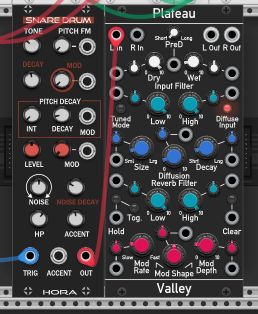
A snare on beats 2 and 4 is what turns a kick-and-hats loop into a track — the backbeat your body nods to. Used a dedicated Hora snare module rather than building it from parts, but the knobs map exactly onto how a snare is synthesized.
A snare is two sounds layered. A tonal body (a pitched tone — the drum shell) and a noise crack (the snare wires rattling). Each has its own envelope, and the contrast between them is the sound. The module exposes both: TONE / PITCH FM / DECAY for the body, NOISE / NOISE DECAY / HP for the crack — plus a PITCH DECAY section (INT = how far the pitch drops, DECAY = how fast) for the attack “thwack.”
Percussion envelopes are AD, not ADSR. Fast attack, decay to zero, no sustain — a drum hits and decays on its own; it never “holds.” On a dedicated module that shape is internal, and the DECAY knobs are those decay times. Short = tight and snappy (techno); long = splashy. For space, keep the decay short and add reverb rather than dialing a long tail.
Tuning it by ear — two moves. Balance NOISE against the body (more noise = clappier, less = thuddier), and tune TONE so the body sits above the kick instead of muddying it. The HP on the noise thins and brightens the crack and keeps it clear of the kick’s low end.
Debugging percussion: a one-shot can’t repeat itself. A snare that “bounced like a ball” turned out to be a useful principle — a single trigger makes a single hit, so any bounce is either a retrigger (too many gates) or an echo (a delay). And a snare whose crack was right but whose tail was “springy” was the tonal body ringing with a falling pitch — shortening the body DECAY and pulling back PITCH DECAY / PITCH FM flattened it to a clean crack. (The other springy-tail suspect is reverb modulation — Plateau’s Mod Depth — so listening dry isolates which.)
Placement. TRIG from a gate-sequencer row on 2 and 4, OUT into its own Plateau for a short-hit-long-tail snare, on its own mixer channel.
Acid line — 303 squelch
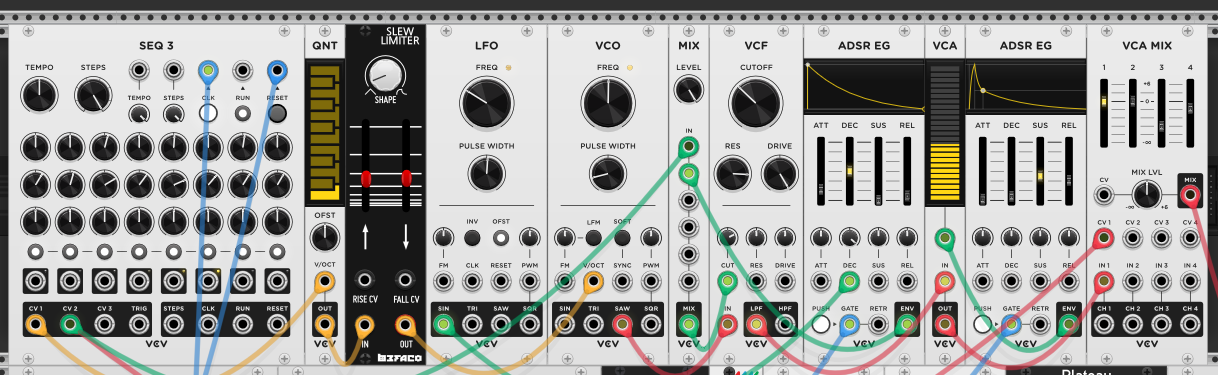
The hook: a Roland TB-303-style acid line. The same subtractive voice as the bass, but tuned for squelch — a saw through a high-resonance low-pass with an envelope sweeping the cutoff, running a fast 16th-note riff.
The squelch is an envelope on a resonant filter. SEQ-3 → QNT → slew → VCO (saw) → resonant VCF → VCA, with two envelopes: ADSR #1 sweeps the filter cutoff (the “wow”), ADSR #2 shapes the VCA. With RES high (near self-oscillation) and CUTOFF low, each note’s cutoff envelope opens the filter from nearly closed and snaps it shut — the resonant peak whistling as it moves is the acid bark. The cutoff envelope’s DECAY is the main tone control: short = a blip, longer = a rubbery sweep. A little DRIVE adds the dirt.
Glide. A slew limiter between the quantizer and VCO glides between notes — the 303 portamento — but order matters: the slew must come after the quantizer, never before. Before it, the quantizer re-steps the smoothed glide into a staircase and every step clicks; after it, the quantizer’s discrete notes get smoothed into a continuous slide. Kept short so only the bigger jumps audibly slide.
Clicks at the onset. With the slew placed right, a remaining click was the VCA’s instant attack — a hair of attack (1–2 ms) removes the hard 0→full edge. A high-Q filter also pings on each cutoff-envelope edge; a touch of attack there (or slightly less resonance) tames it. A subtle ping is actually part of the acid bite, so the goal is click-free, not gone.
Riff and accent. A fast, root-heavy 16th-note pattern — in C minor, mostly the root with an octave pop and a couple of scale tones (E♭, G) — quantized so it stays in key. SEQ-3 CV2 is the accent lane, and acid accents hit two destinations at once: louder (CV2 → the voice’s mixer-channel CV) and brighter (CV2 → the filter cutoff). The per-step accent is the same trick as the bass, now the rhythmic engine of the line.
Summing two sources into one cutoff. The catch with the brightness accent: a filter’s cutoff is a single input, but it needs two signals — the per-note envelope (the squelch) and the per-step accent (the brightness). They can’t both plug in directly, so a small mixer sums them into one cable → VCF CUT. The envelope provides every note’s “wow”; the accent raises the baseline on accented steps so they’re louder and squelchier — the unmistakable acid bark. Keep the accent attenuated to a bump and the base cutoff low, or the sum pins the filter open and the squelch is lost.
Full patch
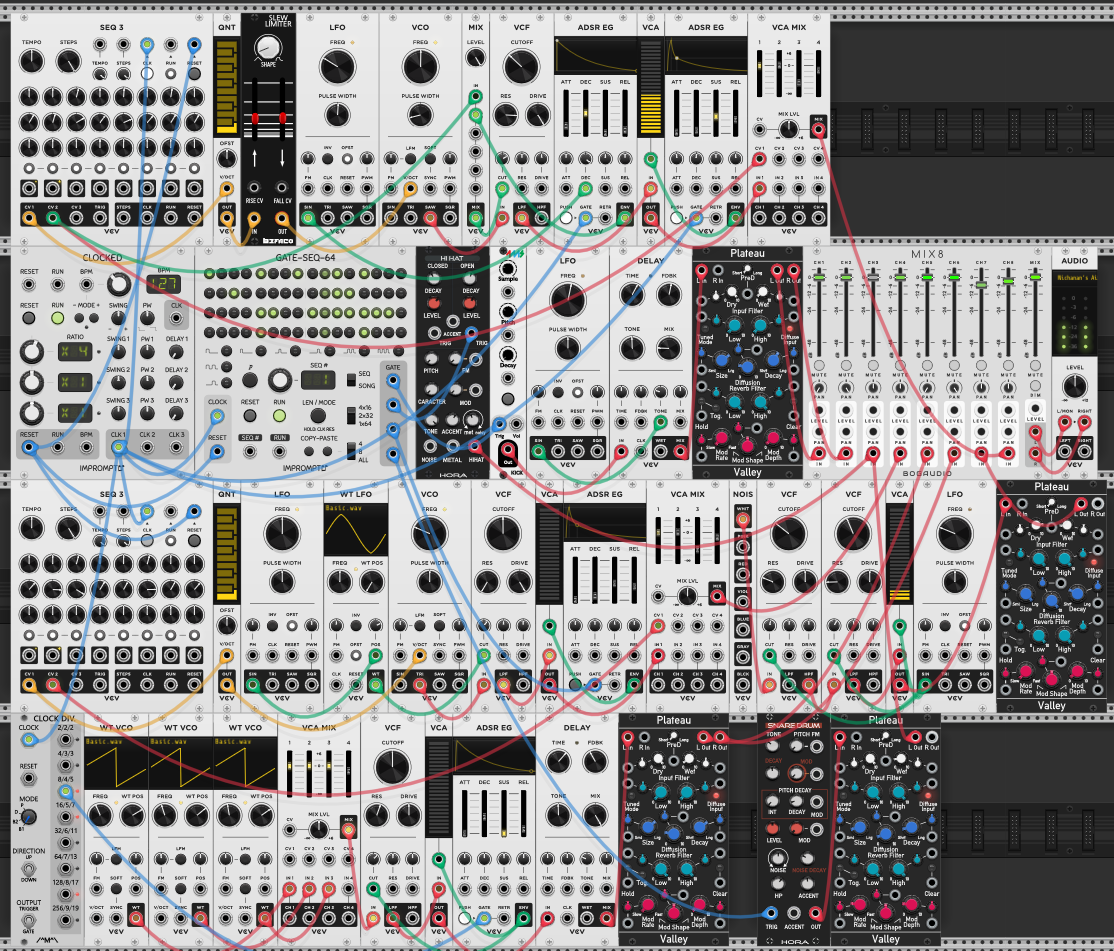
The finished track, grown to four rows organized by voice: a four-on-the-floor kick, a hi-hat, and a snare on the backbeat holding the rhythm; a sub bass and an acid line carrying the low and mid; a chord stab punctuating; and a noise sweep breathing underneath. Seven elements, each with its own sequencing and envelope, several with their own Plateau reverb, all summed in the 8-channel MIX8 master.
Sound characteristics
A predictable foundation. Four-on-the-floor kick, fixed hi-hat pattern, a snare on the backbeat (2 & 4), no probability or drift. The hypnotic quality is the repetition — the groove you could loop for ten minutes. The backbeat snare is what turns the loop from a beat into a track.
Bass that stays out of the kick’s way. The kick and bass share the low end, so the bass is shaped to coexist — tight envelope, locked to the grid, accented per step so it grooves rather than drones. Movement comes from composed pitch and loudness, not from a filter sweep (a sine has no harmonics to sweep).
Composed movement. A 2–3 note pitch sequence and per-step accents make a repeating bassline feel alive without randomness — the opposite philosophy from the thriller patch’s layered generativity.
Fixed chord stabs. A fixed minor triad, triggered sparsely by a clock divider — the classic techno chord-hit, drenched in its own reverb.
An acid hook. A 303-style line — saw through a resonant low-pass with an envelope on the cutoff — gives the track an identity to latch onto. Dual accents (louder and brighter on chosen steps) make it groove rather than drone.
A voice per reverb. Three Plateau instances keep the low end tight while the stab and atmosphere fill the room — the lesson from session 24, applied to keep a dense mix clear instead of muddy.
Atmosphere from swept noise. A slow band-pass sweep over noise adds depth and weather without adding notes or rhythm — texture that fills the space between the musical events.
Reflection
The contrast with the previous session is the lesson. Session 24 chased unpredictability — layers of generativity so nothing repeated exactly. This patch chases the opposite: everything repeats, and the craft is in making repetition feel alive through small composed variations (an accent here, a sparse chord there) rather than randomness. Two emotional goals — dread and drive — demanding nearly opposite tools. Building from an intention is getting more fluent: the gap between “techno” as a feeling and the specific signal-flow decisions (offbeat bass, sparse clock-divided stabs, separate reverbs) was smaller this time.
The honest weakness is the mix. Seven elements went in, but they all sit at roughly equal level, competing for the same space on equal footing — the mixer was barely touched all session, the only move being panning the kick’s reverb to its own channels. It sounds interesting, like it could be part of a song, but it’s busy and flat in the depth dimension. A real track has a hierarchy — some elements forward, some buried, some wide, some centered and mono — and nothing here was placed deliberately.
Two threads for future sessions. First, actually mix: use levels, panning, and EQ/space to give each component a priority and a place, so the voices stop fighting for the same frequencies and stereo position. Second, add dynamism and a little generativity: right now everything repeats identically, and some slow evolution plus controlled randomness (the sessions 20–22 techniques) would keep the loop alive over time without losing the locked-in techno feel.