Generative Rainy Ambient
Intention
A light, airy ambient soundscape — sparkly, like standing in a sunlit meadow. The lead voice is a light breeze that drifts and never settles, joined by sparse percussion, a few bell tones, and a soft bass underneath. Nothing should feel locked to a grid; events drift in and out, and the whole thing should feel like weather rather than a song.
Starting patch
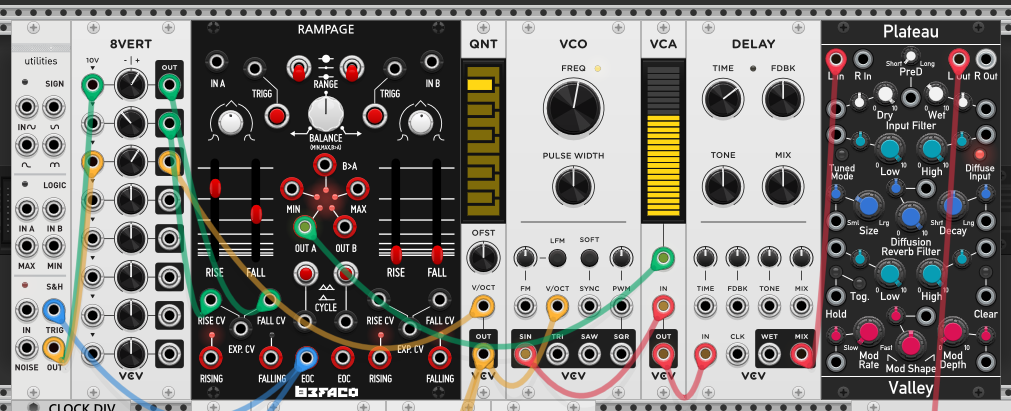
Breeze voice: S&H → 8VERT → QNT → VCO → VCA → DELAY → Plateau → out. A Rampage in cycle mode is the engine — it loops its rise/fall shape and its end-of-cycle trigger fires the S&H, which samples noise into a random voltage. That voltage runs through an 8VERT attenuverter to scale and offset it into a usable pitch range, then through the quantizer so the random values land on scale degrees rather than arbitrary frequencies. The VCO’s sine goes through the VCA into a delay. With Rampage cycling at a slow, irregular rate, the voice plays itself — random notes arriving at uneven intervals, the Krell idea in miniature.
One engine doing two jobs. Rampage’s OUT A — the same rising/falling slope that’s clocking the patch — also patches into the VCA’s CV input, so it shapes each note’s amplitude. The note’s loudness is the function-generator curve: it swells in as the slope rises and fades out as it falls, with no percussive transient. Timing and dynamics come from one source instead of a separate clock and envelope, which keeps the voice’s movement unified — exactly the “fewer random sources, each doing more” approach I wanted to try after session 24.
Plateau for the air. The whole chain lands in a Plateau reverb (Valley’s Dattorro-style algorithm), which is what turns a dry self-playing voice into open sky. Its long Decay holds notes in a tail that overlaps the next one, the Size sets how large the imagined space is, and the dampening filters (Input Filter, Reverb Filter low/high) shape how bright or dark that space sounds — keeping the highs up is what gives the sparkle. Dry/Wet balances the direct note against the wash; for ambient it sits wet.
Right now it’s a single self-playing voice with air around it. To get to the full meadow it needs the three companion layers — sparse percussion, a few bell tones, and a soft bass underneath.
Second voice: ring-mod string pluck
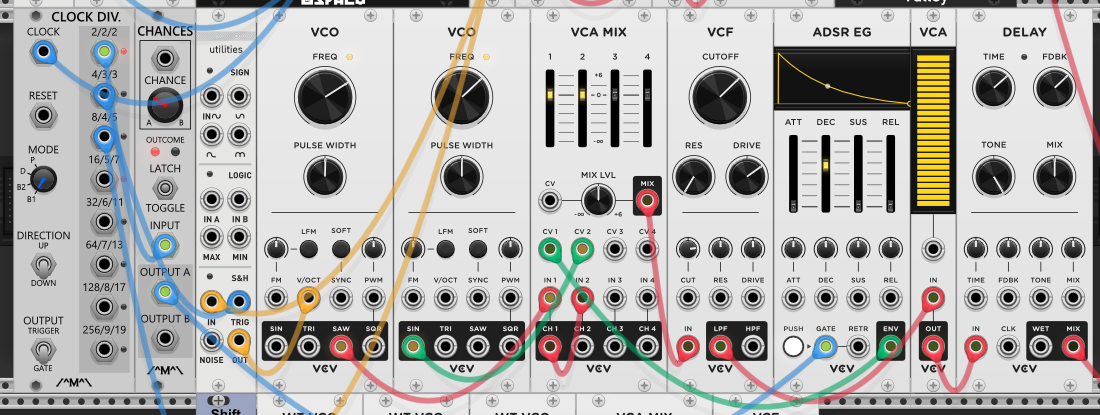
A plucked-string voice to sit against the breeze — except the “string” is a ring-modulated spectrum, struck and damped rather than struck and left to ring like a ring-mod bell.
Sparse, off-grid triggering. The CLOCK DIV is the timing backbone. One division runs through CHANCES — a Bernoulli gate — so each clock is a coin flip that either passes through to the ADSR’s gate or doesn’t. Plucks land probabilistically instead of on every beat, drifting in and out the way the breeze does, so the voice reads as weather rather than a pulse.
Pitch borrowed from the breeze. A separate /2 division clocks an S&H that samples the breeze voice’s quantizer — so this voice draws its notes from the same scale-quantized pool, just held and refreshed on its own slower clock. Both VCOs track that sampled CV, so they transpose together: the interval between them (≈5:4, a major third — 872 and 696 Hz at this sample) stays locked, and the metallic timbre keeps its character on every note instead of recoloring as the pitch moves.
Ring mod from two mixer VCAs in series. No dedicated polarizer this time — the VCA MIX does it with two of its channel VCAs chained. The saw enters CH1, and the ADSR drives CV1, so channel 1 stamps the pluck — fast attack, short decay — onto the carrier. CH1’s output then feeds CH2, where the sine goes into CV2, and channel 2’s VCA multiplies the enveloped saw by that sine. The sine is bipolar audio, so the VCA swings four-quadrant and the result is true ring modulation rather than AM: the two fundamentals cancel, leaving only their sum and difference. And because the carrier is a saw rather than a sine, every harmonic of the saw throws off its own sum/difference pair — at this sampled pitch the fundamentals land near 176 Hz and 1568 Hz, but the saw’s harmonics fill the space above with a dense, inharmonic comb. Squeezed through the short envelope, that comb reads as a bright metallic pluck.
Tone shaping and tail. The mix output runs into the VCF as a static low-pass, rounding off the very top of the comb — the cutoff isn’t modulated yet, just set by hand. From there into the DELAY, whose feedback, tone, and mix spread the sparse plucks into echoes that keep shimmering through the silences between triggers.
The next move is the VCF cutoff, which is sitting still. Patching the envelope (or a slow LFO) onto it would let each pluck snap the filter open and shut — that filter-ping is what would push the voice from “metallic blip” toward a string that really speaks.
Third voice: rain on glass
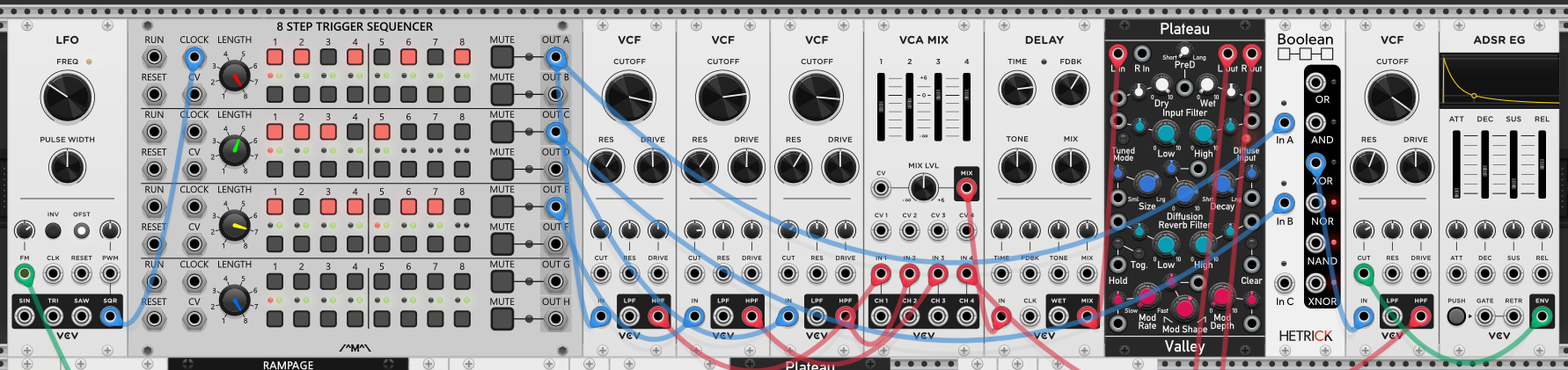
The sparse percussion is built entirely from pinged filters — no oscillators anywhere. Each trigger hits a VCF’s input, and with RES pushed near self-oscillation the filter rings out a short pitched ping; a little DRIVE hardens that ring into a glassy tink. It really does sound like raindrops on a window.
Three drops, spread by ear. Three filters tuned to three different CUTOFFs give three droplet pitches, set by ear rather than to a chord — the slight tuning irregularity is what makes it read as scattered rain instead of a tuned instrument.
Polyrhythmic patter. The LFO’s square wave clocks an 8 STEP TRIGGER SEQUENCER, and each row pings one filter. The rows are set to different LENGTHs, so they slip out of phase and the combined pattern takes many bars to come back around — polyrhythm is what keeps the shower from collapsing into a one-bar loop.
A surprise drop from logic. Rows A and C also run into a Boolean logic module (In A and In B), and its output pings a fourth VCF tuned to a large pitch jump away from the other three. Since that drop only fires on the steps where the logic condition between A and C is met, it lands rarely and unpredictably — an occasional plink far above the rest that breaks the pattern.
Floating, but breathing with the breeze. The rain’s clock is the free-running LFO, unsynced from the breeze and string, so rhythmically the percussion drifts on its own. But the LFO’s frequency is modulated by Rampage’s cycle B — the same cycling function generator whose cycle A is the breeze’s engine. So the patter quickens and slows in sympathy with the breeze’s movement: the voices share no clock, yet they breathe through one source. It’s the “one engine doing two jobs” idea from the breeze pushed across voices — the meadow holds together through shared modulation rather than a shared grid, which is exactly why it can stay off-grid without falling apart.
The four filters sum through VCA MIX into the DELAY, which scatters each drop into a small cluster of echoes, and on into the Plateau that wets the whole shower onto glass.
Fourth voice: bass drone
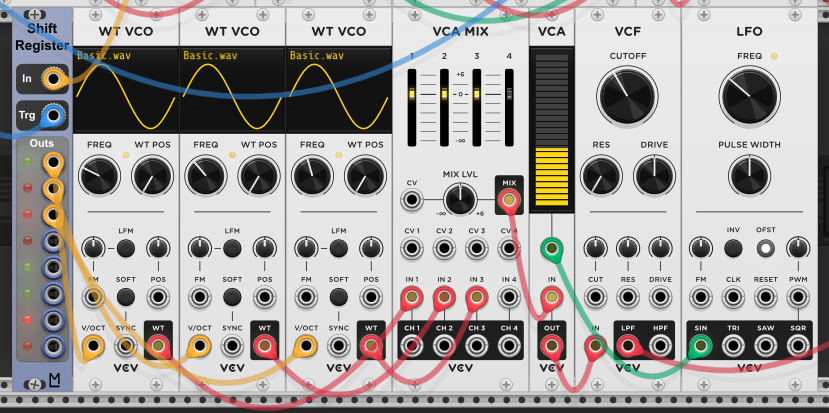
A chord made of recent notes. The bass isn’t a separate line — it’s a slow harmonic shadow of everything above it. Voice 1’s quantizer feeds a shift register’s In, and three of its Outs drive three WT VCOs. The register holds a short queue of pitches: each trigger shifts the newest one in and the oldest one out, so the three oscillators voice the last three notes the meadow’s shared scale produced, an octave or two down. The harmony underneath is literally built from what just drifted by overhead (s21’s shift-register chord that follows the melody).
Advanced sparsely by the coin flip. The register’s Trg is CHANCES’ output B, clocked by a /2 division — so the chord only moves when the Bernoulli flip lands on B. New notes shift in unpredictably and infrequently, which is what makes this a drone — a long-held cluster that occasionally re-voices — rather than a moving bassline.
Wavetable body. Three WT VCOs on Basic.wav with WT POS parked at a fixed reading point, giving the drone more harmonic weight than a plain sine without turning bright. Three oscillators at slightly different settings thicken the cluster into a bed.
Swelling in and out. The three sum through VCA MIX into the VCA, whose CV is a slow LFO sine and nothing else. That single swell fades the whole bed up and down with no attack transient, so the bass breathes underneath rather than articulating notes — a low-pass VCF keeps it warm and dark, anchoring the patch without muddying the sparkle above it.
With the drone in, all four layers of the meadow are present: the self-playing breeze, the ring-mod string, the pinged-filter rain, and this wavetable bass bed — each drawing pitch from the same quantizer and breathing through shared modulation, none of them locked to a common clock.
Texture layer: pink-noise static
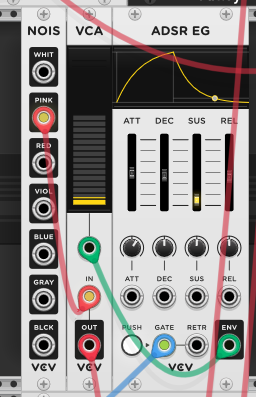
Beyond the four planned layers I added one more — pure texture, no pitch. PINK noise runs into a VCA, and an ADSR with a long attack and long release shapes its gain. Gated on a /4 clock division, the envelope swells the noise up and back down each time it fires, so the static drifts in and out — wind picking up and dying away — rather than sitting there as a constant hiss. That slow rise and fall is the “sweep.” Using pink rather than white noise keeps it warm and dark, with the highs rolled off, so it reads as background haze sitting under the voices instead of cutting across the sparkle. It joins the mix into a Plateau, whose reverb smears it into a soft bed of air beneath everything else.
The full patch
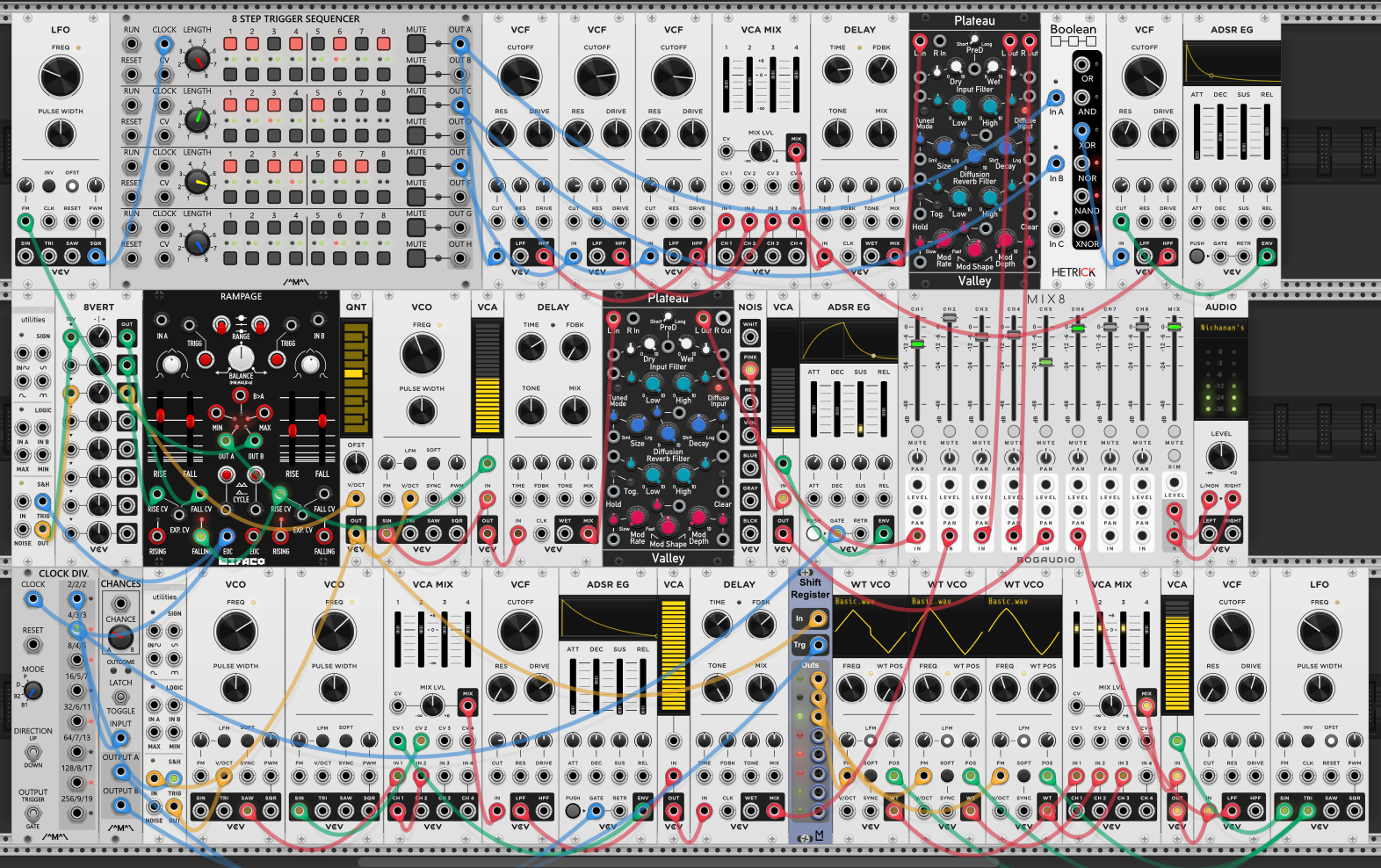
All five layers converge in the MIX8 — each on its own channel, panned to a different spot so the breeze, string, rain, bass, and static occupy separate places across the stereo field rather than stacking in the centre. Each part carries its own DELAY, and there are two Plateau reverbs in play, so the layers sit in different-sized spaces — the rain in one wash, the breeze and the rest in another — instead of a single global room flattening everything together. From the MIX8 it’s out to AUDIO.
Five sources drawing on one shared scale, tied together by a couple of probability gates and a few modulation links, with no master clock holding them in step — and it settles into a single drifting weather system rather than five things playing at once.
Reflection
I set out for a sunlit meadow — bright, organic, soft — and landed somewhere else: a rainy day staring out into fog. It came out darker and more melancholic than I’d pictured, never bright the way “meadow” sounded in my head. It’s not eerie the way session 24 was, though — the unresolved dissonance there read as dread, where this just reads as wistful. Same generative approach, completely different mood, and almost all of the difference was timbre and register, not the notes: the low-passed voices, the ring-mod’s low difference tone, the pink noise, and the reverb damping the highs all pulled the brightness out without my ever deciding to make it dark. The patch picked its own weather.
To actually reach bright next time I think I need to stop damping the top — keep the reverb’s highs open, put brighter sources up in the high register, and let the sparkle live in the signal instead of only in the intention.
The two things I liked most were both accidents. The raindrops — pinged filters ringing out — are the most convincing sound in the whole patch. And the breeze voice drifted into something like a dampened violin, a bowed, almost vocal quality I didn’t plan but want to chase on purpose next time.