Drone & Filter Chaining
Intention
A study of two things at once: the drone — a sustained background tone meant to sit under a patch and evolve without ever restarting — and filter chaining, running one filter into another in series and threading an effect through the filter rather than tacking it on afterward. The drone has to feel alive while never looping, so its movement comes from chaos instead of a periodic LFO; and its grit comes from a distortion wired into the first filter’s send loop, so the filter shapes the distortion instead of the distortion smearing across an already-filtered tone.
Around that core I build out the rest of a patch — a pinged-filter beat ducking under the kick, gate-sequenced drums, and a chance-fired ping that surfaces now and then — but the drone and its filter chain are the study; the rest is the room it lives in.
The unison drone
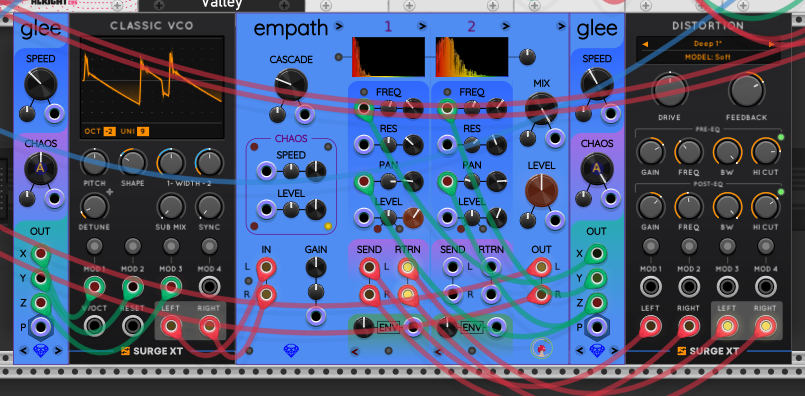
The drone source is a Classic VCO (Surge XT) with its UNI count turned up to 9 — nine copies of the oscillator running at once, stacked into one voice. A single oscillator is a thin, plain tone; nine of them, spread apart by the DETUNE knob, beat against each other into a thick, wide, shimmering wall — the kind of fat detuned unison stack that makes a convincing drone out of a single module. The SUB MIX folds in a sub-oscillator an octave below for weight underneath, and the whole stack is pitched low — the octave set to −2 — so the drone sits two octaves down beneath everything as background atmosphere rather than a lead. SHAPE morphs the waveform’s character and 1-WIDTH-2 sets its pulse width — the two timbre controls the modulation reaches for.
Chaos instead of an LFO. What keeps the drone from being a static held chord is Glee (Sapphire), a chaotic modulation source. Where an LFO cycles the same shape forever — predictable, looping — Glee traces the path of a chaotic attractor: a smooth, continuous wander that drifts and curls and never exactly repeats. SPEED sets how fast it moves, CHAOS how erratic versus orderly the path is, and it puts out several related channels at once (X, Y, Z and a combined P). Patching those into the VCO’s SHAPE and WIDTH keeps the waveform always slowly morphing — the drone’s timbre breathes, thins, fattens and shifts on its own, never settling in the same place twice. That’s the trick to a living drone: the pitch holds still while the shape underneath it stays in constant, non-repeating motion.
Chaining the filters
From the VCO the drone runs into the Empath (Sapphire) dual filter — two filter stages, 1 and 2, that CASCADE wires in series so the first feeds the second. Each stage has its own FREQ (cutoff), RES (resonance), PAN and LEVEL, and running them in series stacks their shaping: two cutoffs carving the stack one after the other for a steeper rolloff, and two resonant peaks that can be tuned apart to emphasise two different bands of the drone. A second Glee chaos-modulates the filter stages’ FREQ and PAN, so both the cutoff carving the drone and its placement in the stereo field drift along with the tone — the same non-repeating motion applied to the filtering as to the waveform.
A distortion inside the filter. The new wiring is what happens to the first stage’s SEND and RTRN (return). Rather than running the distortion after the filter, the first filter’s SEND taps the signal mid-chain and routes it out to a Surge XT Distortion — the Soft-model waveshaper from session 31, here on the “Deep 1” preset — whose output comes back into the filter’s RTRN and carries on through the rest of the chain to the OUT and the mixer. That makes the distortion an insert: the signal detours through it and returns into the path, as opposed to the parallel aux send from session 31, where the dry signal continued untouched and the wet was added alongside. The difference is audible — because the grit re-enters before the rest of the filtering, the second stage carves the distortion’s new harmonics back down, taming the fizz and folding it into the body of the drone, so the result is a gritty tone that still reads as smooth rather than a clean drone with distortion sitting on top.
A static beat, ducked under the kick
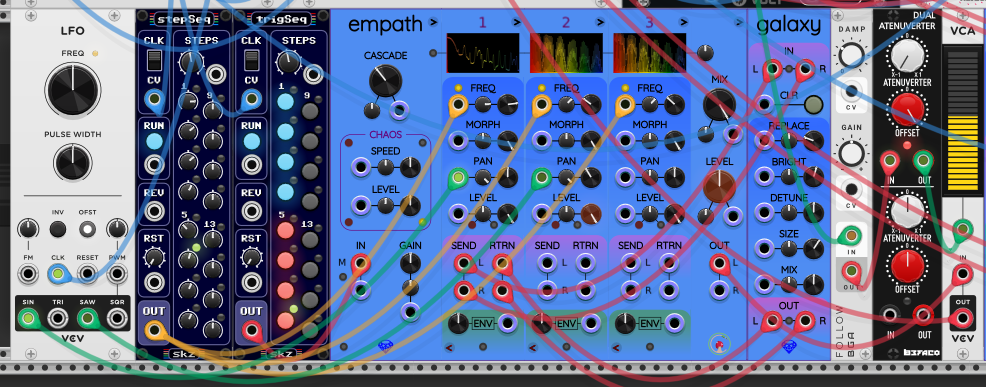
The second voice is the rhythmic counterpart to the drone: where the drone holds, this one pulses — and it makes its sound with no oscillator at all. It’s a second Empath (Sapphire) filter chain, pinged: a trigSeq (skz) sends its trigger output straight into the filter’s IN, and each sharp pulse excites the resonant filter so it rings at its cutoff — a short, pitched, staticky hit on every trigger. The filter is the sound source; the trigger is only the mallet.
Two sequencers, two jobs. The rhythm and the pitch are split across a pair of skz sequencers. The trigSeq owns the rhythm — which steps fire the ping and how the beat is grouped. A stepSeq owns the pitch — its stepped CV drives the filter’s FREQ, and because a pinged filter’s pitch is its cutoff, stepping the cutoff walks a melody through the static beat. One sequencer decides when, the other decides what note — the same division of labour as a drum trigger row against a pitch row, here aimed at a pinged filter instead of a drum. The hits run through their own Galaxy (Sapphire) reverb — a dedicated insert on this voice rather than a shared send — whose SIZE, DAMP and BRIGHT wrap each ping in a wide, shimmering space.
Ducking it under the kick. To stop the static beat from colliding with the kick drum, it’s side-chained to dip out of the way each time the kick lands — the envelope-follower ducking technique, built here from two modules. The kick’s audio runs into a BGA envelope follower (Befaco), which ignores the kick’s waveform and tracks only its amplitude, turning each thump into a smooth control hump that rises and falls with the kick’s loudness. That hump goes into a Dual Atenuverter (Befaco) set to invert it — and offset it back up to a resting level — so a loud kick now produces a downward dip rather than a rise. The inverted envelope drives the static voice’s VCA: every kick pulls the VCA’s gain down and the beat ducks beneath it, then the level springs back up in the gap before the next kick. That pumping is what carves the kick a clean hole to punch through, and only after the duck does the voice run on to the mixer.
The percussion — gate-sequenced kick and hat
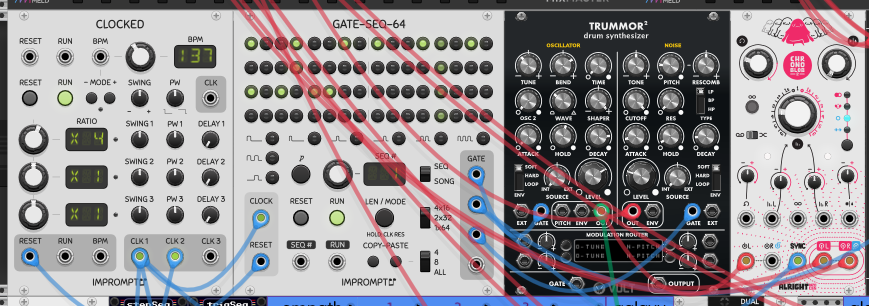
Under the two melodic voices sits a plain drum backing, programmed on a GATE-SEQ-64 (Impromptu) — a 64-step gate sequencer laid out as an 8×8 grid of buttons. Its LEN/MODE carves those 64 steps into lanes (4×16, 4×32 or one long 1×64), so the kick and hat each get their own row of gates to fire from. The gates drive a Trummor² (Vult): the kick from its oscillator section, the hihat from its noise section — the same two-part drum split I keep reaching for, kept deliberately simple here so it just holds the grid for the drone and the static beat to sit on.
The kick through a delay. The one bit of character in the drums is that the kick doesn’t go straight to the mixer — it runs through a Chronoblob delay first. Its TIME is synced to the clock so each echo lands on a beat division, FEEDBACK sets how many repeats trail behind the hit before they fade, and MIX how loud those echoes sit against the dry thump. Low feedback just thickens the kick with a quick slap; push it up and each kick spills into a trailing, dubby pattern of echoes that fills the space between hits — motion in the low end without sequencing a single extra note.
The full patch
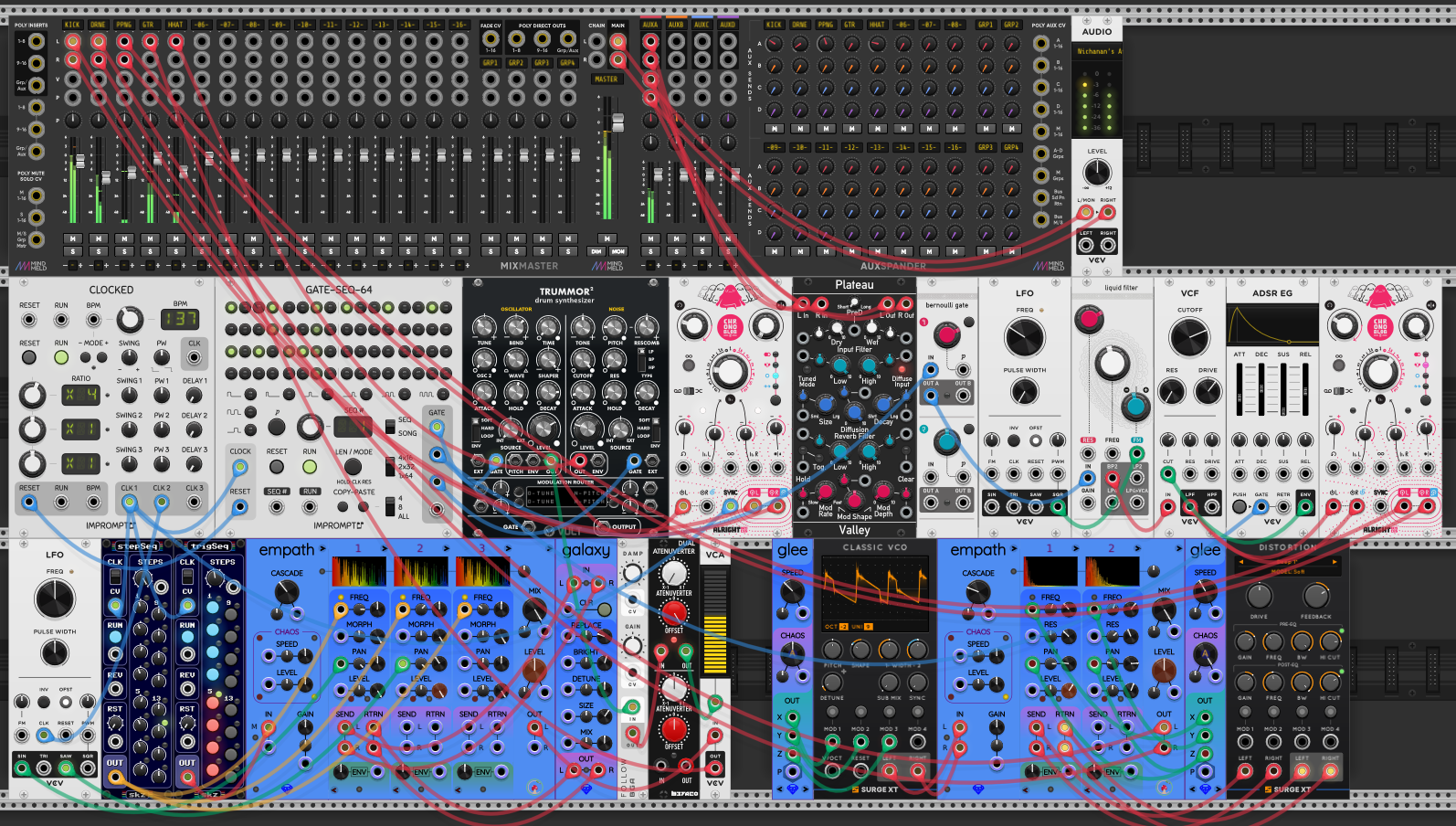
The last voice rides on top of everything: a probabilistic pinged filter, the chance-scattered ping from session 31 brought back as a sparkle layer (top-right of the rack). A bernoulli gate flips a weighted coin on each clock and only sometimes lets a trigger through to ping the liquid filter — the same filter-pinging behind the static beat, but fired by chance rather than a sequencer — so rather than a steady pulse the ping fires once in a while, unpredictably. Its cutoff sits high, so each ping is a bright, high-pitched ding; a VCF and ADSR EG shape its attack and tail; and a Chronoblob throws it into a stereo ping-pong that bounces the ding between left and right. Against the dense, sustained drone and the steady ducked beat, this voice is the opposite kind of event — sparse, high and occasional, a glint that arrives only now and then.
The mix. All five voices land on the same MIXMASTER + AUXSPANDER (MindMeld) send/return setup from session 31, one labelled fader each: KICK and HHAT for the drums, DRNE for the drone, GTR for the static beat, PPNG for the pinged filter. The shared reverb on the AuxSpander send is a single Plateau (Valley) — the same one-room-for-everyone approach as session 31 — with the static beat the exception: it carries its own Galaxy reverb as an insert, keeping a distinct shimmering space of its own while the rest of the voices share the plate. The MAIN mix runs out to AUDIO.
Reflection
Two things stuck from this build. First, that where an effect sits in a chain is as much a choice as which effect it is: looping the distortion into the filter’s send and back — an insert inside the filter rather than after it — gave a grit the next filter stage could re-shape and fold in, nothing like the same distortion bolted on at the end. The chain isn’t a list of modules; its order and its loops are the sound.
Second, how much life a drone gets from chaos instead of an LFO — the pitch never moves, but because the shape is driven by a non-repeating attractor the tone never settles, and a held note that never settles stops sounding synthetic. And setting that constant drone against a beat that constantly ducks and a ping that only rarely fires, the three voices relate to time in completely different ways — always-on, rhythmically carved, and rare. That’s its own kind of arrangement: layering by behaviour, not just by pitch.