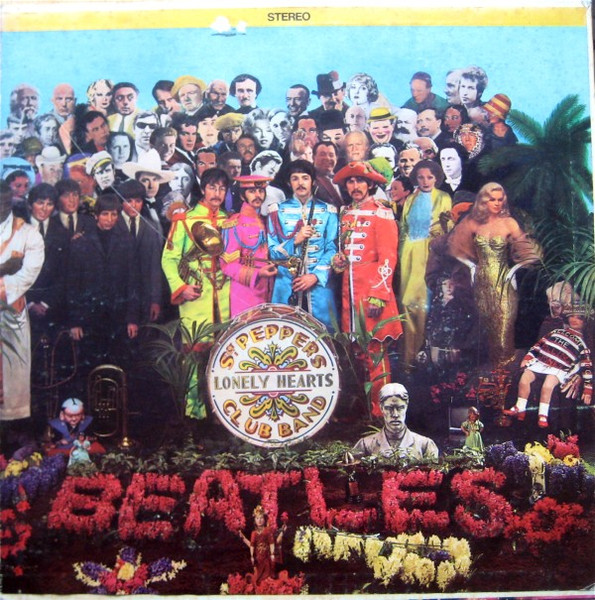
The Beatles
Sgt. Pepper's Lonely Hearts Club Band
- Released
- 1968
- Format
- Vinyl, LP, Album, Repress, Stereo
- Label
- Capitol Records · SMAS 2653
Lineage rock
View on Discogs ↗ Related titles
-
 Brian Eno & David Byrne My Life In The Bush Of Ghosts Eno's studio-as-instrument approach descends directly from what George Martin and Geoff Emerick worked out at Abbey Road on Sgt. Pepper's — a line that runs from 1967 to Eno's ambient work to Madlib's SP-303 in a São Paulo hotel room.
 -
 The Byrds Mr. Tambourine Man Mr. Tambourine Man and Sgt. Pepper's are both 1965-67 documents of rock music deciding it could be a compositional art — the Byrds doing it through arrangement and guitar timbre, the Beatles doing it through studio technique.
Sgt. Pepper’s (1967) ended “rock as a live band captured on tape” and inaugurated “rock as studio composition.” George Martin and Geoff Emerick — Emerick had taken over as chief engineer at nineteen for Revolver the year before — used the four-track at Abbey Road to do things with no precedent as popular music technique: varispeed manipulation, artificial double tracking (invented by Ken Townsend at Abbey Road for Revolver and used extensively here), reverse tape effects, calliope tape loops built from spliced sections on “Mr. Kite,” and the orchestral crescendo on “A Day in the Life” achieved by giving the musicians the lowest and highest possible notes for their instruments and asking them to improvise between them over 24 bars.
The studio became the instrument — that is the specific idea this record introduced into popular music. The line from this to Brian Eno’s explicit theorisation of the studio as a compositional tool is direct. And from Eno to Madlib treating his SP-303 as an instrument rather than a sampler is the same line extended. The chain is longer than it looks, and this is one of its early points.