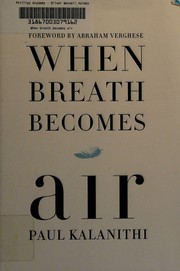
A deeply personal account of one’s visits to the junction between life, identity, meaning, and death. First as the agent (doctor) guiding patients through their illness, then as the patient directly confronting his own. This is a sad story, but the sadness is anything but hollow. Paul Kalanithi lived an extremely fulfilling, impactful and accomplished life in the short time that he had. He saw neurosurgery not as a job, but a calling - captivated by the mysteries surrounding the biological and experiential manifestations of death. When Breath Becomes Air is - as another reviewer had put it - only a little bit about dying, it is instead more about being alive. In the first portion of the book Kalanithi introduces his life and the major turning points that eventually led to the late stages of his residency and untimely diagnosis: his early years in the mountainous Kingman AZ, undergraduate studies at Stanford, medical school at Yale, and practical training again at Stanford. Prior to his decision to pursue medicine, Kalanithi repeatedly found himself at a crossroads between science and literature. The fascination that our physical brains - a collection of neurons subject to the laws of physics - can somehow give rise to life’s virtues and meaning, derived from the depths of relationships we form. How does life as experienced - love, hunger, passion - relate to the firing of neurons, and beating of the heart? Ultimately, he reached the conclusion that the intersection between biology, morality, philosophy and literature - was medicine.
I thought the book was well and powerfully written throughout, however there were certain points where the words hit so hard that I had to look up from the pages for a bit. Two such occurrences were when his visit to his own grandmother’s grave reminded him that his cadaver, back at the lab, was not an apparatus for anatomy practice but somebody’s grandparent and one study session with Lucy (his then-girlfriend, now widow) where she burst out crying at the realization that a “practice EKG” they were looking at was of a fatal arrhythmia - whichever case this screenshot was pulled from, the patient did not survive. Such accounts take the reader right to the cusp between our biological selves as a complex collection of cells, and our experiential selves with thoughts, feelings, and loved ones. We are powered not only by a complex orchestra of metabolic activity but also by hopes, motivations, and desires. I too began to explore this interplay through my studies as a neuroscience/psychology undergrad, but none of my readings were quite as profound and stripped bare as how Kalanithi describes it in this book. It is truly stunning how the brain and genes gives rise to our perceived experiences and humanity. Cell division gone awry in the wrong area can render you unable to relate to others, a cut 2mm deeper into the brain stem can render you paralyzed, bar blinking - what does it mean to live after that?
Paul Kalanithi is survived by his wife, Lucy, and their daughter, Cady (to whom this book is dedicated). Cady was 8 months old when he passed. His final moments poignantly recounted by Lucy in a beautiful epilogue (like Paul, she too could easily be a writer). I’d recommend this book to everyone. While those interested in medicine may relate better to some parts, the book is ultimately about what it means to be alive and how we connect as humans. I’d suggest not reading this in public unless you are OK with strangers coming up to you asking why you are crying.
My favourite quotes:
- “Human knowledge is never contained in one person. It grows from the relationships we create between each other and the world, and still it is never complete.”
- “I had come to see language as an almost supernatural force, existing between people, brining our brains, shielded in centimeter-thick skulls, into communion”
- “You can’t ever reach perfection, but you can believe in an asymptote toward which you are ceaselessly striving” —Paul Kalanithi