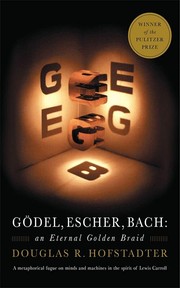
This sat on my to-read list for years. I finally read it the way it asks to be read: slowly, a chapter at a time, partly because the formal proofs demand it and partly because I kept needing to set it down and let an idea settle. I expected a clever book about mathematics and music. What I got was the most rigorous account I’ve encountered of the self as not a thing but a process.
The braid of the title is three strands of one idea. Gödel showed that any formal system powerful enough to describe arithmetic can be made to talk about itself, and that the moment it does, it contains truths it can never prove. Escher drew staircases that climb forever and arrive nowhere, hands that draw the hands that draw them. Bach wrote canons that modulate upward through every key and land back where they began, having seemed to rise the whole time. Hofstadter’s claim is that these are the same phenomenon. A strange loop, a system that climbs through its own levels and tangles back on itself. And that this loop, of all things, is what a self is.
The ‘Strange Loop’ phenomenon occurs whenever, by moving upwards (or downwards) through the levels of some hierarchical system, we unexpectedly find ourselves right back where we started.
My belief is that the explanations of ‘emergent’ phenomena in our brains — for instance, ideas, hopes, images, analogies, and finally consciousness and free will — are based on a kind of Strange Loop, an interaction between levels in which the top level reaches back down towards the bottom level and influences it, while at the same time being itself determined by the bottom level.
The structure of the book performs the argument. Every chapter is preceded by a dialogue that enacts, in its form, the idea the chapter then explains. A dialogue about backwards-and-forwards reads the same in both directions. It is the most disciplined showing-not-telling I’ve seen in non-fiction, and it’s only occasionally insufferable.
It’s also sometimes funny. Somewhere deep in a discussion of recursion, Hofstadter pauses to offer:
Hofstadter’s Law: It always takes longer than you expect, even when you take into account Hofstadter’s Law.
This is a man enjoying himself, and it shines throughout the book. The dialogues are where the real teaching happens, whilst the chapters are the rigorous backing. If the proofs lose you, the Tortoise and Achilles will already have shown you the shape of the thing.
But the part that kept me setting the book down was a convergence I didn’t see coming. Hofstadter builds, with formal machinery, to the claim that the “I” is a self-symbol: a pattern in the brain that has grown dense enough to model the system it is part of, including itself. There is no homunculus at the centre, no soul-pearl the experience happens to. The self is the loop, not a thing the loop happens to. I have heard a version of this my whole life. Nāgārjuna, writing in the second century, argued that nothing has a fixed, self-existing essence — that the self, like everything else, arises dependently, a process mistaken for a substance. Buddhist practice points at it experientially: sit long enough and the solid “I” you assumed you were thins out into something more like weather. What Hofstadter offers is the same conclusion reached from the opposite direction. Not through meditation but through a theorem about arithmetic. Two traditions that could not be more different in method, arriving at the claim that there is no one home, and that this is not a loss.
There’s a tempting misreading of Gödel — that because we can see a truth the system can’t prove, we must be more than machines, that incompleteness is where the soul slips its leash. Hofstadter dismantles it patiently. The capacity to step outside a system and see its limits is real, but it always lands you inside a larger system with its own blind spot; there is no final outside. And whatever we are, we rest on a substrate we can’t perceive. The neurons doing the deciding underneath the self that experiences itself as deciding. He even relocates free will there… not refuted, not vindicated, just what a tangled hierarchy feels like from a level that can’t see its own floor. I came away with less mystery than I started with and somehow no less wonder.
There are whole regions of the book that landed for reasons particular to me. The chapters on computation — there’s a toy programming language built to separate the computations guaranteed to finish from the ones that might run forever, and the proof that the second kind is strictly more powerful is the cleanest thing in the book. The chapter on what makes someone a master: a chess player perceives the board in chunks, not pieces, and loses the advantage entirely on a randomly scattered board — describing, almost exactly, something I’d noticed learning modular synthesis: the moment the individual modules stopped being separate problems and became a single graspable gesture. And the AI chapters, written in 1979, are a remarkable time capsule. Hofstadter guessed that a program good enough to beat the best humans at chess would have to be a general, temperamental intelligence that might rather discuss poetry. Brute force proved him wrong within twenty years, which he has graciously admitted. But his harder claim, that a program won’t write genuinely moving music until it has actually lived, because music is grounded in emotion and not a syntax of notes, is the one I, as someone who makes music, can’t stop turning over. I want him to be right. I’m no longer sure he is.
A program which could produce music as [Bach and Chopin] did would have to wander around the world on its own, fighting its way through the maze of life and feeling every moment of it… To think that we might soon be able to command a preprogrammed mass-produced mail-order twenty-dollar desk-model ‘music box’ to bring forth what Bach and Chopin drew out of their souls would be a grotesque and shameful misestimation of the depth of the human spirit.
I don’t think the book changed what I believe so much as it gave me a second, stranger reason to hold it. I already suspected that the self I defend so carefully is more verb than noun. Hofstadter handed me a version I could follow step by step with no faith required, and there is a particular steadiness in arriving at the same place by two roads that share nothing but the destination.
It’s a long book, and a hard one, and the proofs are more punishing than the ideas they support. But it did the thing I most want a book to do. It made a familiar truth strange again, and a strange truth livable.